

Key Takeaways
A cognitive ability test for hiring can add useful evidence, but only when it is connected to the work and used consistently.
- Measure reasoning and learning-related skills that matter for the role.
- Use validated, accessible assessments alongside interviews and work samples.
- Explain the process clearly and provide reasonable accommodations.
- Interpret scores as one source of evidence, not a complete verdict.
- Review fairness, privacy, and job relevance before scaling the process.
What a cognitive ability test for hiring measures
A cognitive ability test for hiring is designed to assess how a person reasons, learns, processes information, and solves unfamiliar problems. It does not measure a candidate’s entire personality or guarantee future performance. The useful question is whether the capabilities being measured match the demands of the job.
The skills these assessments typically evaluate
Most assessments focus on general mental processes rather than knowledge of one employer’s systems. Depending on the test, that may include verbal comprehension, numerical reasoning, logical thinking, pattern recognition, attention to detail, and the ability to learn and apply new information. These skills can matter in roles where employees must make decisions, follow changing procedures, or handle unfamiliar situations.
A job analysis should come first. For example, a manufacturing role may require careful interpretation of instructions and quick detection of patterns, while a service role may place more weight on processing information accurately under time pressure. The assessment should reflect those realities rather than measure an abstract idea of intelligence.
Common question formats and task types
Candidates may see word relationships, short reading passages, numerical comparisons, sequences, logical rules, or abstract patterns. Some tasks measure speed and accuracy together; others allow more time to reason through a complex item. Clear practice examples can help candidates understand the interface without teaching them the answers.
The format should not become an accidental test of familiarity with online testing. A short explanation of the instructions, response controls, timing, and technical requirements gives candidates a fairer opportunity to show the intended capability. For a useful overview of cognitive ability test formats, employers can compare the kinds of reasoning different assessments claim to measure.
How cognitive ability differs from job knowledge
Job knowledge concerns what a candidate already knows about a process, tool, regulation, or occupation. Cognitive ability concerns how the candidate handles information and approaches problems, including situations where the answer has not been memorized. A new hire may have limited knowledge of an employer’s systems but still learn them quickly.
That distinction matters when recruiting people from different industries, education pathways, or regions. Knowledge tests can be appropriate when immediate technical competence is essential. Cognitive assessments are more useful when training is part of the role and the employer needs evidence about learning-related demands.
When cognitive ability is relevant to job performance
Cognitive ability is most relevant when the job involves learning procedures, interpreting information, troubleshooting, prioritizing, or adapting to change. It should be less prominent when success depends mainly on a physical skill or a narrowly demonstrated technique. Even then, a small reasoning component may be relevant if the role includes safety decisions or changing instructions.
The link to performance should be tested rather than assumed. Compare assessment results with training completion, time to proficiency, quality measures, or other job outcomes after hiring. This keeps the test connected to the work and helps identify whether it adds value for a particular role.
Why employers use cognitive ability tests
Employers often turn to cognitive assessments when resumes and interviews do not provide enough comparable evidence. In high-volume hiring, a consistent test can help organize a large applicant pool before managers invest time in later stages. It is still a screening tool, not a substitute for sound job design or human judgment.

Predicting learning speed and problem-solving
Reasoning tasks can provide evidence about how candidates approach new information and unfamiliar problems. That is especially useful where onboarding is substantial, procedures change, or employees must make decisions without constant supervision. The result is a prediction with uncertainty, not a promise of a particular outcome.
A practical validation exercise is to examine whether stronger assessment results are associated with faster training completion or better early quality scores. Employers should also check whether the relationship holds across locations, shifts, and candidate groups rather than relying on one small sample.
Comparing candidates with a consistent method
A standardized process gives candidates the same instructions, broad task structure, and scoring approach. That can make comparisons more disciplined than relying on different interview questions or informal impressions. Consistency is particularly valuable when several recruiters or managers share responsibility for a high-volume campaign.
Still, standardization does not automatically make a process fair. The test must be accessible, relevant to the role, and administered in a way that does not introduce avoidable differences. A consistent barrier is still a barrier.
Improving hiring decisions beyond resumes and interviews
Resumes often reflect access to previous opportunities, while interviews can be influenced by rapport, accent, confidence, or the interviewer’s expectations. A cognitive assessment adds another structured data point. Used carefully, it can complement mental ability tests that employers use to assess reasoning and problem-solving beyond traditional application materials.
The strongest process combines different kinds of evidence. For example, a reasoning score may be paired with a structured interview, a work sample, attendance-related requirements where lawful, or a role-specific technical exercise. Each method should answer a different question instead of repeating the same signal.
Understanding the limits of test-based predictions
A score cannot capture motivation, coaching, practical judgment, teamwork, access to technology, or every condition in which a person will work. Test anxiety, poor connectivity, language demands, and unfamiliarity with timed assessments can also affect performance. A score is evidence, not destiny.
Employers should avoid treating a single cutoff as a complete hiring decision. Monitor false positives, false negatives, candidate withdrawals, and outcomes after hiring. These checks show whether the assessment is helping the process or merely making it look more scientific.
How to choose the right assessment
Choosing an assessment starts with the role, not the vendor catalogue. Define the decisions employees make, the information they handle, and the level of complexity they face. Then select the smallest set of measures that can provide relevant evidence.
Matching the test to the role’s requirements
Map each assessment component to a real requirement in the job description. A numerical reasoning measure may fit work involving quantities, inventory, or financial records, while verbal reasoning may matter where employees interpret written instructions or communicate detailed information. Do not add a measure simply because it is available.
For frontline roles, consider device access, language, shift conditions, and the difference between a selection test and a training test. The assessment should reflect the actual hiring context, including the realities of candidates who may not have identical educational or digital backgrounds.
Selecting validated and job-relevant content
Validity asks whether the assessment supports the decision being made. Reliability asks whether it measures consistently enough to be useful. Employers should request evidence about the intended population, scoring model, administration conditions, and relationship to relevant job outcomes.
At 9 LINKS, cognitive ability tests are described as evaluating processes such as numerical reasoning, problem-solving, and information retention. That kind of scope can be useful when it matches the role, but employers still need to check how the assessment fits their own jobs and workforce.
Reviewing test length, difficulty, and accessibility
Longer tests are not automatically better. Excessive length can increase fatigue and candidate drop-off, while an assessment that is too easy may not distinguish meaningfully between applicants. Review timing, reading load, mobile performance, connectivity requirements, and whether assistive technology can be used where appropriate.
A short pilot can reveal practical problems before launch. Ask candidates whether instructions were clear, record completion rates, and compare performance across devices and locations. These observations should inform adjustments without changing standards arbitrarily.
Comparing online assessment providers
Compare providers on evidence, administration controls, reporting clarity, data handling, accessibility, support, and total cost. Ask who owns the data, how long it is retained, whether the scoring can be explained to decision-makers, and how updates are governed.
A useful comparison table keeps commercial conversations anchored to the hiring decision:
| Evaluation area | Question to ask | Why it matters |
|---|---|---|
| Job relevance | Which role requirements does the test measure? | Prevents unnecessary testing |
| Validation | What evidence supports the intended use? | Clarifies predictive value |
| Accessibility | Can candidates complete it with reasonable accommodations? | Reduces avoidable barriers |
| Reporting | Can hiring teams understand the results? | Supports consistent decisions |
| Data governance | How are results stored and accessed? | Protects candidate privacy |
The cheapest or fastest option may not be the best fit. A provider that cannot explain its measurement approach or administration conditions creates avoidable risk, even if the interface looks polished.
How to build a fair testing process
Fairness is shaped by the entire process, from the invitation email to the final decision. An assessment can be technically sound and still feel unfair if candidates do not know what to expect or cannot access it reliably. Build the process around job relevance, consistency, accessibility, and review.

Defining the assessment’s place in the selection funnel
Decide whether the test is an early screen, a later-stage supplement, or part of a broader evaluation. Explain what decision it informs and what evidence will be considered afterward. Avoid using a test at a stage where its result has no clear purpose.
For large applicant pools, an early screen may be practical, but the threshold should be based on role requirements and available evidence. For harder-to-fill roles, a later assessment may reduce unnecessary candidate burden while giving hiring teams richer context.
Giving candidates clear instructions and expectations
Tell candidates why they are being assessed, how long it should take, what equipment they need, and whom to contact if something goes wrong. State whether practice questions are available and whether breaks are allowed. Plain language is more useful than technical explanations of psychometrics.
Before sending invitations, check that the process works on the devices candidates are likely to use. A clear message should also explain the next step and avoid implying that a test score alone determines the outcome.
Providing reasonable accommodations
Candidates may need additional time, screen-reader compatibility, alternative formats, or another practical adjustment. The appropriate accommodation depends on the candidate and the assessment, so provide a confidential way to request support and a clear response time.
Accommodation should preserve the assessment’s purpose while removing an unnecessary barrier. Record the process carefully, but limit access to sensitive information to people who need it to administer the assessment or make the decision.
Avoiding unnecessary barriers and adverse impact
Review whether language, device access, timing, geography, or connectivity creates differences unrelated to the job. For employers hiring across India, a process designed for one education level, language background, or urban device environment may exclude capable applicants before their relevant skills are considered.
Use several checks before scaling:
- Compare invitation, completion, and pass rates across relevant groups.
- Review whether each question reflects a genuine job requirement.
- Test the assessment on common devices and realistic network conditions.
- Monitor candidate complaints, accommodation requests, and withdrawal rates.
These checks do not require lowering job standards. They help distinguish a necessary requirement from an obstacle created by the way the assessment is delivered. If differences appear, investigate the cause and document the response.
How to interpret cognitive ability test results
Interpretation should begin with the score report’s definitions, comparison group, and confidence information. A raw number without context can be misleading, especially when different tests use different scales. Hiring teams should know what a score means before using it in a decision.
Using score reports and comparison groups
A percentile, standardized score, or band describes performance relative to a particular comparison group or scoring model. It does not describe a person’s worth or guarantee how they will perform at work. Check whether the comparison group matches the population and purpose of the hiring process.
Reports are most useful when they explain the measured domains, administration conditions, and any limitations. Managers should receive enough guidance to apply the information consistently rather than translating a score into an unsupported label.
Setting practical decision thresholds
A threshold should reflect the level of reasoning required for the role and the consequences of selecting or rejecting candidates. It may be appropriate to set a minimum level for a safety-critical or highly complex task, while a broader review may be better for roles where training can close initial gaps.
Test the threshold against actual hiring outcomes. If many candidates below the cutoff succeed after training, the threshold may be too strict or the assessment may not be measuring the right requirement. If high scorers struggle in the job, investigate the missing evidence rather than simply raising the cutoff.
Combining test results with other evidence
A cognitive score is only one part of a selection decision. Pair it with structured interview ratings, work samples, technical evidence, relevant experience, and demonstrated behavior. The methods should be scored against predefined criteria so that a strong impression does not erase weaker evidence without explanation.
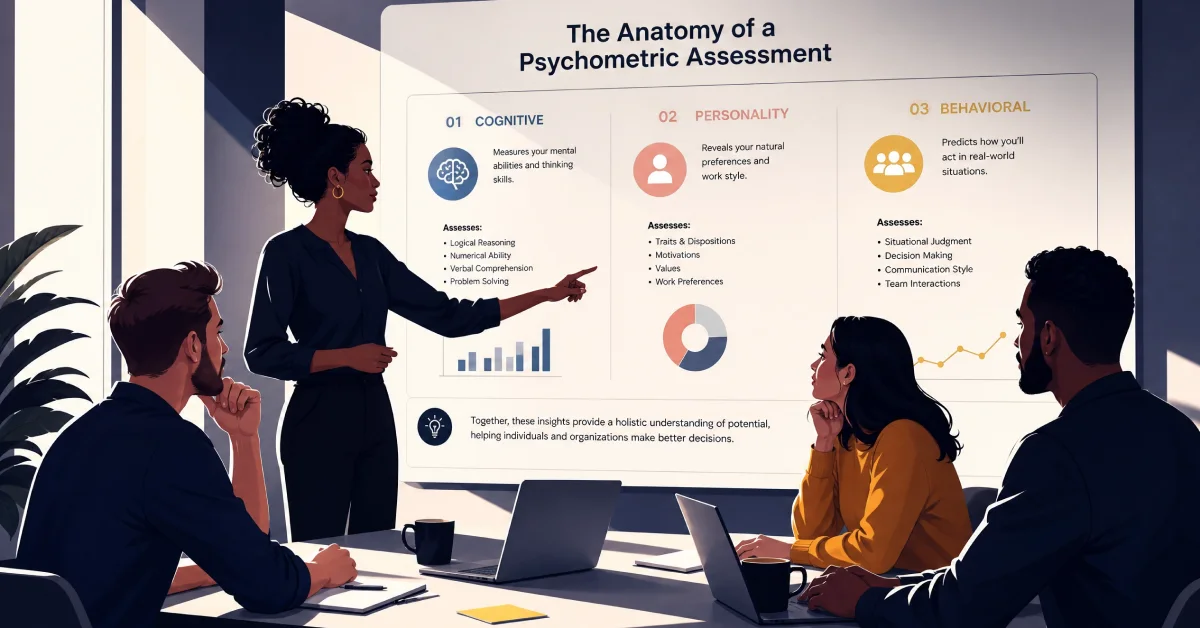
For frontline recruitment, 9 LINKS describes an approach using validated, AI-enabled psychometric assessments, including cognitive, behavioral, and integrity tests, with role-specific reports and remote proctoring. Employers considering such an approach should still define how each signal will be weighted and validated for the specific role.
Recognizing measurement error and unusual results
Every assessment contains some measurement uncertainty. A result may be unusual because of distraction, technical problems, misunderstanding, illness, or an atypical testing condition. Do not treat a marginal score as more precise than the instrument allows.
Create a documented process for reviewing credible irregularities. A retest, alternative evidence, or human review may be appropriate in limited circumstances, but retesting should not become a way to search for a preferred answer. Apply the same rules to comparable cases.
Legal and ethical considerations for employers
Employers should be able to explain why an assessment is used, what job requirement it measures, and how the result affects the decision. Legal expectations vary by jurisdiction and situation, so local professional or legal advice may be necessary. Ethical practice goes further than minimum compliance by treating candidates as people affected by the process.
Connecting assessments to business necessity
The assessment should address a genuine business need, such as learning complex procedures, interpreting information accurately, or solving recurring job problems. A general preference for “smart” candidates is not a sufficient rationale. Define the requirement in observable terms and connect each test component to it.
Review the rationale when the job changes. An assessment validated for one level, location, or work environment may not automatically be appropriate for another. This is especially relevant when hiring models expand across different workforce groups.
Applying the same process consistently
Use the same core instructions, scoring rules, and decision framework for candidates applying to the same role. Record legitimate exceptions, such as approved accommodations or technical incidents, and explain how they were handled. Consistency makes decisions easier to audit and defend.
Recruiters and managers also need training. A well-designed test can still be misused if one manager treats a score as a strict veto while another ignores it entirely. Clear governance reduces that variation.
Protecting candidate data and privacy
Assessment results can reveal sensitive information about an individual’s abilities and should be collected only for a defined purpose. Limit access, use secure transfer and storage, set retention periods, and tell candidates how their information will be handled. Do not reuse results for unrelated decisions without an appropriate basis.
Ask providers about access controls, deletion processes, subcontractors, incident response, and whether automated scoring can be reviewed. Privacy is part of a trustworthy candidate experience, not a technical footnote.
Documenting validation and selection decisions
Keep a record of the job analysis, assessment rationale, validation evidence, instructions, scoring rules, accommodation process, and monitoring results. When a candidate is rejected, the decision should be traceable to the agreed selection criteria rather than an undocumented impression.
Documentation also supports continuous improvement. If the assessment does not predict useful outcomes, produces unexplained group differences, or causes substantial drop-off, the employer has a basis for changing or stopping it.
How to improve the candidate experience
Candidates form an opinion of an employer through every assessment interaction. A process that is clear, technically reliable, and respectful can reduce unnecessary anxiety even when the assessment is challenging. Candidate experience should be measured alongside completion and selection outcomes.
Explaining why the assessment is part of hiring
Tell candidates what the assessment is intended to measure and why that capability matters for the role. Avoid inflated claims about predicting success or language that suggests the test defines overall intelligence. A short, honest explanation builds more trust than a vague promise of scientific hiring.
Also explain how the result will be used with other evidence. Candidates are more likely to engage thoughtfully when they understand that the assessment is one part of a structured process.
Designing a realistic testing environment
Give candidates enough time to check their device, browser, camera or microphone requirements if applicable, and network connection. Provide practice instructions without revealing live items. A support contact should be easy to find during the testing window.
For distributed hiring, test the process in the locations where candidates actually live and work. Small technical failures can become major barriers when applicants have limited data, shared devices, or unreliable connectivity.
Communicating timelines and next steps
State when candidates should expect the assessment, how long review will take, and what happens after completion. If the timeline changes, send an update rather than leaving people to guess. A short rejection message is still more respectful than silence.
Keep instructions consistent across email, text, and the assessment platform. Contradictory details about deadlines or preparation create confusion and can affect completion for reasons unrelated to ability.
Using feedback responsibly and respectfully
Not every hiring process can provide individual scores, but candidates should receive a clear status update. If feedback is offered, describe the assessment’s scope and limitations without attaching a fixed label to the person. Avoid sharing comparative information that could expose other candidates or create false certainty.
Employers should review feedback themes over time. Repeated confusion about instructions, timing, or technical access is evidence that the process needs improvement, not that candidates are careless.
Conclusion
A cognitive ability test for hiring works best as a focused, validated part of a broader selection process. Define the role requirements first, give candidates a fair chance to demonstrate them, interpret results with humility, and keep checking whether the method improves real hiring outcomes. That approach supports clearer decisions without reducing people to a single score.
Frequently Asked Questions
What does a cognitive ability test for hiring measure?
It typically measures reasoning, learning-related processes, problem-solving, verbal or numerical understanding, and the ability to identify patterns or apply information. The exact areas depend on the assessment and should match the role.
Are cognitive ability tests accurate predictors of job performance?
They can provide useful predictive evidence for roles that involve learning, reasoning, and handling complexity, but they are not perfect. Accuracy depends on validity, job relevance, administration, and how results are combined with other evidence.
Should every job use a cognitive ability test?
No. Use one when the job genuinely requires the capabilities being measured and when the assessment adds information beyond other selection methods. A test that has no clear relationship to the work creates unnecessary burden and risk.
How long should a hiring assessment take?
There is no universal ideal length. It should be long enough to measure the intended capabilities reliably but short enough to avoid unnecessary fatigue and drop-off. Pilot completion time and candidate feedback before scaling.
Can candidates prepare for a cognitive ability test?
Candidates can become familiar with common instructions and question formats, but preparation should not replace job relevance or validity. Employers should provide clear practice guidance so that the process does not reward avoidable familiarity with the interface.
How should employers reduce bias in cognitive testing?
Use job-related content, consistent instructions, accessible technology, reasonable accommodations, and monitoring across relevant candidate groups. Combine test results with structured interviews or work samples rather than relying on one score.
What should employers do with a borderline score?
Review the score’s uncertainty, the candidate’s other evidence, and the role’s actual requirements. A documented secondary review or additional job-relevant evidence may be appropriate, applied consistently to comparable candidates.
We Appreciate The Feedback From Our Clients.
It is always a joy to hear how our work has positively impacted them and how our assessments have helped in finding the right people.
We have used 9 LINKS psychometric tool in our Campus Placement Programme.The tool has helped us to identify right candidate as per our organisation requirements…

We have just started using it. It differentiates various personalities and helps in decision making. The clarity on its precision level will be gathered over a period of time…

Counselling test curated for NES has been very useful in identifying the skill sets and allotting appropriate job fitment to students as per their quotients. Multilingual tests developed by considering various key…

It is indeed great pleasure in my part to share complementing note to you & your team. Needless to say 9 LINKS is one of the best organisation to conduct skill gap analysis through assessment of Cognitive skills..

It is crucial that validating the quality of the candidates in recruitment. 9 LINKS is a service that we can confidently say does that. 9 LINKS online assessment precisely giving us the right candidates to pick and proceed on recruitment…

Read Our Blog For The Latest On Research & Insights.
Get Insights into latest developments in HR industry and psychometric assessments.


Take a Free Assessment


