

Key Takeaways
AI can help employers handle high-volume screening, but it should support—not replace—careful hiring decisions.
- Define the job requirements before choosing an assessment method.
- Use screening to organize evidence, not to make unreviewable decisions.
- Combine relevant assessments with structured human review.
- Check candidate experience, accessibility, privacy, and fairness during a pilot.
- Measure quality and fairness as well as speed and cost.
What AI candidate screening assessment means
AI candidate screening assessment India describes the use of automated tools to organize and evaluate information about applicants against job-related criteria. It can support a hiring process, but it is not one single test or a substitute for deciding what the job actually requires. Employers should distinguish between tools that sort or summarize applications and assessments that gather evidence about a candidate’s skills or work-related characteristics.
How screening differs from skills assessment
Screening helps narrow a large applicant pool by checking whether available information aligns with stated requirements. A skills assessment asks candidates to demonstrate or report abilities that matter for the role. Both can be useful, but the evidence they provide is different: a résumé may show experience, while a work sample can show how someone approaches a task. A practical overview of pre-employment assessment can help employers think through job relevance, vendor selection, and fair use of results.
Where AI fits in the hiring process
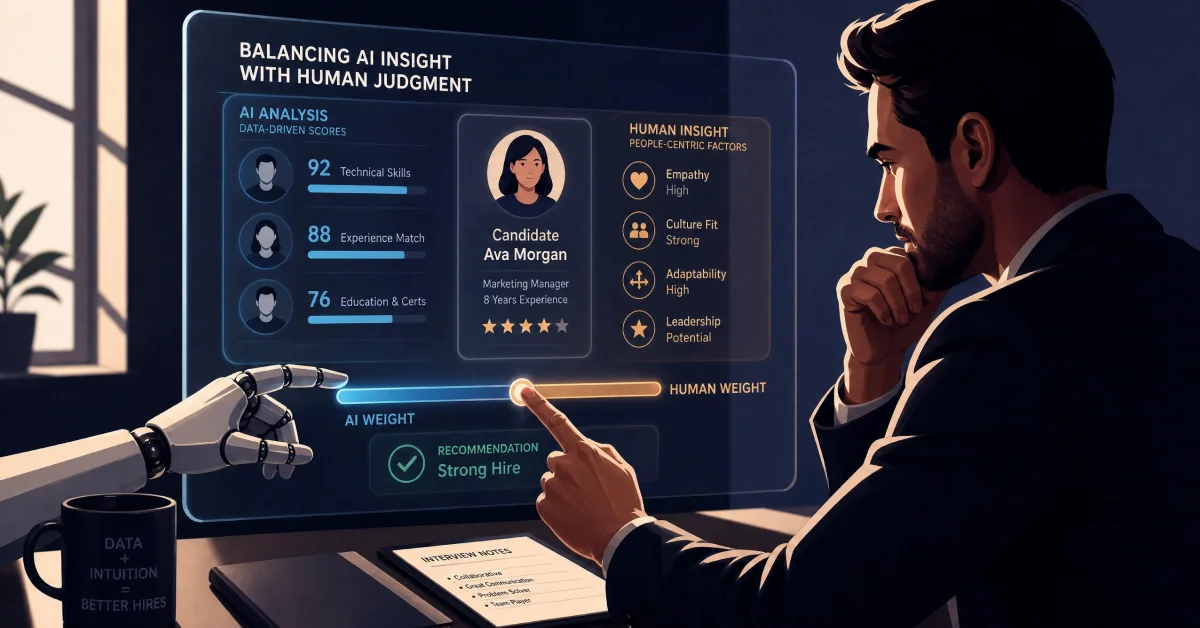
AI may help sort information, apply the same initial criteria across a large set of applications, or summarize assessment results for a recruiter. It fits best as one step in a wider process, with clear criteria set before applicants are reviewed and human decision-makers responsible for final outcomes. For a related discussion of how technology and human judgment can work together, see AI and human judgment.
Which hiring challenges it can address in India
Employers recruiting at scale may need to review many applications across locations, job levels, and varied career histories. A defined screening process can make it easier to compare relevant evidence consistently, while an assessment can add information that a résumé alone does not provide. For frontline roles, 9 LINKS describes its work as validated, AI-enabled psychometric assessments for hiring, combining behavioural, cognitive, and integrity signals to help employers evaluate role fit.
How AI screening and assessment work
An AI-supported process typically begins with information from applications and assessments, then organizes it against criteria selected by the employer. The exact inputs and outputs differ between systems, so buyers should ask what the tool actually evaluates rather than relying on broad claims about AI. The sequence below is a useful way to understand the main stages.

Resume parsing and role-based matching
Resume parsing extracts details such as education, work history, and skills from application documents, making them easier to search or compare. Matching then depends on the role criteria and on how well the tool interprets varied wording, formats, and career paths. Employers should test representative applications, including nontraditional experience, and confirm that an omitted keyword does not automatically outweigh relevant evidence.
Skills tests, simulations, and structured interviews
Tests and simulations can gather evidence that an application does not contain, such as how a candidate reasons through a job-related task. Structured interviews also help when applicants receive consistent questions and reviewers use shared criteria. A range of assessment methods can include skills, situational judgment, reasoning, and language tests; the right mix depends on the actual work and the time candidates must invest.
A useful process makes the purpose of each method explicit. For example, a role might require a practical task to assess a specific skill and a structured interview to explore how the candidate handles a common work situation. If employers use several methods, they should avoid treating repeated measures of the same trait as independent evidence.
How systems score and rank candidates
A score or ranking is an output, not an explanation of whether someone will succeed in a job. Employers should understand which criteria contribute to it, how evidence is weighted, and what a recruiter can see before acting on a result. A score needs context: it should be interpreted alongside the role requirements and other relevant evidence, not treated as a verdict.
The table below shows how to connect a type of evidence to a reasonable use and a question for human review.
| Evidence | Potential use | Review question |
|---|---|---|
| Relevant work history | Identify experience worth exploring | Is the experience comparable to this role? |
| Job-related task | Observe a specific skill in action | Does the task reflect real work? |
| Structured interview | Compare answers to shared criteria | Were the same criteria applied to everyone? |
| Assessment result | Add evidence about role-related attributes | What does the result measure, and what does it not? |
Use the table as a prompt for discussion, not a universal scoring formula. Employers can also read about AI candidate screening to compare common screening approaches and consider where each may fit.
How to choose the right assessment methods
The best method is the one that gives useful evidence about the role without creating unnecessary effort or barriers for applicants. Start with tasks and decisions that are central to the job, then select an assessment that reflects them. Keep the process proportionate: a short, relevant assessment may be more informative than a long battery of unrelated tests.
Match assessment types to role requirements
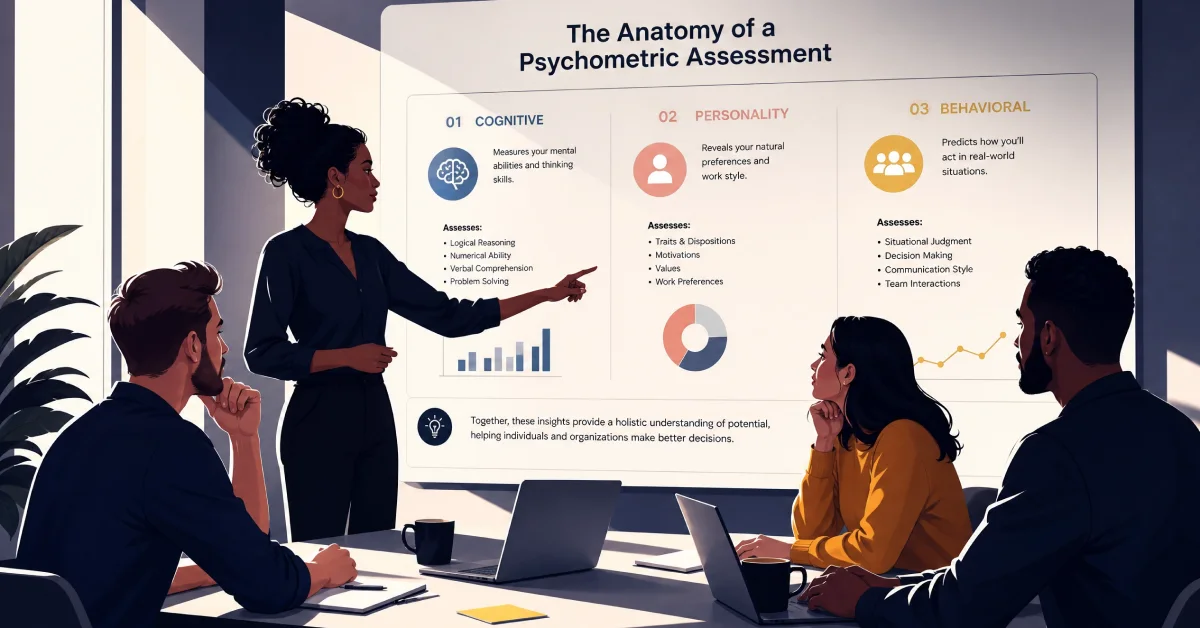
Map each important job requirement to evidence that could reasonably demonstrate it. A practical exercise may suit a task-based skill, while a structured interview can explore judgment in a familiar work situation. Psychometric or competency assessments can add another perspective, but their results need to be interpreted in relation to the role. Employers can explore psychometric testing as one approach to combining assessment evidence with interviews and references.
The following prompts help keep method selection grounded in the job rather than habit:
- Identify the tasks that matter most during the first months in the role.
- Decide what observable evidence would indicate readiness for those tasks.
- Choose the least burdensome method that can provide that evidence.
- Check that each criterion is connected to a genuine job requirement.
After selecting methods, review the candidate journey from application to decision. If an assessment takes substantial time, explain why it is needed and ensure it measures something the employer will actually use.
Balance automation with human review
Automation can help teams process information consistently, particularly when application volumes are high. Human review remains necessary to interpret context, investigate unusual cases, and consider evidence the system may not capture. AI detector guidance makes a similar distinction: an AI detector review can inform further review, but a flag should not be treated as a reason for automatic rejection.
A defined review step helps recruiters question results rather than simply accept them. Employers should document who can review a result, what additional evidence they may consider, and how a decision can be corrected if information is incomplete. This makes the process more accountable without asking recruiters to ignore useful automation.
Set consistent criteria for every candidate
Consistency begins before applications arrive. Define criteria in plain language, set the assessment steps, and prepare reviewers to apply the same standards to every candidate for a role. This does not require treating every applicant as identical; it requires giving candidates a comparable opportunity to show relevant evidence and documenting justified exceptions.
How to evaluate platforms for the Indian hiring market
A platform should work for the roles, applicants, and recruitment conditions an employer actually has—not only for an idealized process. Assess it with realistic examples and ask vendors to explain how its outputs are produced and reviewed. Procurement should consider candidate access and data handling alongside usability and price.

Check support for Indian languages and varied career paths
Hiring across India means applicants may describe similar experience in different ways and may have varied educational or career histories. Test whether the platform handles the language and formats relevant to your applicant pool, and consider whether its requirements disadvantage people whose experience is expressed differently. A good evaluation uses representative applications rather than only polished sample résumés.
Review integrations, data security, and candidate experience
Ask how the platform fits into the recruitment process, what candidate information it collects, who can access results, and how long data is retained. Candidates should be able to understand what is expected of them and get help if they encounter a technical or accessibility problem. A privacy notice such as DealFilter.ai’s policy, although from a different service, illustrates the kinds of questions a clear disclosure can address: data use, third-party providers, retention, and consent.
Recruiters should also be able to explain the assessment in straightforward terms and provide an appropriate route for questions. Public technical explainers take many forms, from property-data analysis to an AI DNS security scan; in hiring, the equivalent expectation is that a vendor can describe its inputs, outputs, and limits clearly.
Compare pricing, scalability, and vendor transparency
Ask vendors to explain how pricing changes with volume, which services are included, and what support is available during implementation. Check whether the platform can handle the expected hiring flow without making candidates repeat steps or recruiters work around missing information. Request documentation of scoring logic, validation evidence, accessibility practices, and processes for reviewing concerns.
A vendor’s confidence in a tool is not a replacement for evidence. Compare claims against a small, well-defined pilot and assess whether the product’s stated capabilities match your requirements. Avoid selecting a platform solely because it offers more features than the hiring problem calls for.
How to use AI responsibly in hiring
Responsible use starts with the employer’s choices about what to measure, which candidates to assess, and how results affect decisions. A tool may apply its rules consistently and still produce unsuitable outcomes if those rules are poorly chosen. Clear accountability, regular review, and meaningful candidate communication should be part of the process from the outset.
Identify and reduce bias in data and assessments
Review whether criteria relate to the work and whether the assessment gives candidates a fair opportunity to demonstrate them. Check outcomes across relevant groups where lawful and appropriate, and investigate patterns that may indicate an unintended barrier. Also examine sample cases manually: an apparently consistent rule can still overlook a valid route into a role.
Hiring fraud and identity concerns deserve careful handling too. Guidance on interview identity risks and screening fraud and trust can help employers think about verification without turning suspicion into a blanket assumption about candidates. Any additional checks should be relevant, proportionate, and explained.
Protect candidate privacy and explain how AI is used
Tell candidates when an automated tool is part of the process, what it is used to assess, and how a human reviewer participates. Collect only information needed for the stated hiring purpose, restrict access, and establish a retention schedule. Employers should be prepared to answer basic questions about how results are used and who can see them.
Keep decisions reviewable and accessible to candidates
A candidate should not be left with an unexplained outcome that no one can revisit. Provide a route to raise a concern, request an accommodation, or correct an error in application information. Recruiters need access to enough context to review a result, and managers should record the job-related reasons behind a final decision.
How to implement and measure a screening program
A measured rollout gives an employer a chance to identify practical problems before a process becomes routine. Begin with a defined role or team, set expectations with stakeholders, and decide what evidence will determine whether the process should continue. Keep the first version simple enough to evaluate rather than adding every available assessment at once.
Pilot the process with a defined role or team
Select a role with clear requirements and a manageable hiring flow. Before the pilot, record the current process and agree on measures such as time between stages, completion rates, recruiter workload, candidate feedback, and the quality of evidence available for decisions. Review both successful and unsuccessful candidate journeys to see where the process may be confusing or inconsistent.
A short pilot can also expose operational details that are easy to miss in a vendor demonstration: whether instructions are clear, whether assessment access works on candidates’ devices, and whether recruiters can interpret reports. Adjust the process based on observed problems, and do not treat a faster workflow as a success if it reduces useful review.
Train recruiters and hiring managers
Training should cover what each assessment measures, what it cannot establish, and how its results fit alongside interviews and other evidence. Recruiters should practise explaining the process to candidates and handling questions about a score or automated step. Employers can use the 9links blog to explore related ideas about assessment, recruitment, and workplace psychology.
Track quality, fairness, speed, and candidate feedback
Use a balanced set of measures rather than relying on a single efficiency figure. Review how candidates progress through each stage, whether assessment completion differs across groups, how much time recruiters spend, and whether hiring managers find the evidence useful. Pair numerical indicators with candidate and recruiter feedback so that a change in the process is not mistaken for an improvement in hiring quality.
Once the pilot produces evidence, decide what to retain, revise, or stop. Employers considering a role-focused assessment can explore assessment options and assess how they fit their own requirements. For frontline hiring, 9 LINKS offers validated, AI-enabled psychometric assessments that combine behavioural, cognitive, and integrity signals to help employers evaluate role fit.
Employers who want to build a more evidence-led process can explore 9 LINKS’ assessments for frontline hiring and consider whether a role-specific approach fits their workforce needs.
Conclusion
AI can help organize information in high-volume hiring, but responsible screening still depends on clear job criteria, relevant assessments, transparent data practices, and human review. Employers in India can make better decisions by piloting a focused process and measuring its effects on quality, fairness, speed, and candidate experience together.
Frequently Asked Questions
AI screening can be useful when it addresses a defined hiring need, but the outcome depends on the criteria, evidence, and oversight built into the process.
What is AI candidate screening?
It is the use of automated tools to organize or evaluate applicant information against criteria set for a role. The precise function varies by tool, so employers should confirm what information it uses and how its output informs decisions.
Is AI screening the same as an online assessment?
No. Screening may sort or summarize application information, while an assessment gathers evidence about skills or other job-related attributes. A hiring process may use either or both.
Can AI make hiring decisions on its own?
Employers should define meaningful human review and remain accountable for decisions. Automated results need context, and candidates should have a way to raise concerns or correct inaccurate information.
How can employers choose a suitable assessment?
Start with the work requirements and identify what evidence would demonstrate them. Choose a method that measures that evidence, is proportionate for candidates, and can be interpreted consistently.
How should employers check for bias?
Review whether criteria are job-related, examine outcomes for patterns that may signal barriers, and test the process using varied candidate examples. Investigate concerns rather than assuming consistent automation is automatically fair.
What should candidates be told about AI in hiring?
Candidates should receive a clear explanation of where automation is used, what it evaluates, how results are reviewed, and where to ask questions or request an accommodation.
What should an employer measure during a pilot?
Track candidate completion and feedback, recruiter workload, time through the process, decision quality, and fairness indicators. Considering these together gives a fuller picture than measuring speed alone.
We Appreciate The Feedback From Our Clients.
It is always a joy to hear how our work has positively impacted them and how our assessments have helped in finding the right people.
We have used 9 LINKS psychometric tool in our Campus Placement Programme.The tool has helped us to identify right candidate as per our organisation requirements…

We have just started using it. It differentiates various personalities and helps in decision making. The clarity on its precision level will be gathered over a period of time…

Counselling test curated for NES has been very useful in identifying the skill sets and allotting appropriate job fitment to students as per their quotients. Multilingual tests developed by considering various key…

It is indeed great pleasure in my part to share complementing note to you & your team. Needless to say 9 LINKS is one of the best organisation to conduct skill gap analysis through assessment of Cognitive skills..

It is crucial that validating the quality of the candidates in recruitment. 9 LINKS is a service that we can confidently say does that. 9 LINKS online assessment precisely giving us the right candidates to pick and proceed on recruitment…

Read Our Blog For The Latest On Research & Insights.
Get Insights into latest developments in HR industry and psychometric assessments.
Take a Free Assessment


