

Key Takeaways
A behavioral assessment can add useful evidence to hiring and employee development when it is tied to the work people actually do. It should inform decisions, not make them on its own.
- Define the role requirements before selecting a test.
- Choose an assessment with evidence that supports its intended use.
- Combine results with interviews, work samples, and other relevant evidence.
- Make instructions, access, privacy, and accommodations part of the process.
- Review outcomes over time and update the approach as roles change.
What a behavioral assessment test measures
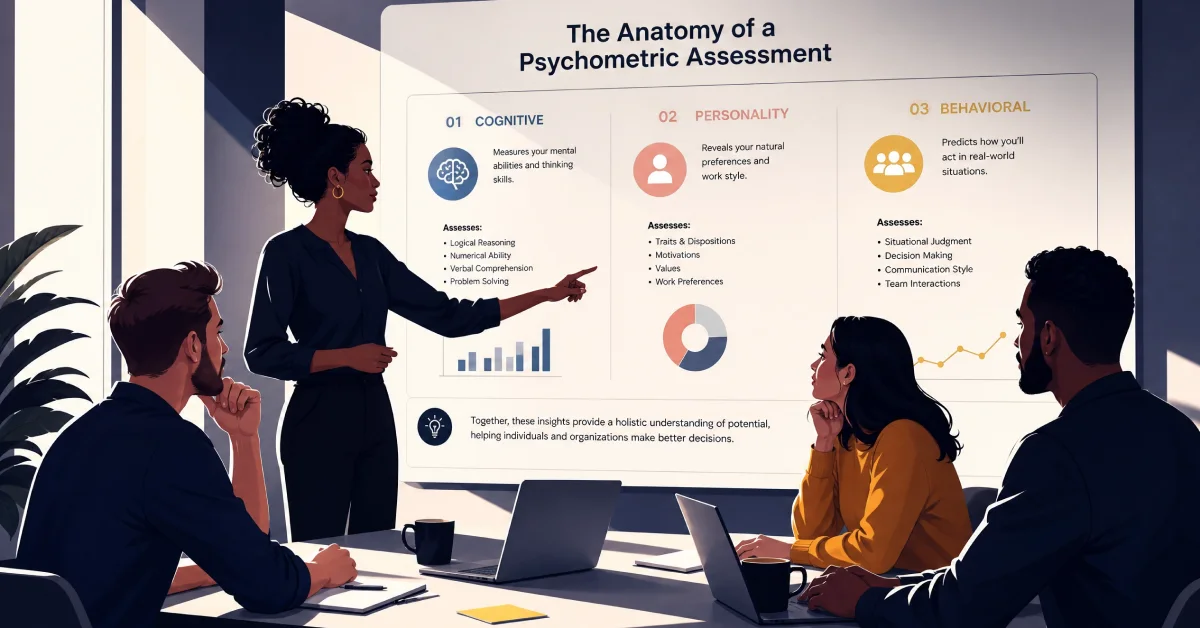
A behavioral assessment test for employees India employers consider is most useful when it helps clarify how a person tends to approach work, communication, and decisions. It does not replace qualifications, skills checks, or a thoughtful interview. The value lies in adding structured evidence to a process that might otherwise rely heavily on impressions.
Personality traits, work preferences, and observable behaviors
Some assessments describe relatively consistent preferences, such as a preference for structure, collaboration, or a faster pace. Others focus on how a person responds in particular workplace situations. Either way, results are best read as tendencies that may show up in a work context, not as a complete account of someone’s character.
A carefully chosen assessment can help a hiring team ask better follow-up questions: What kind of support does the person need to do their best work? Which behaviors matter in this role, and in which situations? Keeping those questions specific helps prevent broad labels from standing in for evidence.
How behavioral assessments differ from aptitude and skills tests
Behavioral assessments examine patterns of work preferences or responses, while aptitude tests examine abilities such as reasoning and skills tests evaluate proficiency in a task. These tools answer different questions, even when an employer uses them together. A candidate might, for example, demonstrate strong technical knowledge while preferring a work environment that differs from the role’s day-to-day demands.
The distinction matters because employers should not treat a score from one type of test as evidence about a different quality. A behavioral profile does not establish job knowledge, and a cognitive score does not reveal every relevant work behavior. For a broader comparison of assessment formats in India, see this guide to employment assessments.
What assessment results can—and cannot—predict
Assessment results can help generate hypotheses about how a candidate may approach job-related situations. They cannot guarantee performance, establish a person’s future behavior in every circumstance, or determine whether someone will succeed without considering training, management, and workplace conditions. Context shapes interpretation: the same preference can be useful in one role and less relevant in another.
It helps to separate a test’s stated purpose from the conclusions a hiring team hopes to draw. Before acting on results, ask whether the tool has evidence for the intended role and decision, and whether the interpretation stays within that evidence. A practical overview of behavioral assessments in hiring offers further guidance on using scores alongside interviews and work samples.
When to use assessments during the employee lifecycle
Assessments may support selection, onboarding conversations, development planning, or team discussions, but the purpose should be clear at each stage. A hiring tool should be chosen and evaluated for hiring use; it should not automatically become a performance-management instrument. Employees also need to understand when information is being collected and how it will inform a decision.
Using assessments at more than one stage can be helpful when each use is considered on its own merits. A development conversation, for instance, should invite reflection rather than turn a profile into a permanent label. In every case, managers should connect results to observable work and practical next steps.
Common types of behavioral assessments
The term behavioral assessment covers several methods, and they do not all measure the same thing. Some ask candidates to describe their usual preferences; others ask them to respond to a realistic workplace scenario. The right format depends on what the employer needs to understand and how the results will be used.

Personality inventories and trait-based assessments
Personality inventories typically use a set of questions to estimate patterns in a person’s preferences or tendencies. Their value depends on clear interpretation and a match between the traits measured and the requirements of the role. They should not be treated as a clinical diagnosis or a shortcut to deciding whether a person is a “fit.”
A profile may be more useful as a prompt for structured discussion than as a verdict. For example, an interviewer can ask candidates how they handle competing priorities, then assess their answers against the same job-related criteria. Learn more about types of behavioral assessments and what they are intended to measure.
Situational judgment tests for workplace decisions
Situational judgment tests present work-related scenarios and ask candidates how they would respond. They can help employers explore decision-making in contexts such as customer service, teamwork, or escalation of a concern. The scenarios should reflect real demands of the role, not assumptions about a single “correct” personality.
Clear scoring criteria are essential. Hiring teams should decide in advance which response features matter and why, then apply those criteria consistently. A scenario that is unfamiliar because of language, local context, or access needs may measure something other than the intended judgment, so test design and administration deserve careful review.
Structured behavioral interviews and work simulations
Structured behavioral interviews ask candidates comparable questions about past experiences and evaluate the answers against predefined criteria. Work simulations ask them to complete or respond to a task resembling the job. Both approaches can provide concrete evidence, especially when the task and scoring rubric are closely connected to actual duties.
A behavioral assessment can complement these methods, rather than replace them. As a general measurement principle, specificity matters in many settings: Grinding Dynamics coordinates concrete-floor planning, basketball court friction focuses on traction testing, and engineered wood and solid oak require attention to material differences. In an assessment, too, the method should match the question being asked.
Role-specific assessments for managers and customer-facing teams
Roles differ in the behaviors that matter. A manager may need to set expectations, support employees, and handle conflict; a customer-facing role may involve listening, explaining options, and responding calmly to difficult interactions. Those distinctions should guide both the assessment content and the way results are interpreted.
The scenario’s setting also matters: Evel Knievel is associated with an exhibit exploring simulated danger and sensation seeking, while backseat driving guidance addresses behavior in the specific setting of a car. These are not hiring measures, but they illustrate why behavior should be understood in context rather than assumed to transfer unchanged across situations. Employers can also review behavioral test formats when comparing what different assessment approaches reveal.
How employers in India can choose the right test
Choosing an assessment begins with the job, not with a vendor’s feature list. Employers hiring across locations, languages, and workforce levels should consider whether the tool reflects the actual tasks and conditions candidates will encounter. A sound process also asks what evidence supports the test and whether candidates can complete it fairly.
Start with job analysis and role requirements
Identify the core tasks, decisions, and interactions in the role before deciding which behaviors to assess. Speak with people who understand the work, review the job’s real demands, and distinguish essential requirements from preferences that merely describe the current team. This is particularly useful in high-volume recruitment, where generic criteria can be repeated across roles that are not truly alike.
A short role map can help focus the selection process:
- List the tasks that occur regularly and those that carry higher risk.
- Identify the behaviors that support those tasks, using observable language.
- Separate trainable skills from requirements needed on entry.
- Confirm the criteria with managers and people doing the work.
The resulting criteria should describe work, not a favored personality type. They also give recruiters a shared basis for deciding whether an assessment is relevant and which results deserve follow-up.
Check validation evidence for the intended use
Ask what the assessment measures, how its scores are interpreted, and what evidence supports its use for the decision at hand. Validation is not a general stamp that makes every application appropriate; the evidence should fit the construct, population, and purpose. Employers should also ask how the vendor handles updates to the assessment or its scoring.
A useful review separates several questions that are often bundled together. Does the test measure what it claims to measure? Is that quality relevant to this role? Does the available evidence support using the score in this stage of hiring? Answering each question helps avoid treating a polished report as proof of job relevance.
Assess language, accessibility, and cultural fit
Candidates should be able to understand the instructions and access the assessment without unnecessary barriers. Review the language used, the device and connectivity assumptions, the time demands, and any accommodations that may be needed. Employers should also consider whether scenarios make sense across the locations and communities from which they recruit.
Cultural fit should not become a proxy for similarity to current employees or for comfort with a particular communication style. Focus instead on behaviors required by the job and test whether the assessment provides a fair opportunity for candidates to demonstrate them. Accessibility and fairness are part of the quality of the measure, not administrative details to address later.
Compare scoring methods, reporting, and vendor support
Compare how scores are produced, what reports explain, and whether users receive enough guidance to interpret results responsibly. Ask what information is retained, who can access it, and what support is available when recruiters or candidates have questions. For Indian frontline hiring, 9 LINKS provides validated, AI-enabled psychometric assessments for hiring, with role-specific insights into behavioral fit, cognitive ability, and integrity.
The vendor should be able to explain the limits of its results as clearly as its intended use. Employers can compare tools using a small set of practical questions:
| Area to compare | Questions to ask |
|---|---|
| Role relevance | Does the assessment reflect the tasks and demands of this role? |
| Evidence | What supports the intended use and interpretation of scores? |
| Candidate access | Are language, devices, and accommodations considered? |
| Reporting | Can recruiters understand what scores do and do not mean? |
A report is only useful when the people making decisions can interpret it accurately. Choose a process that makes the evidence understandable and gives candidates a clear way to ask for help.
How to use assessments fairly in hiring
Fair use depends on the whole hiring process, not simply on choosing a reputable test. Employers should establish how assessment evidence fits with interviews, work samples, and qualifications before reviewing individual results. Consistent administration and a clear opportunity to ask questions help candidates understand what is expected.

Combine test results with interviews and job-relevant evidence
Use assessment results as one source of evidence among several. Compare them with structured interview responses, relevant work samples, and documented qualifications, while checking that each source relates to the role. A score that conflicts with other evidence is a reason to investigate further, not to assume that one source must be right.
A fair process gives candidates more than one meaningful way to demonstrate their capabilities. Employers can use structured interviews and work samples to test job-relevant questions directly, then consider whether assessment results add useful context. This approach reduces the risk of allowing one measure to dominate a decision.
Set consistent criteria before reviewing candidate scores
Define the criteria and decision process before looking at individual results. This helps reduce the chance that a score will be interpreted differently depending on a candidate’s background, interview style, or the hiring manager’s first impression. Recruiters should record how each criterion connects to the role and apply the same standard across candidates.
Consistency does not mean ignoring relevant differences in candidates’ circumstances. It means using the same job-related framework while allowing appropriate accommodations and considering evidence fairly. Employers can use this guide to behavioral assessments in recruitment to think through job relevance, accessibility, and consistent decisions.
Offer reasonable accommodations and clear instructions
Candidates need to know what the assessment involves, how long it is expected to take, what materials or devices they need, and whom to contact if they encounter a barrier. Instructions should be clear and accessible, and employers should have a practical way to discuss reasonable accommodations. The goal is to assess the intended qualities, not a candidate’s ability to navigate avoidable obstacles.
Where appropriate, explain whether the assessment is timed, how results will be considered, and whether there is an opportunity to request support. A calm, predictable candidate experience also makes it easier to interpret results as evidence about the assessment’s intended subject rather than about confusion or technical difficulty.
Avoid using a single score as an automatic rejection rule
A single threshold can conceal uncertainty about what a score means, especially when the assessment is one part of a broader selection process. Before using any cutoff, employers should have a defensible reason tied to the role and a consistent process for reviewing exceptions or conflicting evidence. When a score appears surprising, a trained reviewer should consider the full record.
Human review does not mean disregarding scores whenever they are inconvenient. It means understanding the limits of the measure and making decisions with documented, job-related reasoning. That distinction helps preserve both consistency and sound judgment.
Legal, privacy, and cultural considerations in India
Employers using assessments in India should plan for privacy, access, and fairness from the beginning of the process. Requirements may depend on the context, the information collected, and the way a decision is made, so organizations should seek current legal advice for their circumstances. Clear communication and careful data handling also help build trust with candidates and employees.
Explain the purpose of testing and how results will be used
Tell candidates why the assessment is being used, what it is intended to measure, and how the results may inform hiring. Explain who will review the information and whether the assessment is one part of a larger decision. Plain language is preferable to broad promises that the test is simply “objective” or “scientific.”
A clear explanation gives candidates a chance to ask questions and helps prevent misunderstandings about the purpose of the assessment. It also encourages hiring teams to make explicit whether results are used for selection, development, or another defined purpose.
Limit access to assessment data and define retention periods
Assessment results should be available only to people who need them for a defined work purpose. Set access controls, establish retention periods, and document what happens to data when it is no longer needed. Reports should be handled with the same care as other sensitive candidate or employee information.
Avoid circulating raw scores or profiles broadly when a focused summary is enough for the decision. A clear retention plan should explain who is responsible for deletion or archiving and how exceptions are handled. These practices can reduce unnecessary exposure and make the process easier to explain.
Review consent, privacy, and applicable employment requirements
Before launching a program, review what information the assessment collects, how it is processed, and which parties may handle it. Confirm that candidate notices and any consent process are suitable for the specific use, and ask legal or privacy specialists to assess applicable requirements. This is especially important when a vendor processes data on an employer’s behalf or when recruiting spans multiple locations.
Documentation should match what actually happens. If the assessment’s use changes, revisit the notice, access arrangements, and retention plan rather than assuming that an earlier review covers every new purpose.
Check for cultural bias and adverse impact across candidate groups
Review whether assessment content, language, administration, or scoring may disadvantage groups of candidates. Look for differences in completion, performance, or selection outcomes and investigate patterns rather than assuming that every difference has the same cause. If concerns emerge, examine the assessment and its role in the wider process before continuing unchanged.
The review should include local context and candidate experience, not just a numerical comparison. Ask whether the task is genuinely job-related, whether instructions are understood, and whether the assessment measures the intended quality across the groups being recruited. Ongoing monitoring can reveal issues that were not visible during initial selection.
How to implement an employee assessment program
A careful implementation makes assessment use predictable for candidates and practical for hiring teams. Start with a defined purpose, a limited pilot, and people who can review how the process works in real conditions. Implementation should include not only the test itself but also communication, training, recordkeeping, and a plan to revisit the approach.
Pilot the assessment with a small, representative group
A pilot can reveal whether instructions are clear, whether candidates can complete the process with available devices, and whether the results are useful to reviewers. Include a range of roles, locations, and candidate experiences that reflect the intended population. Use the pilot to test the process, not to make broad claims from a small sample.
Record completion issues, questions raised, and points where recruiters need clarification. If the assessment is intended for a role with distinct job levels, check whether the same tool and interpretation make sense across those levels. A pilot is valuable precisely because it can uncover assumptions before they become routine.
Train recruiters and managers to interpret reports
People who review reports should understand what the assessment measures, what it does not measure, and how results relate to established job criteria. Training should include examples of appropriate interpretation and common errors, such as treating a preference as a fixed limitation. It should also explain how to handle a result that does not align with interview or work-sample evidence.
For frontline hiring, 9 LINKS combines behavioral, cognitive, and integrity signals to help employers evaluate role fit and make clearer hiring decisions. Recruiters and managers still need to understand the scope of each signal and use it within a consistent process rather than treating any one result as conclusive.
Give employees useful feedback without labeling them
When assessments are used for development, discuss results as possible patterns and preferences, not as permanent definitions of a person. Invite employees to reflect on what fits their experience and where the profile does not. Translate the conversation into practical actions, such as a communication adjustment, coaching goal, or opportunity to practice a skill.
Feedback is more useful when it is specific, respectful, and connected to the employee’s own work. Avoid sharing interpretations as labels that might follow someone across roles without their input or a clear reason. A development discussion should support agency, not narrow future opportunities.
Document decisions and review the process regularly
Keep a record of the assessment’s purpose, the criteria used, who reviewed the results, and how the information contributed to decisions. Periodically examine how candidates experience the process and whether the tool remains relevant to the role. If managers use the assessment inconsistently, improve training and process guidance before relying on additional scores.
Documentation makes it easier to identify where a decision was based on relevant evidence and where assumptions may have crept in. It also supports responsible review when roles, recruitment volumes, or assessment methods change.
How to interpret results and measure effectiveness
A useful assessment program should be reviewed against its purpose, not judged by how detailed its reports look. Employers can assess whether results add information to selection or development, whether the process is fair and usable, and whether the information is handled responsibly. Measures should be chosen before rollout so that teams know what success would mean.
Read profiles in the context of role-specific competencies
Start with the requirements of the role and ask what a result may suggest about a candidate’s approach to those requirements. Avoid turning a profile into a general ranking of people. If a measured preference is not connected to a task or competency, it may not belong in the decision.
When translating results into hiring insights, 9 LINKS describes its reports as turning behavioral, cognitive, and integrity data into clear, actionable hiring insights. Employers should still interpret any report against role-specific criteria and the evidence gathered through the rest of the process.
Look for patterns rather than treating traits as fixed outcomes
A single response or score should not be treated as proof of how a person will behave in every situation. Look for patterns across relevant evidence and ask what circumstances might influence them, including experience, training, team expectations, and access to support. The aim is a reasoned view of potential work behavior, not a fixed label.
Patterns should also be revisited as people gain experience. A candidate’s early profile is not a forecast of every future contribution, and an employee’s development should not be constrained by assumptions drawn from an assessment completed at one point in time.
Track hiring quality, retention, and employee development
Choose measures that relate directly to why the organization introduced the assessment. Depending on that purpose, employers might review completion rates, candidate feedback, consistency of decisions, later job performance, retention, or participation in development. Interpret outcomes cautiously: many factors beyond an assessment affect hiring and employee results.
Compare trends over time and, where appropriate, across comparable roles or hiring groups. The analysis should help answer whether the tool adds value and whether any group experiences avoidable barriers. A change in one metric alone is rarely enough to show that an assessment caused an outcome.
Revalidate the approach when roles or business needs change
Job requirements can shift as workflows, technology, customer expectations, or staffing models change. Revisit the assessment when the role changes materially, when monitoring raises concerns, or when the vendor updates the instrument or scoring. A tool that once matched a job may no longer be suitable for the new demands.
Treat review as part of the program rather than a one-time sign-off. An assessment remains useful only when its purpose, evidence, administration, and interpretation continue to fit the people and roles involved.
Conclusion
A behavioral assessment can strengthen hiring and development when it measures something relevant to the job and is interpreted alongside other evidence. For employers in India, fair practice means choosing carefully, explaining the process, protecting candidate information, and reviewing results over time. The goal is not to turn people into scores, but to make decisions more consistent, transparent, and connected to the work.
Frequently Asked Questions
What is a behavioral assessment test for employees?
It is a structured method for gathering information about work-related preferences, tendencies, or responses to workplace situations. Its purpose and interpretation depend on the assessment used.
What does a behavioral assessment measure?
Depending on its design, it may measure patterns in work preferences or responses to job-related scenarios. Employers should check the tool’s stated construct rather than assume all behavioral assessments measure the same things.
Are behavioral assessments suitable for hiring in India?
They may be useful when selected for a defined role and used fairly alongside interviews, work samples, and relevant qualifications. Employers should consider language, accessibility, privacy, and the context of the candidate population.
Can a behavioral assessment predict job performance?
Assessment results may contribute evidence about job-related tendencies, but they cannot guarantee future performance. Job demands, training, management, and workplace conditions also influence outcomes.
Should an assessment score determine whether someone is hired?
A single score should not usually decide the outcome by itself. Employers should use established criteria and consider relevant evidence from the full selection process.
How can employers make behavioral assessments fairer?
They can define job-related criteria in advance, give clear instructions, offer appropriate accommodations, monitor outcomes, and combine results with other relevant evidence. Consistent human review is also important.
Can assessments be used for employee development?
They can support development conversations when the purpose is clear and results are discussed as tendencies rather than fixed labels. Employees should be invited to reflect on the results and identify practical goals.
We Appreciate The Feedback From Our Clients.
It is always a joy to hear how our work has positively impacted them and how our assessments have helped in finding the right people.
We have used 9 LINKS psychometric tool in our Campus Placement Programme.The tool has helped us to identify right candidate as per our organisation requirements…

We have just started using it. It differentiates various personalities and helps in decision making. The clarity on its precision level will be gathered over a period of time…

Counselling test curated for NES has been very useful in identifying the skill sets and allotting appropriate job fitment to students as per their quotients. Multilingual tests developed by considering various key…

It is indeed great pleasure in my part to share complementing note to you & your team. Needless to say 9 LINKS is one of the best organisation to conduct skill gap analysis through assessment of Cognitive skills..

It is crucial that validating the quality of the candidates in recruitment. 9 LINKS is a service that we can confidently say does that. 9 LINKS online assessment precisely giving us the right candidates to pick and proceed on recruitment…

Read Our Blog For The Latest On Research & Insights.
Get Insights into latest developments in HR industry and psychometric assessments.


Take a Free Assessment


