

Key Takeaways
An AI hiring assessment can add useful evidence to recruitment, but only when it measures capabilities that matter for the role. Choose and use one with clear safeguards, human review, and a plan to check results over time.
- Start with real job requirements, then select assessments that measure relevant skills or behaviors.
- Evaluate validity, accessibility, candidate experience, reporting, and fit with your existing hiring process.
- Test for disparities across candidate groups and keep people involved in consequential decisions.
- Clarify what data is collected, how it is handled, and which responsibilities sit with the vendor.
- Pilot the assessment and monitor whether it helps predict job performance and supports fairer decisions.
How AI hiring assessments work
An AI hiring assessment combines structured evidence about a candidate with software-supported analysis. It can help employers handle large applicant pools, but the value depends on whether the assessment measures something relevant to the work. In India’s varied hiring environments, a process suited to one role or location may not transfer neatly to another.
From job requirements to assessment criteria
Start by describing the work, not by selecting a test. Identify the tasks, decisions, and interactions that make someone effective in the role, then translate those demands into measurable criteria. For example, a customer-facing position may require careful listening and dependable judgment, while a technical role may call for specific problem-solving skills.
Those criteria should be documented before reviewing candidates. It gives recruiters a consistent basis for deciding what evidence matters and helps prevent an assessment from rewarding qualities that are easy to measure but unrelated to performance. This is the foundation of job-relevant evidence: the measure should connect to a real requirement, not merely produce a score.
Common formats, from coding tests to simulations
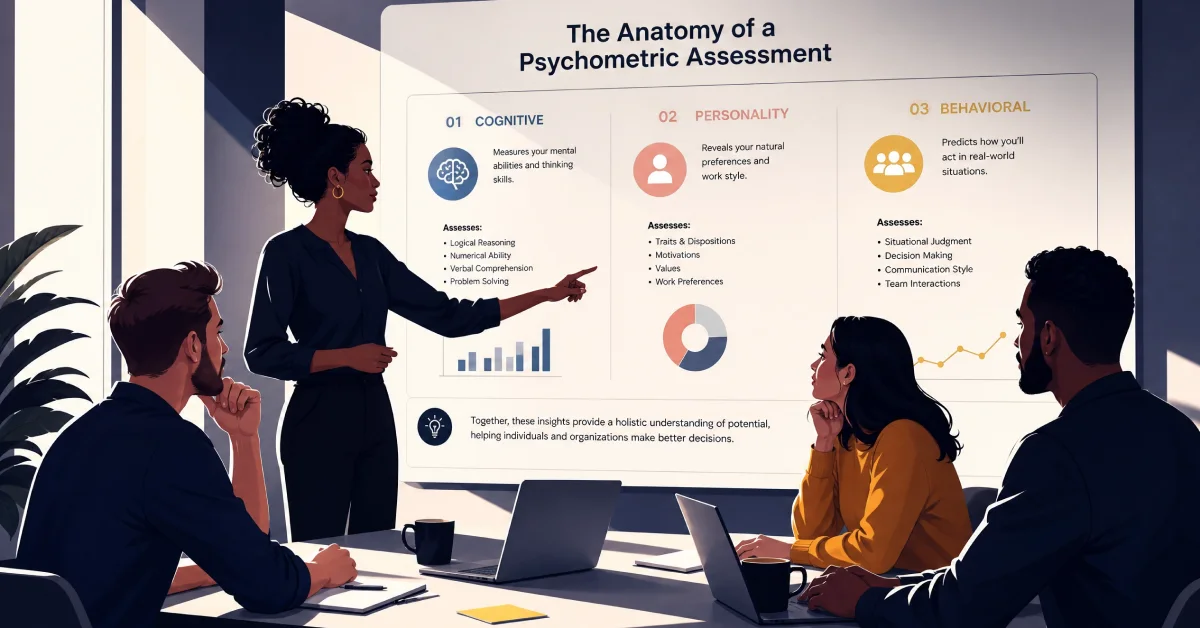
Assessment formats vary with the role. Employers may use knowledge or cognitive tests, structured questionnaires, coding exercises, work samples, situational judgment questions, or simulations. Each format reveals a different kind of evidence; a short task can show how someone approaches a work problem, while a structured assessment may measure a defined set of behavioral or cognitive characteristics.
It also helps to distinguish assessments from adjacent checks. A background screen, for instance, serves a different purpose than a skills or psychometric assessment; employers hiring logistics workers can review logistics background screening as a separate part of their process. Keep each method tied to a specific question, and do not treat one format as a complete picture of a candidate.
Where AI contributes to scoring and recommendations
Depending on the system, AI may support scoring, identify patterns in responses, or help organize results for review. Employers should ask what inputs are used, how scores are produced, and what a recommendation means in practice. A score is not self-explanatory, and its apparent precision does not establish that it predicts success.
For a practical overview of candidate screening assessments in India, see this guide to AI candidate screening. Treat any automated recommendation as evidence to examine alongside other information, not as a decision in itself. A short explainer can help hiring teams discuss the distinction before adopting a tool.
How assessment results fit into the hiring process
Assessment results are most useful when they add a consistent source of evidence to a broader process. Recruiters can combine them with structured interviews, work samples, and verified role requirements, then document how each piece informed the decision. This is especially helpful in high-volume recruitment, where consistency can otherwise vary between interviewers and locations.
Assessment scores should not silently become a pass-or-fail rule. Establish who reviews results, what other evidence is considered, and how a candidate can raise a concern or request an accommodation. That process helps keep the result in proportion to its purpose.
What to evaluate when choosing a platform
A platform should fit the work and the hiring process, rather than the other way around. A polished interface or broad feature list cannot compensate for assessments that do not measure the needs of the role. Compare vendors by asking for evidence, a clear account of how results are used, and the practical support needed to operate the tool responsibly.

Role coverage and assessment validity
Check whether the available assessments map to the roles and hiring levels you actually recruit for. Ask what each assessment measures, what evidence supports its use, and whether the vendor can explain how it relates to relevant job requirements. Avoid assuming that a test designed for one position will be suitable for a different one simply because both roles share a broad job title.
A compact comparison can make vendor conversations more concrete. Record what each tool measures and what evidence you still need before deciding whether it belongs in the process.
| Evaluation question | What to look for | Follow-up to ask |
|---|---|---|
| Role fit | Measures linked to actual job requirements | How was the link established? |
| Evidence | Clear information about validation and scoring | What evidence supports this use? |
| Reporting | Results that hiring teams can interpret | What does each score mean? |
| Adaptability | Suitability for your roles and hiring context | What changes require reassessment? |
Use the answers to separate meaningful evidence from general claims. A guide to role-fit assessment tools can also help frame questions about job relevance, reporting, and workflow fit.
Candidate experience and accessibility
Consider the experience from the candidate’s point of view: the instructions, device requirements, time commitment, language, and support available if something goes wrong. A process that is confusing or inaccessible may prevent capable candidates from completing it, making completion patterns part of assessment quality rather than a minor operational detail.
Ask how candidates can request accommodations and whether there is an appropriate alternative format when needed. Test the process on the devices and connections candidates are likely to use, and make instructions clear before the assessment begins. Candidate feedback can reveal friction that a vendor demonstration will not.
Integration with your applicant tracking system
Confirm how assessment invitations, completion status, and results will move through your existing applicant tracking system and related workflows. Ask the vendor to describe what can be transferred, what requires manual handling, and who can view candidate information. Do not assume that a platform integrates with a particular system unless the vendor confirms it for your setup.
Map the process from application to review before signing. If recruiters need to switch tools repeatedly or copy scores by hand, the added work can create delays and introduce avoidable errors. A small workflow test can surface these issues early.
Reporting, support, and total cost of ownership
Review a sample report with the people who will use it. A useful report should make the assessment’s scope and results understandable without suggesting that a score is a complete judgment of a person. Ask what training and support are available, how issues are handled, and what costs apply beyond the initial purchase.
Compare the full effort of using the tool, including setup, recruiter time, candidate support, and ongoing review. Due diligence is context-specific: evaluating an assessment platform is not the same as comparing international moving services, where service scope, document handling, and costs raise different questions. The useful common habit is to verify what is included before committing.
How to assess fairness and reduce bias
Fairness requires more than a general promise from a vendor. Employers need to understand how the assessment is built and used, then examine whether its outcomes create unexplained differences between candidate groups. This work should continue after launch, because changes in roles, applicant pools, or decision practices can affect results.
Check training data and evaluation methods
Ask what data informs the assessment, how the scoring method was evaluated, and what limitations are known. If an AI system uses historical decisions or other patterns that reflect past practice, those patterns may reproduce unfairness rather than measure job-related capability. Request explanations in language your hiring team can understand, not just a technical summary.
The same questions arise in other high-stakes automated decisions. An overview of AI bias in fintech discusses how historical data and proxy variables can shape outcomes; the domain differs, but the need to question data and test assumptions carries across. For a general perspective on responsible AI in hiring, consider how governance and human judgment fit into the process.
Test outcomes across candidate groups
Before relying on results, review how candidates from relevant groups perform at each stage. Compare completion, score distributions, advancement, and hiring outcomes where lawful and appropriate, and investigate meaningful differences rather than explaining them away. A disparity does not automatically prove that an assessment caused harm, but it is a reason to examine the tool and the surrounding process.
Keep records of the analysis, the questions raised, and any changes made. In other fields, even a tree care service depends on its own context and professional criteria; evidence from one setting cannot validate a hiring measure. Assessments likewise need evaluation against the roles and candidates for which they are being used.
Provide accommodations and alternative assessment options
Make it possible for candidates to request reasonable accommodations without being disadvantaged for doing so. This can mean adjusting timing, offering accessible instructions, or providing an alternative assessment format when the standard method is not suitable. The appropriate option depends on the measure and the individual’s needs.
Tell candidates how to ask for support and make sure recruiters know where to direct requests. Review whether any change preserves the intended assessment purpose, and document the approach consistently. Accessibility should be considered before launch, not improvised after a candidate encounters a barrier.
Keep human review in consequential decisions
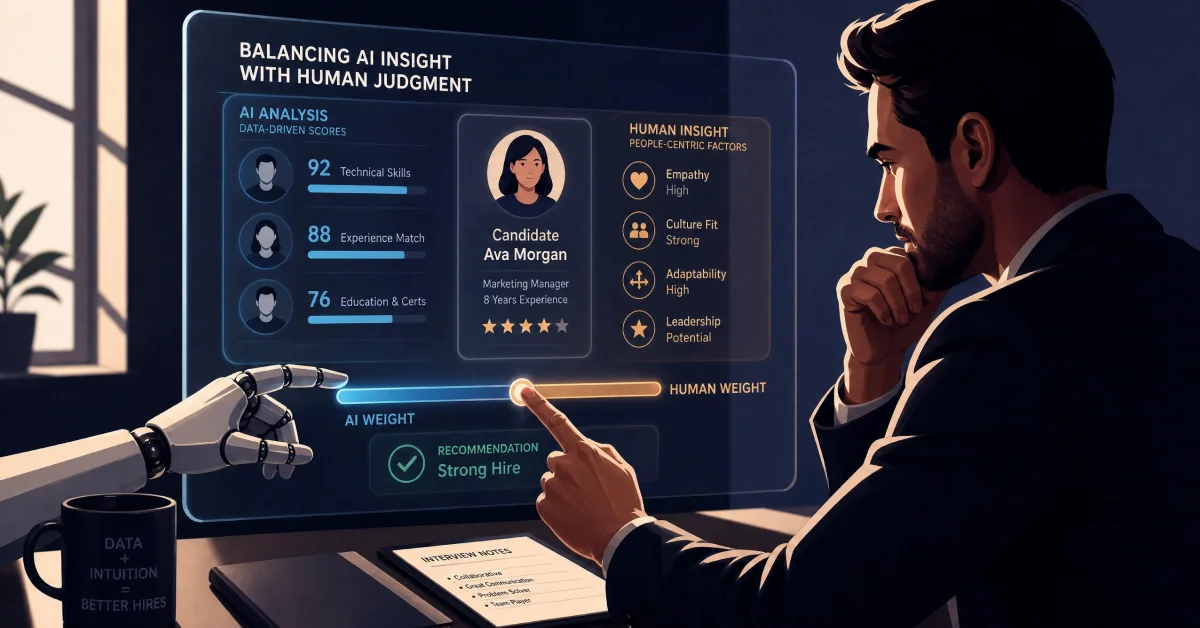
A person should review assessment evidence before it affects a consequential hiring decision. Reviewers need enough context to understand what the assessment measures, what it does not measure, and how it fits with interviews or work samples. A score should prompt a question or inform a judgment, not replace the judgment itself.
Set a clear route for candidates or recruiters to flag an unexpected result. That route is more useful when reviewers have authority to investigate and correct process problems. Human oversight is meaningful only when people can question recommendations rather than simply approve them.
Privacy, compliance, and security considerations in India
Candidate information deserves careful handling throughout the recruitment process. Before adopting a platform, establish what information it collects, why each item is needed, and who can access it. India’s applicable legal and regulatory requirements can change, so employers should verify their obligations with qualified advisers rather than rely on a generic vendor statement.

Clarify what candidate data the platform collects
Request a clear inventory of data collected during application, assessment, and reporting. Ask whether the platform processes responses, identity details, device or usage information, or other information, and distinguish what is necessary from what is optional. Understand whether the vendor uses information for purposes beyond delivering the assessment.
The inventory should also explain which parties receive data and what candidate-facing explanations are provided. If a vendor cannot describe the data flow in plain language, pause before moving candidate information into the system. Clear boundaries make later reviews more manageable.
Review consent, retention, and deletion practices
Understand how candidates are informed about data use, what consent or other lawful basis applies, how long information is retained, and how deletion requests are handled. Ask what happens to records when a hiring process closes or a contract ends. Retention should have a defined purpose and period, rather than continuing by default.
Document who within the organization can approve exceptions and how candidate requests are routed. The exact requirements depend on the circumstances and current law, so obtain legal advice for your process. A vendor’s standard terms do not remove the employer’s need to understand its own responsibilities.
Ask about data storage, access controls, and security
Ask where candidate data is stored and processed, how access is controlled, and what security practices the vendor can explain and document. Confirm how access is granted and removed when staff change roles, and what process applies if a security incident occurs. Request enough detail to assess the arrangement against your organization’s policies.
Security review should cover the full information flow, including exports and reports shared outside the platform. Limit access to people who need the information for hiring, and avoid keeping unnecessary copies. These are operational questions as much as technical ones.
Confirm responsibilities with vendors and legal advisers
Clarify in writing which party handles candidate notices, requests, retention, deletion, and incident communication. Ask the vendor to explain its role and identify any other processors involved. Then have internal privacy, security, and legal teams review the arrangement against the organization’s obligations.
This is also a useful point to test how well the vendor communicates limits and responsibilities. AI is used in many fields, from AI-informed search to recruitment, but practices that suit one domain do not automatically suit another. Evaluate the actual data flow and intended use in your hiring context.
How to implement an AI hiring assessment
Implementation works best as a controlled change to the hiring process, not as a quick software rollout. Define the problem first, pilot the assessment in a bounded setting, and decide how people will interpret results before inviting candidates. This gives the team a chance to learn without making an untested method central to every hiring decision.
Define the hiring problem and success criteria
Be specific about what needs to improve. The problem might be inconsistent evaluation across locations, limited evidence about a role requirement, or difficulty managing a high-volume process. Choose success criteria that reflect the purpose, such as completion, candidate experience, consistency, or the relationship between assessment evidence and later job outcomes.
Set a baseline before rollout so the team can judge whether the new process makes a meaningful difference. A tool should not be adopted simply because it produces more data or a faster score. Tie each measure to a decision the hiring team can act on.
Pilot assessments with representative roles
Choose a small set of roles that reflect the real range of your hiring needs, and run a pilot with clear safeguards. Before starting, decide what will be reviewed, who will see results, and how candidates will be supported. Track the practical experience as well as scores, including completion issues and recruiter feedback.
A short pilot plan is easier to run when responsibilities are explicit:
- Select roles with distinct, documented requirements.
- Test the candidate journey on likely devices and connections.
- Train reviewers before they see assessment results.
- Record completion, feedback, and process issues.
After the pilot, discuss what the evidence supports and what remains uncertain. Do not generalize results from a small or narrow group to every role. Adjust the assessment or process, then test again where necessary.
Train recruiters and hiring managers to interpret results
Training should cover the assessment’s purpose, scoring, limitations, and place in the hiring process. Reviewers should know how to compare results with structured interview evidence and job requirements without treating a score as a definitive label. Where the assessment reveals an area to explore, interview questions should be consistent across candidates.
For frontline roles, 9 LINKS provides validated, AI-enabled psychometric assessments that combine behavioural, cognitive, and integrity signals into hiring insights. Hiring teams still need to understand what each signal represents and how it applies to the role before using it in a decision. Training can help maintain that distinction.
Communicate the process clearly to candidates
Tell candidates why the assessment is part of the process, what it involves, how long it is expected to take, and what happens after completion. Explain how to request an accommodation or help with technical difficulties. Clear communication reduces uncertainty and gives candidates a fairer chance to participate.
Keep the explanation practical and consistent across roles and locations. If the assessment is optional or one part of a broader evaluation, say so plainly. Candidates should not have to guess how their results will be used.
How to measure assessment quality over time
An assessment is not permanently validated for every use just because it worked during an initial pilot. Hiring needs, candidate populations, and job requirements change, so employers should schedule regular reviews. Monitor both the candidate journey and the relationship between assessment evidence and the outcomes the organization cares about.
Track completion rates and candidate feedback
Measure how many candidates begin and complete the assessment, how long it takes, and where people encounter friction. Compare completion patterns across roles and recruitment channels, and invite feedback about clarity, accessibility, and relevance. A sharp drop-off may point to a confusing instruction, a technical barrier, or a mismatch between the assessment and the hiring stage.
Review feedback alongside the numbers. Completion alone cannot show whether candidates understood the process or felt they had a fair opportunity to demonstrate their abilities. Use recurring concerns to update instructions and support.
Compare assessment scores with job performance
Where appropriate, compare assessment evidence with later job outcomes using carefully chosen measures. Define the outcomes before analyzing results, and account for the fact that performance is influenced by training, supervision, and working conditions as well as individual capability. A relationship in one role or hiring cohort should not be assumed to hold elsewhere.
At 9 LINKS, assessments are tailored to specific roles and hiring levels rather than relying on off-the-shelf templates. Employers should still review whether the measures remain relevant when duties change, and whether the evidence supports their continued use. Keep conclusions proportionate to the data available.
Monitor selection rates and potential disparities
Review advancement and selection patterns at each stage, including who completes the assessment and who progresses. Where lawful and appropriate, examine differences between candidate groups and investigate whether they relate to assessment design, access, scoring, or other parts of the process. Record the outcome of each review so that concerns are not lost between hiring cycles.
No single metric establishes fairness. Combine quantitative monitoring with candidate feedback and review of individual cases, and escalate concerns when the results are difficult to explain. A recurring difference is a reason to investigate and, if needed, pause or revise the assessment.
Revisit tools when roles or hiring needs change
Reassess the tool when a role’s responsibilities, candidate pool, hiring volume, or process changes. A previously suitable assessment may no longer measure the most important requirements, while a new location or applicant group may expose barriers that were not apparent during the pilot. Include the vendor in the review, but keep the employer responsible for deciding whether the tool remains appropriate.
Set a regular review date and an event-based trigger, such as a substantial change to the job or a persistent shift in outcomes. This makes assessment quality an ongoing part of hiring governance, rather than a one-time procurement decision.
Conclusion
An AI hiring assessment can support clearer, more consistent hiring when it is tied to role requirements, accessible to candidates, and evaluated with care. For employers in India, the practical choice is not simply which platform has the most features; it is which assessment can be used transparently, reviewed by people, and monitored against meaningful outcomes over time.
Frequently Asked Questions
What is an AI hiring assessment?
It is a software-supported method for evaluating job-relevant candidate evidence, such as skills, responses, or structured assessment results. The exact method varies by platform and role.
How do employers choose an AI hiring assessment?
Start with the role requirements, then examine the assessment’s validity, candidate experience, accessibility, reporting, privacy practices, and fit with the hiring workflow.
Can an AI assessment make hiring decisions on its own?
It should not be treated as a complete or automatic verdict. Human reviewers should consider assessment results alongside interviews, work samples, and other relevant evidence.
How can employers check whether an assessment is fair?
Ask how it was developed and evaluated, monitor outcomes across candidate groups where appropriate, gather candidate feedback, and investigate unexplained differences.
What candidate data should employers ask about?
Ask what information is collected, why it is needed, who can access it, whether it is shared, how long it is retained, and how deletion requests are handled.
Should candidates be told about an AI assessment?
Yes. Clear instructions should explain why the assessment is used, what candidates can expect, how results fit into the process, and how to request help or an accommodation.
How often should an employer review an assessment?
Review it regularly and whenever roles, hiring needs, candidate populations, or assessment processes change. Monitor both outcomes and candidate experience between reviews.
We Appreciate The Feedback From Our Clients.
It is always a joy to hear how our work has positively impacted them and how our assessments have helped in finding the right people.
We have used 9 LINKS psychometric tool in our Campus Placement Programme.The tool has helped us to identify right candidate as per our organisation requirements…

We have just started using it. It differentiates various personalities and helps in decision making. The clarity on its precision level will be gathered over a period of time…

Counselling test curated for NES has been very useful in identifying the skill sets and allotting appropriate job fitment to students as per their quotients. Multilingual tests developed by considering various key…

It is indeed great pleasure in my part to share complementing note to you & your team. Needless to say 9 LINKS is one of the best organisation to conduct skill gap analysis through assessment of Cognitive skills..

It is crucial that validating the quality of the candidates in recruitment. 9 LINKS is a service that we can confidently say does that. 9 LINKS online assessment precisely giving us the right candidates to pick and proceed on recruitment…

Read Our Blog For The Latest On Research & Insights.
Get Insights into latest developments in HR industry and psychometric assessments.
Take a Free Assessment


