

Key Takeaways
A cognitive ability assessment can add useful evidence to hiring, but it works best as one part of a role-specific, fair process. The practical choices—from test content to score interpretation—matter as much as the score itself.
- Measure reasoning skills that reflect the role’s actual demands.
- Use consistent instructions and scoring criteria for every candidate.
- Consider assessment results alongside interviews and work samples.
- Review accessibility, fairness, and legal requirements before and during use.
- Track outcomes over time and adjust the process when evidence calls for it.
What a cognitive ability assessment measures
A cognitive ability assessment estimates how someone approaches tasks that involve thinking, learning, and solving problems. The questions may sample different kinds of reasoning, rather than reproduce the day-to-day work of a particular job. For employers, the goal is to understand whether the abilities assessed are relevant to the role—not to reduce a candidate to a number.
Reasoning, problem-solving, and learning agility
These assessments commonly examine how people identify patterns, work through unfamiliar problems, and make sense of new information. That can be useful when a role involves changing procedures or learning new tasks, but a test result is not a complete account of how someone will perform. Consider the demands of the job and the training candidates will receive before deciding which abilities matter.
Verbal, numerical, and abstract reasoning
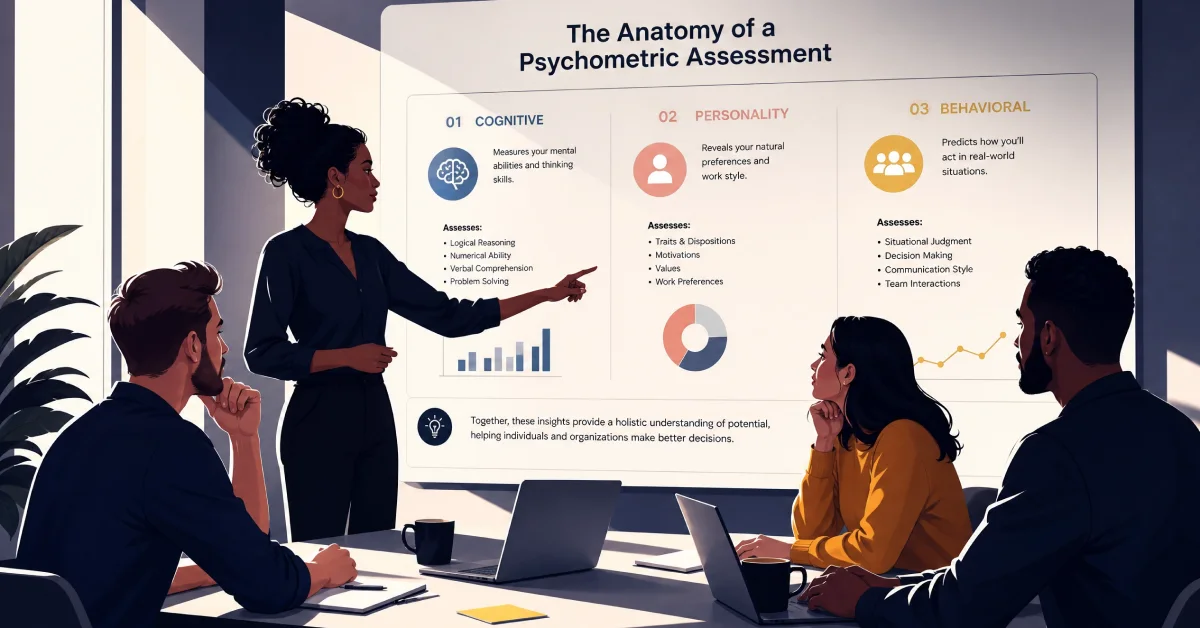
Question types may involve understanding written material, interpreting numbers, or recognizing relationships and patterns. The mix varies by assessment, so employers should check what the test actually covers instead of assuming that all cognitive tests measure the same things. A guide to common test formats can help clarify how item types and scoring approaches differ.
How assessments differ from personality and skills tests
A cognitive assessment focuses on reasoning and related thinking skills. A skills test typically checks proficiency in a particular task or tool, while a personality assessment explores preferences or behavioral tendencies. These measures answer different questions, so a hiring team should be clear about what each one contributes and avoid treating them as interchangeable.
What test scores can—and cannot—tell you
A score summarizes performance on a particular assessment under particular conditions. It may help compare candidates against consistent criteria, but it cannot by itself explain motivation, experience, teamwork, or future performance in every situation. Treating it as one piece of evidence supports more balanced decisions than allowing a single result to determine who advances.
Why employers use cognitive ability assessments
Employers may use these assessments to add a consistent source of information to hiring decisions. They can be especially useful when a role requires learning new procedures or handling unfamiliar problems, though usefulness depends on how closely the assessment fits the job. The measure should complement other evidence, not displace a thoughtful review of candidates.

Predicting performance across different roles
Reasoning tasks may offer relevant evidence for roles that involve problem-solving, learning, or managing complexity. Their value will vary with the work: a measure that fits one position may not be meaningful for another. Employers should connect any expected benefit to the actual tasks and training demands of the role.
Comparing candidates with consistent criteria
When the same assessment, instructions, and scoring approach are used for everyone in a hiring stage, recruiters have a more consistent basis for comparison. Consistency does not automatically make a process fair or job-related, however. The assessment still needs to measure something relevant, and results should be interpreted alongside other evidence.
Identifying potential beyond experience and credentials
A cognitive assessment may provide another way to consider candidates whose experience or formal credentials do not tell the full story of their ability to learn and reason. This can be useful in high-volume recruitment, where resumes may offer limited detail. It should broaden the evidence considered, not become a shortcut that excludes people based on an unrelated score.
Balancing predictive value with candidate experience
A test adds a step to the candidate journey, so employers should be able to explain why it is being used and how the result will inform decisions. Clear instructions and a reasonable process can help candidates focus on the task rather than guess what is expected. Some employers also explore problem-solving and learning agility as part of making more informed hiring decisions, while keeping the assessment proportionate to the role.
How to choose the right assessment
Choosing a test begins with the job, not a vendor’s feature list. Define which work demands the assessment should reflect, then compare options against that purpose and the people who will take them. Employers hiring across different frontline roles or levels may need distinct assessment choices rather than one standard test for every opening.
Match test content to the role’s actual demands
Start by identifying the tasks that require reasoning, interpreting information, or learning new procedures. Then check whether the test samples those capabilities in a way that makes sense for the role. For example, the assessment emphasis for a position involving frequent number interpretation may differ from one centered on understanding written instructions.
A simple comparison can make the fit easier to discuss with hiring managers:
| Role demand | Possible assessment emphasis | Question to check |
|---|---|---|
| Interpreting written procedures | Verbal reasoning | Does the role rely on written information? |
| Working with quantities or data | Numerical reasoning | Are calculations or data interpretation part of the work? |
| Solving unfamiliar problems | Abstract or general reasoning | Does the role involve novel situations? |
The examples are starting points, not a recipe for selecting a test. Confirm the match through job analysis and ensure the assessment does not introduce demands unrelated to successful work.
Compare test length, format, and accessibility
Length and format affect both the candidate experience and how easily the assessment fits into recruitment. Review whether the test can be completed using the devices and conditions candidates are likely to have, and whether instructions are understandable. A format that creates avoidable barriers can interfere with the purpose of measuring job-relevant ability.
Evaluate reliability, validity, and evidence quality
Ask what evidence supports the assessment’s consistency and its relevance to the intended hiring use. Validity is not a label to accept without context: employers should understand what was studied, for which population and purpose, and how closely that evidence applies to their roles. Review the assessment’s scoring method and documentation before using scores to influence hiring decisions.
Review vendor data protection and reporting practices
Before implementation, understand what candidate information is collected, how it is used, who can access it, and how long it is retained. Reporting should be clear enough for hiring teams to understand the limits of the result, not just its headline score. 9 LINKS provides validated, AI-enabled psychometric assessments for hiring India’s frontline workforce, with assessments tailored to specific roles and hiring levels rather than relying on off-the-shelf templates.
How to build assessments into your hiring process
A well-chosen assessment still needs a sensible place in the hiring process. Decide what decision it is intended to inform, make the process consistent, and explain the step to candidates. For employers recruiting at scale, small differences in timing or instructions can lead to an uneven experience across applicants.

Decide when candidates should take the test
The best timing depends on the number of applicants, the effort required, and the information needed at each stage. If a test is used early, make sure it is a proportionate and job-related screen; if later, consider whether candidates have already invested significant time. Apply the same stage and rules consistently to comparable applicants.
Set consistent instructions and testing conditions
Candidates need to know how long the test is expected to take, whether there are time limits, and what materials or devices are permitted. Keep these conditions stable across candidates unless an accommodation is arranged. Consistency makes comparisons more meaningful and reduces confusion that has little to do with the ability being assessed.
Combine scores with interviews and work samples
Assessment results are more useful when they sit alongside other evidence that answers different questions about role fit. A hiring team might use a simple sequence to avoid over-relying on any one source:
- Define the job-related criteria before reviewing results.
- Use the assessment to inform, not replace, the broader evaluation.
- Compare results with structured interview evidence and relevant work samples.
- Record the reason for the final decision in terms of role requirements.
This approach makes it easier to see where different evidence agrees or raises a question for follow-up. 9 LINKS assessments combine behavioral, cognitive, and integrity signals to help employers evaluate role fit and make clearer hiring decisions.
Communicate expectations and next steps to candidates
Tell candidates why the assessment is part of the process, how it will be used, and what happens after completion. Give a contact route for questions or accommodation requests, and share a realistic timeline for next steps. Clear communication respects candidates’ time and can prevent avoidable uncertainty during a hiring process.
How to interpret results responsibly
A test score needs context before it can inform a hiring decision. Employers should know what the score represents, how it was produced, and how closely the assessment maps to the role. A clear, documented approach helps hiring teams use results consistently without mistaking a measure for a complete picture of a person.
Use role-related benchmarks and scoring rules
Set scoring rules before reviewing candidates and tie them to the role’s requirements. A benchmark should be supported by evidence and applied consistently, rather than adjusted informally for individual applicants. Where roles differ in demands, avoid assuming that a single cutoff is appropriate across all of them.
Consider score ranges and measurement error
No measurement is perfectly precise, and small score differences may not represent meaningful differences in ability. Learn how the assessment reports uncertainty or score ranges, and avoid treating close results as a definitive ranking. The purpose is to make a more informed decision, not to imply a precision the test cannot provide.
Avoid treating a single score as a hiring decision
Use the assessment as one part of a broader review of job-related evidence. An unusual result may prompt a structured follow-up, but it should not automatically override relevant experience, interview evidence, or a work sample. This is particularly important when the testing conditions or candidate experience may have affected performance.
Train hiring teams to understand assessment reports
Recruiters and hiring managers should know what a report does and does not claim. They need to distinguish observed test performance from broader assumptions about a candidate’s character or future success. 9 LINKS reports turn behavioral, cognitive, and integrity data into clear, actionable hiring insights, giving hiring teams information to consider within the rest of their process.
How to support fairness and accessibility
Fairness depends on more than selecting a test with a promising evidence base. Employers should look at how the assessment is administered, who is affected by the process, and whether candidates can access it on reasonable terms. Review should be ongoing, especially when hiring across roles, locations, or candidate populations.
Check for adverse impact across candidate groups
Monitor outcomes across relevant candidate groups in ways that respect privacy and applicable requirements. Differences in selection rates can be a signal to examine the assessment, its cutoff, or the surrounding process; they do not by themselves establish a cause. Investigate patterns and document decisions about any changes.
Provide reasonable accommodations
Make a clear process for candidates to request accommodations and assess requests individually. An accommodation should address access barriers while preserving the ability to evaluate the role-related skill in question. Train the people handling requests so candidates are not left to navigate an unclear or improvised process.
Use accessible formats and clear instructions
Check readability, navigation, compatibility with assistive technology, and the clarity of prompts before rolling out an assessment. Instructions should explain the task in plain language without coaching candidates toward answers. Employers comparing accessible assessment formats can also consider whether the format works for high-volume hiring and the conditions candidates will encounter.
Review compliance with applicable employment laws
Employment assessment requirements vary by location and circumstance, so seek appropriate legal guidance for the jurisdictions where candidates are recruited. Keep records of the assessment’s purpose, selection rules, accommodations, and monitoring. Revisit these practices when a role or process changes rather than assuming an earlier review remains sufficient.
How to validate and improve your approach
An assessment process should be evaluated after it is put into use. Employers can compare hiring decisions with later job-related outcomes, ask candidates and hiring teams what worked, and revisit assumptions as roles evolve. This helps keep the process grounded in evidence rather than habit.
Track assessment outcomes against job performance
Define job-related outcomes that can be monitored fairly and consistently, such as relevant performance measures or successful completion of training. Examine how assessment results relate to those outcomes, while accounting for the limits of the data and differences between roles. A relationship observed in one setting should not be assumed to apply everywhere.
Gather feedback from candidates and hiring teams
Candidate feedback can reveal confusing instructions, technical barriers, or timing problems that internal teams may not notice. Hiring teams can explain whether reports informed decisions in a useful and understandable way. Consider this feedback alongside outcomes, rather than treating satisfaction alone as proof that an assessment is valid.
Reassess cut scores and processes over time
Review scoring rules when job demands change, new evidence becomes available, or monitoring identifies an unexpected pattern. Revisions should be documented and applied consistently, with a clear rationale for the change. Avoid moving cutoffs simply to reach a preferred hiring outcome.
Retire tests that no longer fit the role or evidence base
If a test no longer reflects the work or lacks adequate support for its intended use, reconsider its place in the process. A familiar tool is not automatically the right tool. When evidence no longer supports an assessment’s role, replacing or discontinuing it can be more responsible than preserving it for convenience.
Conclusion
A cognitive ability assessment for recruitment is most useful when its content fits the job, its administration is consistent, and its results are considered alongside other evidence. Employers can improve decision quality by explaining the process, supporting access, and reviewing outcomes over time. The aim is not to let a test make the decision, but to make hiring more thoughtful and grounded in role-related evidence.
Frequently Asked Questions
These answers offer a starting point for employers considering cognitive testing in recruitment. The right approach depends on the role, the assessment’s evidence, and the hiring context.
What is a cognitive ability assessment for recruitment?
It is a hiring assessment designed to estimate abilities such as reasoning, problem-solving, or learning from new information. Employers should use one only when those abilities relate to the job.
What does a cognitive ability test measure?
Depending on the test, it may measure verbal, numerical, abstract, or broader reasoning skills. The specific content and scoring approach differ across assessments.
Are cognitive assessments suitable for every role?
No single assessment is a fit for every job. Employers should connect test content to actual role demands and consider whether it adds useful evidence.
Should a test score determine who gets hired?
A score should not be the sole basis for a hiring decision. Consider it with other job-related information, such as structured interview evidence and relevant work samples.
How can employers make cognitive assessments fairer?
Use consistent instructions and scoring rules, monitor outcomes for potential adverse impact, provide reasonable accommodations, and review accessibility. Fairness also depends on whether the test is relevant to the role.
When should candidates take a cognitive assessment?
Timing depends on the assessment’s length, the hiring volume, and the decision it is meant to inform. Apply the stage consistently and explain it clearly to candidates.
How often should employers review their assessment process?
Review it regularly and whenever job demands, candidate populations, or hiring procedures change. Use outcome data and feedback to decide whether the process still fits its purpose.
We Appreciate The Feedback From Our Clients.
It is always a joy to hear how our work has positively impacted them and how our assessments have helped in finding the right people.
We have used 9 LINKS psychometric tool in our Campus Placement Programme.The tool has helped us to identify right candidate as per our organisation requirements…

We have just started using it. It differentiates various personalities and helps in decision making. The clarity on its precision level will be gathered over a period of time…

Counselling test curated for NES has been very useful in identifying the skill sets and allotting appropriate job fitment to students as per their quotients. Multilingual tests developed by considering various key…

It is indeed great pleasure in my part to share complementing note to you & your team. Needless to say 9 LINKS is one of the best organisation to conduct skill gap analysis through assessment of Cognitive skills..

It is crucial that validating the quality of the candidates in recruitment. 9 LINKS is a service that we can confidently say does that. 9 LINKS online assessment precisely giving us the right candidates to pick and proceed on recruitment…

Read Our Blog For The Latest On Research & Insights.
Get Insights into latest developments in HR industry and psychometric assessments.

Take a Free Assessment


