

Key Takeaways
A sound job-fit decision comes from comparing candidates with the work itself, not with an undefined idea of an ideal employee. Use a consistent process that gives candidates a fair chance to show relevant evidence.
- Define essential qualifications and outcomes before reviewing applicants.
- Match each assessment method to a specific role criterion.
- Ask consistent interview questions and score answers against shared standards.
- Keep work samples realistic, proportionate, and accessible.
- Record decisions and review hiring outcomes to improve the process.
Define what job fit means for the role
Job fit is the degree to which a candidate’s demonstrated capabilities and work behaviors align with a role’s actual requirements. That definition needs to be specific enough to guide hiring decisions, but not so narrow that it screens out people who could succeed through a different path. For employers hiring at scale, especially into frontline roles, clarity at the start helps keep evaluation consistent across candidates and interviewers.
Separate essential qualifications from preferences
Start by identifying which requirements a person must meet to perform the job safely and effectively, and which would simply be useful. A required license or ability to work a stated shift may be essential; familiarity with one particular system may be a preference if it can be learned on the job. Making the distinction explicit helps prevent a polished résumé or a familiar career path from standing in for evidence of capability. It also gives recruiters a fairer basis for reviewing applicants with different backgrounds.
Identify the role’s most important outcomes
Rather than relying only on a list of duties, name what a successful hire should accomplish. A service role might require accurate transactions and calm customer interactions; a production role could depend on following procedures and maintaining quality. These outcomes become the anchor for deciding what to assess and what a strong response looks like. A useful test is whether a candidate could understand the outcome from the job description and whether an interviewer could gather evidence for it.
Translate team needs into observable behaviors
Terms such as “reliable,” “collaborative,” and “adaptable” can mean different things to different interviewers. Translate them into actions that can be described and evaluated: following a handover process, asking for clarification when instructions conflict, or adjusting priorities when demand changes. That shift makes role-relevant evidence easier to compare than impressions about someone’s personality. It also helps interviewers explain why a behavior matters to the work rather than treating it as a general preference.
Distinguish job fit from culture fit
“Culture fit” can become a vague judgment about whether a candidate feels familiar or shares an interviewer’s background. Keep the focus on job-related behaviors and working conditions instead: for example, the role may require close coordination, adherence to safety procedures, or comfort with a rotating schedule. Candidates do not need to resemble the existing team to contribute well. When discussing fit, tie every conclusion to a requirement that has been defined in advance.
Choose reliable ways to assess candidates
No single method provides a complete picture of a candidate. Interviews can reveal how someone explains past decisions, while a work sample can show how they approach a task; each is useful only when connected to a criterion. 9 LINKS provides validated, AI-enabled psychometric assessments for hiring India’s frontline workforce, combining behavioural, cognitive, and integrity signals to help employers evaluate role fit and make clearer hiring decisions.

Match each assessment method to a hiring criterion
Choose a method because it can produce evidence about a specific requirement, not because it is familiar or easy to administer. A role’s core criteria can be paired with different forms of evidence, while leaving room to use more than one method where the decision matters. The table below is a starting point, not a substitute for defining standards for the actual role.
| Hiring criterion | Possible evidence | What to evaluate |
|---|---|---|
| Clear communication | Structured interview response | Relevant details and understandable explanation |
| Task accuracy | Short job-related work sample | Correct steps and attention to instructions |
| Response to changing demands | Situational interview question | Prioritization and reasoning |
| Role-related behavioral signals | Validated assessment | Results interpreted against role criteria |
After choosing a method, check that it assesses the criterion directly and does not introduce unnecessary hurdles. For example, a task intended to assess accuracy should not depend on specialized software knowledge unless that knowledge is genuinely required on day one.
Combine interviews with work samples and other evidence
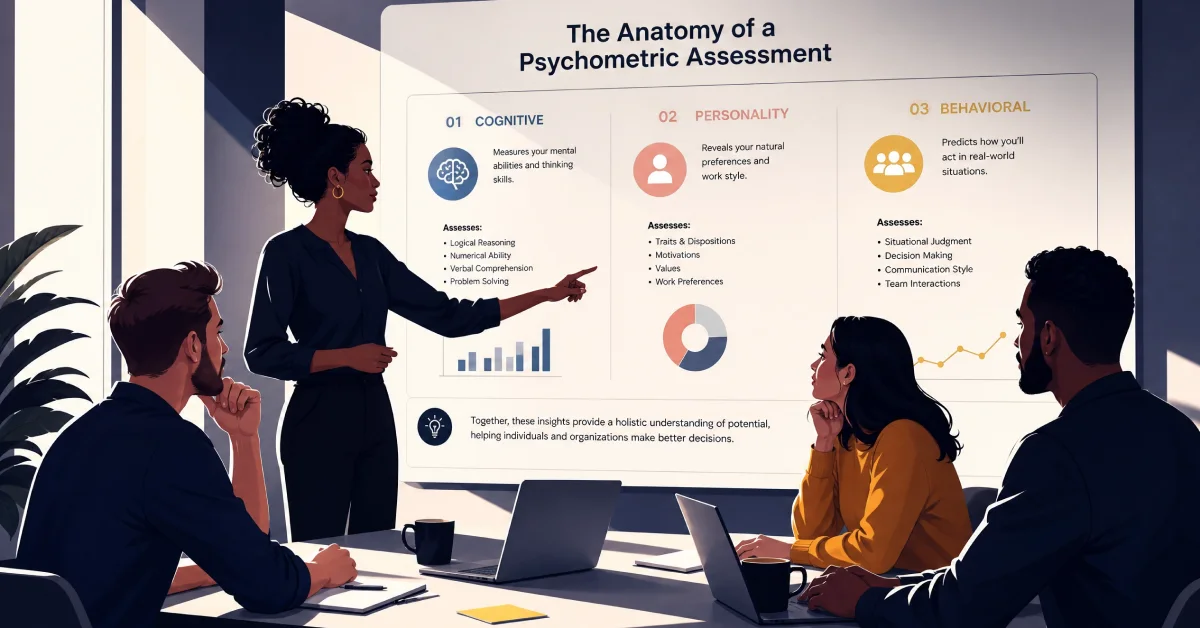
Different sources of evidence can help distinguish a well-practiced interview answer from the ability to carry out a task. A structured interview can explore a candidate’s reasoning, while a short exercise can show how that reasoning translates into action. For some employers, validated psychometric assessments can add information about behavioural, cognitive, and integrity signals; 9 LINKS offers assessments tailored to specific roles and hiring levels, with reports that turn those signals into clear, actionable hiring insights.
Consider the evidence together rather than allowing one score, impressive anecdote, or interviewer’s first impression to decide the outcome. Each method should answer a distinct question, and the hiring team should know how much weight to give its results before candidates are assessed.
Use assessments that reflect actual job tasks
A useful assessment resembles an important part of the work without requiring candidates to complete unpaid production work. Ask what the person would actually need to do, then create a bounded exercise that gives them a fair opportunity to demonstrate it. Where personality or workplace preferences are assessed, explain how the information relates to the role and avoid treating a single response as a complete prediction of performance. For a broader perspective on these tools, see workplace preference measures.
Set consistent evaluation standards in advance
Write down what counts as strong, adequate, or insufficient evidence before reviewing applications or interview responses. Standards should describe observable results, not simply labels such as “good attitude.” Use the same criteria for everyone applying to the same role, and make sure evaluators understand how to apply them. This reduces the chance that standards will shift after an interviewer meets a candidate they particularly like.
Structure interviews to gather comparable evidence
Interviews are more useful when candidates have comparable opportunities to demonstrate the skills the role requires. A consistent structure does not mean every conversation must sound mechanical; it means the same core topics and evaluation standards are used for each person. Employers can still ask follow-up questions, provided those prompts clarify evidence rather than steer candidates toward a preferred answer.
Ask every candidate the same core questions
Prepare a small set of questions that map directly to the role criteria and ask each candidate the same core questions in the same order where practical. This makes responses easier to compare and helps interviewers notice when they have given one person more hints or more time than another. A short guide can include prompts such as:
- Describe a time you had to follow a detailed process.
- Tell me about a time you handled a difficult interaction.
- How have you prioritized when several tasks needed attention?
- What would help you succeed during your first weeks in this role?
The answers will naturally differ, but each candidate has had a similar opening to provide evidence. A consistent interview structure is also a useful starting point for interview-based job-fit assessment.
Use behavioral questions to explore past performance
Behavioral questions ask candidates to describe a real situation, what they did, and what happened next. They can reveal how a person approached a relevant challenge, though a single example should not be treated as proof of future success. Ask for enough context to understand the candidate’s role in the event and whether the example reflects the demands of the job. If someone has limited work experience, examples from training, volunteering, or other relevant responsibilities may still offer useful evidence.
Add situational questions for role-specific challenges
Situational questions give candidates a consistent hypothetical challenge tied to the role. For example, an interviewer might ask how a candidate would respond if urgent work arrived while they were completing a task that required careful checking. Listen for how they identify priorities, seek information, and manage risk, rather than expecting one exact script. Keep the scenario realistic and avoid adding complications that are unrelated to the job.
Probe for details without leading the candidate
A neutral follow-up helps clarify what happened without supplying the answer. Ask what the candidate did first, what information they used, or how the outcome was checked. Avoid prompts that reveal the desired response, such as suggesting the candidate should have escalated an issue before they have explained their approach. Consistent probing helps interviewers gather comparable detail while still allowing candidates to tell their own story.
Use work samples and skills assessments responsibly
Work samples can make an evaluation more concrete because they ask candidates to demonstrate a task or skill rather than only describe it. They also take time and can create barriers if instructions are unclear, the exercise is too long, or the technology is unfamiliar. Responsible design keeps the exercise connected to the job and gives candidates a clear understanding of what is expected.

Design realistic exercises with clear instructions
Choose a task that represents a meaningful part of the work, then state what the candidate should produce, how much time is available, and what materials or tools they may use. Avoid relying on unwritten assumptions that current employees happen to know. A well-scoped exercise lets candidates focus on the skill being assessed instead of guessing what the evaluator wants. Where the role involves procedures, explain which instructions are fixed and which decisions are left to the candidate.
Keep tasks proportional to the role
The time and complexity of an assessment should match the level and responsibilities of the position. A short, focused exercise may be sufficient to see how someone handles a routine task; an elaborate assignment can burden candidates without yielding better evidence. Be especially careful not to ask applicants to solve a real business problem or complete work the organization may use. Proportionality respects candidates’ time and can make the assessment more relevant.
Define scoring criteria before reviewing submissions
Decide in advance which features matter, and give reviewers a shared scoring guide. For a written task, criteria might include whether the response follows instructions, includes the necessary information, and is understandable. For a practical exercise, the guide can distinguish correct process from a result that looks polished but misses a key requirement. Apply the same criteria to each submission, and record evidence for the rating rather than relying on an overall impression.
Offer reasonable accommodations and alternatives
Tell candidates how to request an accommodation and provide a contact who can respond without requiring unnecessary personal details. Consider whether an alternative format or a modest adjustment in timing would allow the candidate to demonstrate the same skill. The aim is to assess job-related capability, not a candidate’s ability to navigate an avoidable barrier. Communicate any approved changes to evaluators so they judge the evidence against the same role criteria.
Reduce bias and improve the candidate experience
A fair process depends on more than good intentions. Familiarity, first impressions, and assumptions about a person’s background can influence how evidence is interpreted, especially when criteria are vague. Clear communication and a consistent evaluation routine help candidates understand the process and help hiring teams keep attention on the work.
Train interviewers to recognize common bias
Prepare interviewers to notice patterns such as favoring candidates who share their interests, overvaluing confidence, or allowing one early impression to shape every later judgment. Training is most useful when paired with practical habits: use the agreed questions, take evidence-based notes, and connect ratings to the rubric. Remind the team that communication style, accent, or similarity to current employees is not a substitute for job-related capability. When an interviewer raises a concern, ask what observed evidence supports it.
Use independent ratings before group discussion
Ask interviewers to record their ratings independently before discussing a candidate as a group. This reduces the chance that the first or most confident voice will set the direction for everyone else. During discussion, compare the evidence behind ratings and identify where evaluators interpreted the same response differently. A disagreement can be useful if it prompts a specific question about the criterion rather than a debate about whether someone simply “feels right.”
Give candidates a clear, accessible process
Explain the stages, likely timing, assessment format, and expected preparation before each step. Let candidates know whom to contact if they need clarification or an accommodation, and provide updates when plans change. Clear instructions are particularly helpful in high-volume hiring, where applicants may otherwise be unsure whether a task is required or what will happen next. A predictable process respects candidates’ time and makes it easier for them to show relevant skills.
Follow consistent guidelines for AI-based assessments
When AI-supported assessments are used, understand what information they consider and how results are intended to inform a decision. Use only role-relevant evidence, provide appropriate oversight, and avoid allowing a tool’s output to replace human review. Employers should explain the assessment process to candidates and check that it is applied consistently. 9 LINKS applies validated psychometrics and AI to hiring, using behavioural, cognitive, and integrity signals to help employers evaluate role fit and make clearer hiring decisions.
Make and review the hiring decision
A hiring decision should follow from the criteria set at the beginning, not from a last-minute preference for one candidate’s style or background. Reviewers need a practical way to combine evidence, resolve disagreements, and explain the final choice. Then, over time, hiring teams can examine whether their assessments are producing information that helps them make better role-related decisions.
Compare evidence against role criteria
Review candidates criterion by criterion, using the same standards and giving greater attention to evidence that directly reflects the work. A candidate may be strong in one area and still need development in another; record that difference rather than compressing the whole evaluation into a vague overall impression. Consider the quality and relevance of each piece of evidence, including its limitations. The objective is a defensible decision based on what the role requires.
Resolve conflicting feedback with targeted follow-up
If interviewers disagree, first identify the source of the disagreement. They may have observed different evidence, applied the rubric differently, or placed different importance on a criterion. Return to the notes and scoring guide before deciding that another assessment is needed. If a genuine gap remains, use a focused follow-up question or task that addresses that gap and treat candidates consistently.
Document the reasons for the final decision
Keep a concise record of the criteria considered, the evidence that supported the decision, and any material uncertainty. Documentation helps explain the process to stakeholders and makes later review more useful. Write about observed, job-related evidence rather than personal judgments or unnecessary sensitive information. A clear record also makes it easier to see whether interviewers followed the agreed process.
Track hiring outcomes to improve future assessments
Review how well the criteria and methods served the role after hires have had time to perform the work. Look for patterns in which assessment results aligned with relevant job expectations and where they did not; avoid treating a small number of hires as conclusive proof. Gather feedback from managers and new employees about whether the hiring process represented the job accurately. Use those observations to refine questions, exercises, and standards for the next hiring cycle.
Conclusion
Assessing job fit works best when employers define success clearly, gather comparable evidence, and interpret it against role-specific standards. A thoughtful process can make hiring decisions easier to explain while giving candidates a fair opportunity to demonstrate what they can do. Review the approach regularly, and adjust it when the role or the evidence shows that the criteria need to change.
Frequently Asked Questions
What does job fit mean in hiring?
Job fit describes how well a candidate’s demonstrated skills, experience, and work behaviors align with the requirements and conditions of a specific role. It should be defined using job-related criteria rather than general impressions.
How can employers assess job fit fairly?
Set role criteria in advance, give candidates comparable opportunities to provide evidence, and use consistent scoring standards. Review ratings against observed evidence and provide a clear process for questions or accommodations.
Is job fit the same as culture fit?
No. Job fit focuses on a candidate’s alignment with the work and its requirements. Culture fit can become subjective, so employers should assess specific behaviors needed for the role instead of similarity to the existing team.
Which methods can be used to assess job fit?
Employers can combine structured interviews, job-related work samples, and other relevant assessments. Each method should measure a defined criterion, and no single result should be treated as a complete picture of a candidate.
What should a work sample test?
A work sample should reflect an important task or skill required by the position. Keep it proportionate, explain the instructions, and evaluate it using standards decided before reviewing submissions.
How many interview questions should candidates receive?
There is no universal number. Choose a manageable set of questions that covers the role’s important criteria, ask every candidate the same core questions, and use neutral follow-ups to clarify their evidence.
How often should hiring assessments be reviewed?
Review them when the role changes and periodically after hires have had time to demonstrate their work. Use multiple sources of feedback and treat patterns cautiously, especially when the number of hires is small.
We Appreciate The Feedback From Our Clients.
It is always a joy to hear how our work has positively impacted them and how our assessments have helped in finding the right people.
We have used 9 LINKS psychometric tool in our Campus Placement Programme.The tool has helped us to identify right candidate as per our organisation requirements…

We have just started using it. It differentiates various personalities and helps in decision making. The clarity on its precision level will be gathered over a period of time…

Counselling test curated for NES has been very useful in identifying the skill sets and allotting appropriate job fitment to students as per their quotients. Multilingual tests developed by considering various key…

It is indeed great pleasure in my part to share complementing note to you & your team. Needless to say 9 LINKS is one of the best organisation to conduct skill gap analysis through assessment of Cognitive skills..

It is crucial that validating the quality of the candidates in recruitment. 9 LINKS is a service that we can confidently say does that. 9 LINKS online assessment precisely giving us the right candidates to pick and proceed on recruitment…

Read Our Blog For The Latest On Research & Insights.
Get Insights into latest developments in HR industry and psychometric assessments.


Take a Free Assessment


