

Key Takeaways
A well-designed pre-employment assessment helps Indian employers evaluate job-relevant capability with greater consistency. It should support human judgment, not replace it.
- Match each assessment to the actual demands of the role.
- Account for language, education, regional, device, and accessibility differences.
- Use validated methods and consistent instructions for every candidate.
- Combine assessment results with structured interviews and other evidence.
- Track hiring outcomes so the process improves over time.
Understanding pre-employment assessment in India
A pre-employment assessment India program can give employers structured evidence before they invest time in every interview. The strongest programs focus on capabilities that matter for performance, such as reasoning, behavioral tendencies, communication, technical knowledge, or integrity. They also recognize that a test is only useful when it is connected to a specific job. For a broader overview of pre-employment testing, employers can compare where assessments fit and what they are designed to reveal.
What a pre-employment assessment measures
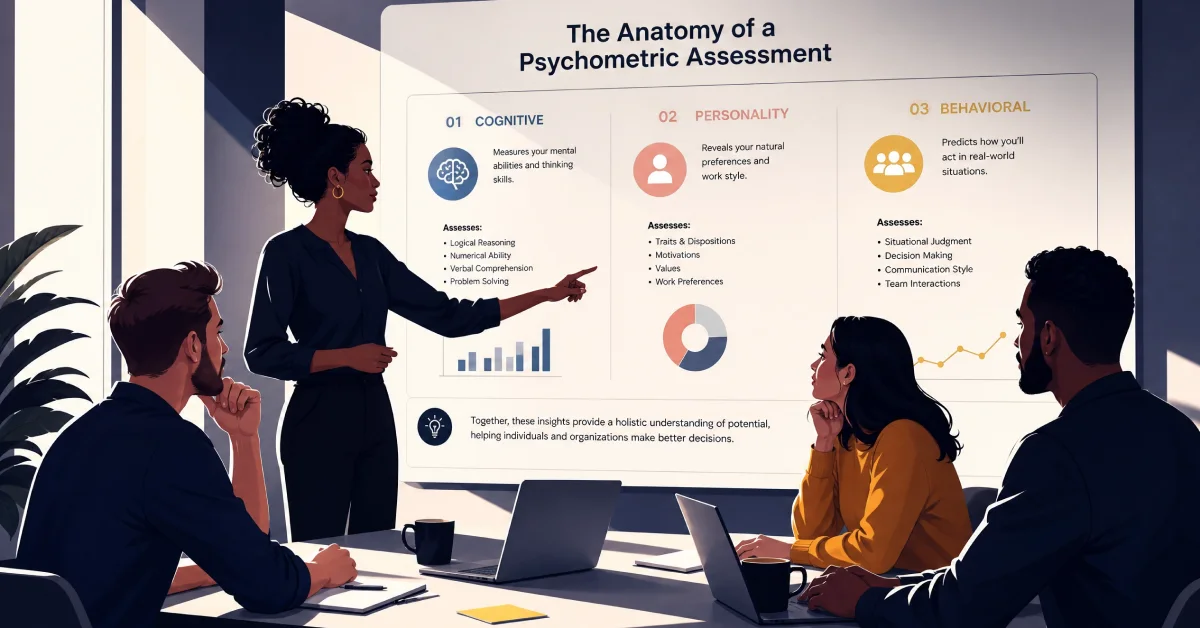
An assessment may measure one capability or combine several. Cognitive tests examine reasoning, learning potential, and problem-solving; technical tests examine role knowledge; behavioral measures explore likely work patterns; and situational questions ask how a candidate might respond to realistic workplace demands. The right combination depends on the job rather than on a desire to collect as much data as possible.
A useful assessment describes observable, job-related evidence. For example, a customer-facing role may require communication and patience, while a production role may require attention, safety-minded behavior, and dependable decision-making. The result should help a hiring team ask better questions, not create a false impression of certainty.
Why Indian employers use hiring assessments
High-volume hiring can make resume screening and unstructured interviews difficult to apply consistently. Candidates may have very different educational backgrounds or work histories, even when they could succeed in the same role. A structured assessment adds another comparable signal and can help recruiters focus interview time where it is most useful.
For frontline employers, the practical questions are often role fit, trainability, reliability, and the likelihood of staying in the job. Psychometric methods can contribute objective evidence, but they work best when validated for the intended population and interpreted alongside experience and context.
When assessments add value to the recruitment process
Testing is most useful when a hiring decision involves a clear, repeatable question. That question might be whether an applicant can reason through unfamiliar information, handle a common workplace situation, or demonstrate the baseline knowledge needed for a technical task. It is less useful when the employer cannot explain what a score means for performance.
Assessments can be especially helpful in campus hiring, frontline recruitment, internal mobility, and roles with many applicants. They should remain proportionate, though. A short, relevant assessment is often more respectful than a long battery of unrelated tests.
How assessments differ from interviews and resumes
A resume records a candidate’s reported history, while an interview reveals how the person communicates in a particular conversation. An assessment can add a standardized task or set of questions, making it easier to compare candidates against the same criteria. None of these sources is complete on its own.
Structured interviews bring context and human judgment; assessments bring repeatability and a defined measurement approach. A sensible process uses both. The aim is better evidence for decisions, not the elimination of professional judgment.
Choosing the right types of hiring assessments
There is no universal hiring test. A warehouse supervisor, nurse, service associate, sales officer, and software developer need different evidence, even if they move through the same recruitment funnel. Begin with the work, identify the capabilities that predict success, and then select the lightest assessment approach that can measure them credibly.

Cognitive ability and problem-solving tests
Cognitive assessments commonly examine reasoning, numerical interpretation, verbal understanding, and problem-solving. They can indicate how a person approaches new information, which matters in roles involving changing procedures or frequent decisions. The assessment should reflect the level of complexity candidates will actually face.
For a practical explanation of mental ability testing, employers can review mental ability tests and consider how these measures complement interviews. Scores should not be treated as a general ranking of intelligence; they are evidence about performance on a defined type of task.
Technical, role-specific, and job simulation tests
Technical assessments should resemble the work as closely as possible without creating unnecessary barriers. A coding exercise may ask candidates to solve a relevant problem, while a service simulation may ask an applicant to respond to a customer situation. For manufacturing or operations, a scenario can test sequencing, safety judgment, or attention to instructions.
The closer the task is to the job, the easier it is to explain why it belongs in the process. It also gives candidates a clearer sense of the work they are being considered for. Assessment designers should set difficulty by seniority and provide enough instructions for the score to reflect capability rather than confusion.
Personality, behavioral, and situational judgment assessments
Personality and behavioral assessments explore tendencies that may influence workplace conduct, such as patience, formality, sociability, or persistence. Situational judgment tests present realistic choices and examine how candidates prioritize or respond. These methods are most defensible when linked to documented role requirements.
Employers considering psychometrics should review guidance on choosing psychometric assessments, particularly the importance of reliability, validity, interpretation, and candidate experience. Behavioral results describe tendencies, not fixed labels or guarantees of future performance.
Language, communication, and aptitude tests
Language and communication tests can be relevant where employees must explain information, document work, or interact with customers and colleagues. Aptitude tests may examine numerical, verbal, or abstract reasoning. The key is to distinguish a genuine job requirement from a preference for a particular educational or linguistic background.
For multilingual hiring, instructions and response formats deserve as much attention as the score itself. A candidate should not be rejected for struggling with avoidable wording when the role does not require that level of language proficiency.
Designing assessments for Indian candidates
India’s workforce is not a single testing population. Candidates differ in language, schooling, geography, internet access, device availability, and familiarity with formal assessments. A process that looks neutral on paper can create unequal barriers in practice. Design therefore needs both psychometric discipline and operational realism.
Aligning tests with the role and seniority level
Start with a role profile that names the behaviors, knowledge, and capabilities required for effective performance. Entry-level hiring may call for foundational reasoning, learning ability, communication, and reliability, while a senior role may require more complex judgment and domain expertise. Do not use a difficult test simply because it is available.
Each assessment should have a clear decision purpose. If a score will determine who advances, recruiters should know the threshold, the evidence behind it, and what additional information will be reviewed before a final decision.
Accounting for language, education, and regional diversity
Language can distort results when it is not the capability being measured. Use clear instructions, translated or localized materials where appropriate, and pilot testing with candidates resembling the intended workforce. Education level should also be considered when deciding whether an item measures job potential or exposure to a particular academic curriculum.
A fair design does not lower job standards. It removes irrelevant obstacles so that candidates are assessed on capabilities connected to the work. This is particularly relevant when employers recruit across states, rural and urban locations, or varied educational pathways.
Supporting mobile-first and low-bandwidth participation
Many candidates complete hiring steps on a phone, sometimes with limited data or an unstable connection. A practical assessment should load quickly, work on common devices, save progress appropriately, and explain what happens if connectivity fails. Long instructions and complex interfaces can reduce completion for reasons unrelated to ability.
Before launch, test the candidate journey on different screen sizes and network conditions. Recruiters should also provide a clear support route and a reasonable window for completion. These small operational choices can make the process more accessible without changing what is being measured.
Avoiding cultural and accessibility bias
Review questions for assumptions about family life, local customs, technology access, or workplace norms. Accessibility checks should cover visual presentation, timing, navigation, and assistive technology needs. Subject-matter experts and representative pilot candidates can identify problems that a design team may miss.
A careful review should ask whether a lower score reflects the target capability or an unrelated barrier. That question belongs in assessment design before it becomes a candidate complaint.
Evaluating assessment providers and platforms
Choosing a provider involves more than counting available test types. Employers need to understand how an assessment was developed, how results are interpreted, and whether the platform works for the hiring conditions they actually face. This is especially important for high-volume and frontline recruitment, where small sources of friction can affect completion and time to hire.

Essential features for employers and recruiters
Look for role-relevant assessment design, clear candidate instructions, configurable workflows, usable reports, and controls for administering tests consistently. Recruiters should be able to understand what a score represents without needing a specialist to translate every report. Candidates should know the expected time, purpose, and next step.
A provider should also explain its validation approach and limits. Claims about prediction, fairness, or integrity need evidence and should be assessed against the employer’s own roles and workforce.
Comparing customization, integrations, and reporting
Customization matters when roles differ by industry, seniority, or location. Ask whether the provider can tailor assessments to defined competencies, adjust workflows, and present results in a format hiring managers can use. Integration questions include the applicant tracking system, identity or access controls, scheduling, and data export.
Reporting should support decisions rather than bury them in technical language. A useful report distinguishes measured strengths, areas for further exploration, and the confidence or context needed for interpretation.
Reviewing data security and compliance standards
Before sharing candidate information, review where data is stored, who can access it, how long it is retained, and how deletion requests are handled. Ask about encryption, access logs, incident response, vendor arrangements, and any independent security reviews. Documentation should be available before procurement, not after an issue occurs.
The employer remains responsible for using assessment data appropriately, even when a provider hosts the platform. Clear roles and written controls reduce uncertainty across the hiring team.
Assessing candidate experience and support
A technically capable platform can still fail if candidates cannot complete the assessment or obtain help. Test the invitation, login, instructions, mobile experience, pause or resume behavior, and support response before a live campaign. Candidate feedback can reveal friction that completion metrics alone do not show.
Support should cover recruiters as well as applicants. When a hiring team understands how to interpret results and handle exceptions, the assessment is more likely to be used consistently.
Using assessments fairly and legally
Fair assessment is both an ethical responsibility and a practical requirement for dependable hiring. Employers should define the job-related purpose, apply the same process to comparable candidates, and keep records of how results inform decisions. A test should not become an opaque gate that candidates cannot understand or challenge.
Protecting candidate data and consent
Candidates should receive a plain-language explanation of what information is collected, why it is needed, how it will be used, and who may see it. Consent and notices should match the actual process, including any remote monitoring or identity checks. Access should be limited to people with a legitimate hiring responsibility.
Data minimization matters. If a piece of information does not support the stated hiring purpose, collecting it creates unnecessary risk without improving the decision.
Meeting privacy and employment requirements in India
Indian employers should obtain current legal advice on applicable privacy, technology, employment, and sector-specific requirements. Policies should address retention, security, candidate rights, cross-border processing where relevant, and the responsibilities of external providers. Requirements may differ according to the organization, data involved, and hiring context.
Legal compliance does not by itself establish validity. A lawful process can still be poorly designed if it measures irrelevant traits or creates avoidable barriers.
Maintaining consistency across candidates
Consistency means comparable instructions, timing, scoring rules, and review standards for candidates applying to the same role. Exceptions may be necessary for accessibility or technical problems, but they should be documented and handled through a defined process. Hiring managers should not quietly change thresholds after seeing individual results.
A simple audit trail can record the version of the assessment, the decision rule, the reviewer, and any approved exception. This makes the process easier to explain and improve.
Documenting decisions and handling accommodations
Record how assessment evidence contributed to progression, rejection, or further review. Do not store more personal information than necessary, and separate sensitive accommodation details from ordinary hiring notes where appropriate. Candidates should have a practical way to request an accommodation or report a technical issue.
The goal is not identical treatment in every circumstance. It is a consistent, job-related standard with reasonable steps that allow candidates to demonstrate relevant capability.
Integrating assessments into the hiring workflow
An assessment is one stage in a larger decision system. Its value depends on when it is used, what happens afterward, and whether hiring managers understand its limits. A well-designed workflow reduces duplicated effort while preserving room for human review.
Selecting the right stage for testing
Early testing can help manage large applicant volumes, but it should not demand significant unpaid effort before candidates understand the role. A short screen may work before an interview, while a job simulation may be more appropriate after basic eligibility and motivation have been reviewed. The stage should match the time and effort required.
Explain the purpose of the assessment at the invitation stage. Candidates are more likely to complete a process when they know what they will do, how long it will take, and what follows.
The video topic should reinforce practical assessment design rather than suggest that one score can determine a person’s future. Hiring teams still need structured conversations and role-specific evidence.
Setting scorecards and role-specific benchmarks
A scorecard translates assessment evidence into a consistent decision framework. It can specify the capabilities being assessed, the acceptable range, red flags requiring review, and the evidence that must come from another stage. Benchmarks should be set before reviewing a large candidate group whenever possible.
Avoid treating a single cutoff as a complete definition of merit. A candidate slightly below one threshold may have relevant experience or a strong performance on another job-critical dimension, while a high score may require contextual review.
Combining test results with interviews and references
Assessment results should guide interview questions rather than predetermine the interview outcome. An interviewer might explore a low score on a role-relevant capability, ask for a concrete example of behavior, or test whether the result reflects a misunderstanding of instructions. References and work samples can add further evidence when appropriate.
This combined approach is especially useful when hiring for roles where performance depends on several interacting capabilities. It also makes it easier to notice disagreement between sources instead of hiding it behind a composite score.
Managing candidate communication and follow-up
Send clear invitations, reminders, completion confirmations, and outcome messages. If the process is delayed, say so. Rejected candidates may not receive detailed test data, but a respectful message and an accessible support route protect trust in the employer.
Recruiters should also close the loop internally. Track incomplete assessments, technical incidents, accommodation requests, and candidate questions so the process can be adjusted rather than repeated unchanged.
Measuring the impact of pre-employment assessments
An assessment should earn its place in the hiring process through evidence. Measure whether it helps identify candidates who perform well, whether candidates can complete it fairly, and whether it improves the workflow without creating unnecessary cost. The review should include both business outcomes and candidate experience.
Tracking validity, completion rates, and time to hire
Start with basic operational measures: invitation-to-completion rate, average completion time, technical failure rate, stage-to-stage conversion, and time to hire. Then examine whether assessment scores relate to later indicators such as training performance, supervisor ratings, productivity, or quality outcomes. The choice of outcome must fit the job.
A faster process is not automatically a better process. If speed comes from rejecting candidates through a poorly designed screen, the apparent improvement may conceal weaker hiring decisions.
Evaluating quality of hire and retention
Quality of hire can include early performance, successful training completion, attendance patterns, manager evaluations, and retention at defined intervals. Compare these outcomes with assessment results while accounting for role, location, manager, and hiring cohort. Patterns should be tested over time rather than inferred from a handful of cases.
For organizations focused on frontline workforce stability, retention is a particularly useful outcome, but it should not be attributed to an assessment without examining pay, supervision, scheduling, working conditions, and onboarding as well.
Monitoring adverse impact and selection fairness
Review pass rates and progression rates across relevant groups where lawful and appropriate, taking care not to expose sensitive information unnecessarily. Large differences deserve investigation into language, device access, timing, content, and scoring. The purpose is improvement, not the creation of new labels for candidates.
Fairness review should happen during pilots and after launch. A test that performed acceptably in one location or job family may behave differently in another.
Improving assessments through hiring data
Use outcome data to revisit items, benchmarks, instructions, and workflow timing. Remove questions that do not contribute to a meaningful decision, investigate unexpected score patterns, and ask hiring managers whether reports lead to consistent action. Candidate feedback can identify problems that outcome data cannot explain.
For organizations exploring a more evidence-led approach, skills-based hiring offers a useful framework for defining competencies before choosing assessment methods. The result should be a measured cycle: define the role, assess relevant capability, review outcomes, and refine the process.
Conclusion
A practical pre-employment assessment India strategy connects validated measurement with the realities of Indian hiring: diverse candidates, high volumes, varied access, and role-specific performance needs. Employers get better results when they design for the job, communicate clearly, protect candidate data, combine scores with human evidence, and keep testing whether the process predicts useful outcomes.
Frequently Asked Questions
What is a pre-employment assessment?
It is a structured method used before hiring to measure job-related capabilities such as reasoning, technical knowledge, communication, behavioral tendencies, or situational judgment.
Are pre-employment assessments suitable for every role?
They can support many roles, but the content and length should reflect the work. An assessment is not appropriate simply because it is available; it should answer a clear hiring question.
Should assessments be used before or after interviews?
Either can work. Early tests may help manage volume, while later simulations may be more suitable after basic eligibility and motivation have been reviewed.
How can employers reduce bias in hiring assessments?
Use job-related content, clear instructions, consistent scoring, representative pilot testing, accessibility reviews, and regular checks for differences in completion and selection rates.
Do assessment scores replace interviews?
No. Assessments provide structured evidence, while interviews and work samples add context, communication detail, and opportunities to explore relevant experience.
What should candidates be told before taking a test?
They should receive the purpose, expected duration, format, deadline, device or connectivity requirements, data-use information, and a way to request support or an accommodation.
How do employers know whether an assessment works?
They can compare scores with later job-related outcomes, completion and conversion rates, time to hire, retention, candidate feedback, and fairness indicators over time.
We Appreciate The Feedback From Our Clients.
It is always a joy to hear how our work has positively impacted them and how our assessments have helped in finding the right people.
We have used 9 LINKS psychometric tool in our Campus Placement Programme.The tool has helped us to identify right candidate as per our organisation requirements…

We have just started using it. It differentiates various personalities and helps in decision making. The clarity on its precision level will be gathered over a period of time…

Counselling test curated for NES has been very useful in identifying the skill sets and allotting appropriate job fitment to students as per their quotients. Multilingual tests developed by considering various key…

It is indeed great pleasure in my part to share complementing note to you & your team. Needless to say 9 LINKS is one of the best organisation to conduct skill gap analysis through assessment of Cognitive skills..

It is crucial that validating the quality of the candidates in recruitment. 9 LINKS is a service that we can confidently say does that. 9 LINKS online assessment precisely giving us the right candidates to pick and proceed on recruitment…

Read Our Blog For The Latest On Research & Insights.
Get Insights into latest developments in HR industry and psychometric assessments.

Take a Free Assessment


