
Key Takeaways
Psychometric assessment for hiring is most useful when it measures clearly defined, job-related requirements and supports—not replaces—human judgment.
-
Start with a structured job analysis before selecting an assessment.
-
Match cognitive, behavioral, personality, and integrity measures to the role.
-
Use validated, reliable, accessible assessments under consistent conditions.
-
Interpret scores alongside interviews, work samples, and relevant evidence.
-
Track hiring and performance outcomes so the process can improve over time.
Understand what psychometric assessment measures
Psychometric assessment for hiring gives employers structured evidence about how candidates may think, behave, and respond at work. It does not predict every aspect of future performance, and it should not be treated as a substitute for understanding the job. The strongest process connects each measure to a real requirement, then uses the result as one part of a broader decision. For a useful overview of psychometric hiring principles, the same rule applies: measure what matters, and explain why.
Cognitive ability, personality, and behavioral preferences
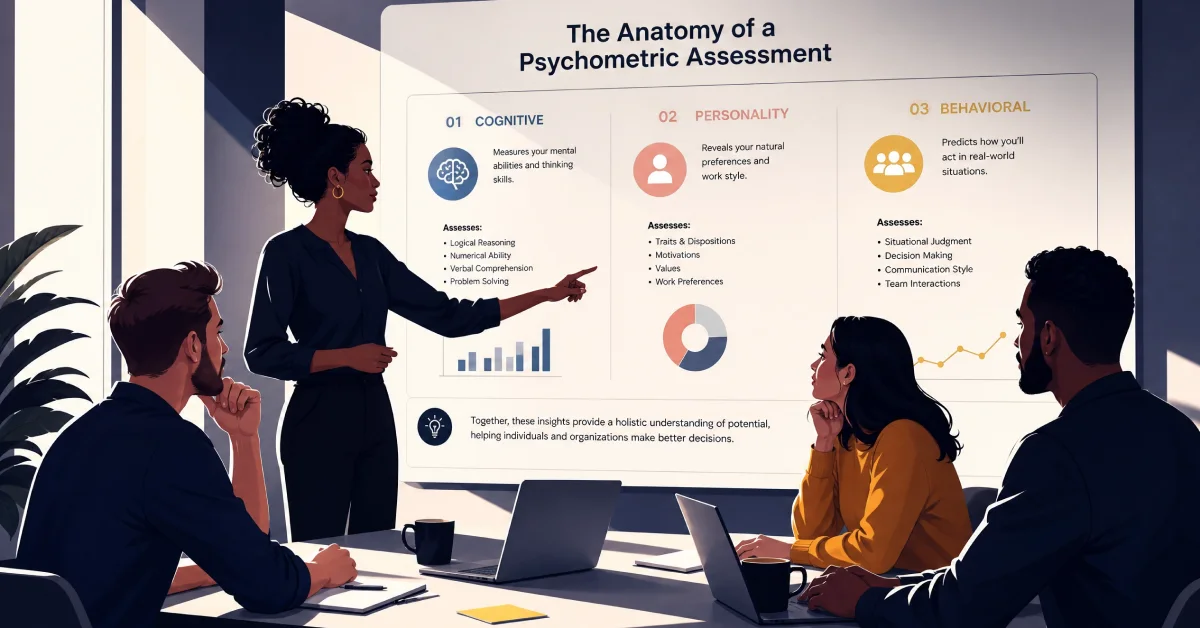
Cognitive assessments can examine reasoning, problem-solving, verbal understanding, or numerical thinking, depending on the role. Personality and behavioral measures explore relatively consistent preferences, such as how someone approaches structure, collaboration, pace, or uncertainty. These are different constructs, so a score in one area should never be presented as a complete description of a candidate.
Skills, motivation, and situational judgment
Skills assessments focus on what a person can do, while motivation measures may explore the conditions that encourage effort and persistence. Situational judgment exercises present realistic workplace choices and examine how candidates prioritize or respond. For frontline hiring, these methods can make the assessment more relevant than abstract questions alone, particularly when the role involves customers, safety, or time pressure.
How assessments differ from resumes and interviews
A resume records experience that candidates choose to present, while an interview captures behavior in a short and socially demanding exchange. A psychometric assessment adds standardized evidence, making candidates easier to compare on defined constructs. Structured evidence improves consistency because every participant receives the same task, instructions, and scoring logic.
When psychometric assessment adds the most value
Assessment is especially useful when hiring at scale, comparing candidates with different educational or employment histories, or filling roles where turnover is costly. It can also help when interviewers disagree or when a resume provides little evidence of job-relevant capability. The value is lower when the test is unrelated to the role, excessively long, or used as a mechanical rejection rule.
Choose the right assessment for the role
There is no universally best psychometric test. The right choice depends on the decisions an employee must make, the skills they need immediately, and the behaviors associated with successful performance. A practical selection process considers scientific quality as well as candidate effort, accessibility, language, and administration. This assessment selection guide is useful as a reminder to consider validity, reliability, usability, and interpretation together.

Matching assessment types to job requirements
Begin with the work rather than the test catalog. A manufacturing role may require attention, reasoning, and safety-related judgment; a customer-facing role may place more weight on communication, emotional regulation, and service behavior. The assessment should sample those demands at an appropriate level of complexity.
|
Job requirement |
Suitable evidence |
Example decision use |
|---|---|---|
|
Numerical reasoning |
Timed or untimed reasoning tasks |
Handling prices, records, or measurements |
|
Customer interaction |
Situational judgment and behavioral measures |
Responding to difficult service moments |
|
Safety and compliance |
Integrity-related and judgment measures |
Following procedures under pressure |
|
Team coordination |
Structured interview and work sample |
Sharing information and resolving issues |
The table is a starting point, not a formula. Employers should confirm that each measure is necessary, understandable to candidates, and supported by evidence relevant to the role.
Selecting tests for entry-level and experienced candidates
Entry-level candidates may have limited work history, so job-relevant reasoning, situational judgment, and foundational skills can provide useful additional evidence. Experienced candidates can be assessed against more complex responsibilities, but years of experience should not automatically replace direct measurement. In both cases, the level and language of the assessment should reflect the actual job rather than an assumed academic background.
Balancing candidate experience with predictive value
Long, repetitive assessments can reduce completion rates without improving the decision. Keep the process focused, tell candidates what will happen, and provide clear instructions and reasonable opportunities to request adjustments. A fair experience is not merely a courtesy; it helps ensure that the score reflects the intended construct rather than confusion or avoidable friction.
When to use one assessment versus a test battery
One well-chosen measure may be sufficient for a narrow decision, especially when the role has a dominant requirement. A battery can be appropriate when success depends on several distinct capabilities, but every added test should have a clear purpose. Combining overlapping measures creates noise, increases candidate burden, and can make results harder to explain.
Build a job-related assessment process
A sound assessment process begins before a candidate opens a test link. Hiring managers, subject-matter experts, and talent professionals should agree on what good performance looks like and how evidence will be collected. This prevents the assessment from becoming a generic filter disconnected from the work. It also creates a defensible record of why each stage exists.
Start with a structured job analysis
Document the tasks, conditions, decisions, and constraints that define the role. Speak with effective employees and supervisors, review performance expectations, and distinguish essential requirements from habits that simply reflect the current team. For high-volume roles, repeat this exercise across locations so local preferences do not quietly become selection criteria.
Define the competencies and outcomes to measure
Translate tasks into observable competencies, then connect them to outcomes such as accuracy, customer service, safe working, or reliable attendance where those outcomes are properly defined. Avoid vague labels such as “culture fit” unless they are broken into behaviors that can be explained and assessed. This step gives the assessment a clear boundary.
Set scoring criteria before reviewing candidates
Decide in advance which results are essential, which are developmental, and how much each source of evidence will contribute. A simple scoring plan reduces the temptation to change standards after seeing a favored candidate. It also makes calibration easier when several recruiters or managers are involved.
A concise process checklist can keep the work consistent:
-
Identify the job tasks and conditions that matter most.
-
Select measures that correspond to those requirements.
-
Define score interpretations and decision rules in advance.
-
Record exceptions, adjustments, and reasons for human review.
After the checklist is agreed, test it with sample cases and ask whether two trained reviewers would reach reasonably similar conclusions. If not, the problem may be the decision rule rather than the assessment itself.
Connect assessment results to the hiring workflow
Decide where the assessment belongs: before screening, after a basic eligibility review, or later alongside an interview or work sample. Candidates should know what the result will be used for and who can access it. In high-volume recruitment, clear workflow ownership matters as much as the test because delayed reviews and inconsistent follow-up can undermine a well-designed process.
Evaluate validity, reliability, and fairness
A polished report is not proof that an assessment is suitable. Employers need evidence that the tool measures its stated construct, produces reasonably consistent results, and supports fair decisions for the population being assessed. These questions matter particularly across India’s varied languages, educational experiences, regions, and workforce contexts. External psychometric testing guidance can provide useful terminology, but the employer still needs to examine fit for its own role and candidates.

What validity means in employee selection
Validity concerns the interpretation and use of scores, not a permanent label attached to a test. Ask whether the measure represents a job-relevant construct and whether evidence supports the decisions being made from it. A test may be useful for one role and inappropriate for another, even within the same organization.
Checking reliability and consistency over time
Reliability asks whether results are sufficiently consistent when the underlying trait or ability has not meaningfully changed. Review internal consistency, test-retest evidence where relevant, scoring consistency, and the effects of administration conditions. Unexplained variation can make a precise-looking score misleading.
Reducing bias and supporting accessibility
Fairness requires more than using the same test for everyone. Review language, reading load, timing, disability access, device requirements, and assumptions built into scenarios. Provide appropriate accommodations and investigate whether a measure creates consistent disadvantages unrelated to the job requirement.
Meeting legal and regulatory expectations
Selection practices should be job-related, documented, consistently administered, and reviewed for potential adverse impact. Keep records of the assessment purpose, validation rationale, scoring rules, accommodations, and human review. Legal obligations vary by jurisdiction, so organizations should obtain qualified local advice rather than treating a generic checklist as legal clearance.
Administer psychometric assessments effectively
Administration can alter what a score means. A candidate who receives unclear instructions, an unstable connection, or an unexpected language barrier is not being assessed under the same conditions as everyone else. Good administration therefore combines standardization with practical support, particularly for remote and high-volume hiring. Candidates should experience the process as purposeful and understandable, not as a hidden test of endurance.
Communicating the purpose and process to candidates
Explain what the assessment measures, how long it should take, what happens after submission, and whether there are practice questions. Avoid promising a job outcome or implying that one score defines a person. Clear communication builds trust and gives candidates a fair chance to demonstrate relevant capability.
Standardizing testing conditions and instructions
Use the same invitation language, time guidance, scoring approach, and technical expectations for comparable candidates. Train administrators to respond consistently to common questions and document material interruptions. Standardization does not mean ignoring genuine access needs; it means making differences deliberate, transparent, and job-related.
Using remote and supervised assessment options
Remote delivery can widen access and support distributed recruitment, but it requires planning for device compatibility, connectivity, privacy, and identity verification. Supervised options may be appropriate for higher-stakes decisions, provided monitoring is proportionate and disclosed. Offer a clear route for technical problems so an avoidable interruption does not become an unexplained low score.
Protecting candidate data and confidentiality
Collect only information needed for the stated hiring purpose, limit access, and set retention periods. Explain how reports are stored and who may review them, especially when external administrators or automated systems are involved. Confidentiality is both a data responsibility and a foundation for candidate confidence.
Interpret psychometric assessment results
Interpretation is where measurement becomes a hiring decision, and it deserves as much care as test selection. Scores need context: the construct measured, the comparison group, the confidence around the result, and the role requirement. A report should guide questions and next steps, not encourage false precision. Human reviewers remain responsible for considering relevant evidence and documenting their reasoning.
Reading scores, benchmarks, and comparison groups
A percentile, standardized score, or band only makes sense against its reference group and scoring method. Ask whether the benchmark reflects the target population and whether the role requires a minimum level, a relative ranking, or a balanced profile. Avoid comparing scores from different instruments as though they share the same scale.
Combining test results with interviews and work samples
Use interviews to explore examples, work samples to observe task performance, and assessments to add standardized evidence about selected constructs. Each method should answer a different question. A structured synthesis is stronger than an informal average because it preserves the meaning and limitations of each source.
Avoiding overreliance on a single score
No assessment captures every factor that affects performance, including training, supervision, resources, and team context. A low result may prompt a targeted review rather than an automatic rejection, while a high result should not excuse missing evidence on an essential requirement. Evidence should be triangulated before a consequential decision is made.
Recognizing unusual, incomplete, or inconsistent results
Flag incomplete sessions, improbable response patterns, technical interruptions, and large contradictions between measures. These signals do not automatically indicate dishonesty or poor ability; they indicate that the result may need verification. Follow a predefined review path, invite clarification where appropriate, and record the final rationale.
Improve hiring outcomes with assessment data
Assessment programs should be evaluated by what happens after hiring, not only by how quickly they produce a shortlist. Track whether scores relate to agreed performance outcomes, retention, training progress, or safety indicators, while respecting privacy and appropriate use. A data-informed hiring approach can strengthen human judgment when the feedback loop is real. Without that loop, even a carefully selected assessment can become routine rather than useful.
Tracking quality of hire and retention
Define quality of hire before launch, using measures such as early performance, successful training completion, manager ratings, or retention at a meaningful interval. Compare outcomes across roles and cohorts rather than relying on anecdotes. Results should be interpreted cautiously because onboarding, management, pay, and local labor conditions also influence retention.
Reviewing adverse impact and candidate completion rates
Monitor progression and completion by relevant demographic and access groups where lawful and appropriate. A sudden drop-off may signal confusing instructions, poor mobile design, timing pressure, or an assessment that is not suitable for the population. Review fairness and candidate experience together rather than treating completion as a purely operational metric.
Validating results against on-the-job performance
Link assessment records to later outcomes using controlled access and a clearly stated purpose. Look for patterns: which measures distinguish stronger performance, which add little beyond the interview, and where false positives or false negatives occur. This local evidence is more useful for future decisions than assuming that a tool behaves identically in every role.
Updating assessments as roles and teams change
Review the process when technology, customer expectations, safety procedures, or team structures change. A measure that was job-related two years ago may no longer reflect the work. At 9 LINKS, validated assessments are described as combining behavioral, cognitive, and integrity signals for role-fit decisions across frontline hiring contexts; any employer using such measures should still review their relevance against current job requirements.
Conclusion
A credible psychometric assessment for hiring is not a shortcut around judgment; it is a structured way to improve the evidence behind judgment. When employers analyze the role, choose suitable measures, administer them fairly, and validate results against real performance, assessments can support clearer decisions and more consistent hiring across diverse teams.
Frequently Asked Questions
What is a psychometric assessment for hiring?
It is a standardized assessment used to measure job-relevant abilities, traits, preferences, skills, or judgment so employers can add structured evidence to selection decisions.
Which psychometric tests are common in recruitment?
Common types include cognitive ability tests, personality questionnaires, behavioral assessments, situational judgment tests, skills tests, and integrity-related measures.
Are psychometric assessments more accurate than interviews?
Neither method is automatically better in every situation. A validated assessment and a structured interview answer different questions, so combining them thoughtfully is usually more informative than relying on either alone.
Should every candidate take the same assessment?
Candidates applying for the same role should generally receive comparable measures and instructions. Adjustments may be needed to provide equitable access, and different roles may require different assessments.
How long should a hiring assessment take?
The assessment should be no longer than necessary to measure the intended requirements. Length depends on the number and complexity of constructs, but unnecessary repetition can reduce completion and candidate goodwill.
Can candidates prepare for psychometric tests?
Candidates can become familiar with common formats and practice managing time. Preparation should not change the underlying job-related construct being measured, and employers should provide clear instructions without coaching answers.
How can employers tell whether an assessment works?
Track completion, fairness indicators, hiring decisions, subsequent performance, training outcomes, and retention. Review those results periodically and update the process when the role or workforce changes.
We Appreciate The Feedback From Our Clients.
It is always a joy to hear how our work has positively impacted them and how our assessments have helped in finding the right people.
We have used 9 LINKS psychometric tool in our Campus Placement Programme.The tool has helped us to identify right candidate as per our organisation requirements…

We have just started using it. It differentiates various personalities and helps in decision making. The clarity on its precision level will be gathered over a period of time…

Counselling test curated for NES has been very useful in identifying the skill sets and allotting appropriate job fitment to students as per their quotients. Multilingual tests developed by considering various key…

It is indeed great pleasure in my part to share complementing note to you & your team. Needless to say 9 LINKS is one of the best organisation to conduct skill gap analysis through assessment of Cognitive skills..

It is crucial that validating the quality of the candidates in recruitment. 9 LINKS is a service that we can confidently say does that. 9 LINKS online assessment precisely giving us the right candidates to pick and proceed on recruitment…

Read Our Blog For The Latest On Research & Insights.
Get Insights into latest developments in HR industry and psychometric assessments.

Take a Free Assessment


