

Key Takeaways
Psychometric assessment for healthcare hiring can add useful evidence when it is tied to real job demands and used alongside human judgment. A fair process is built through careful tool selection, clear communication, and regular review.
- Start with the decisions and behaviors the role requires.
- Select assessments that are relevant to those requirements and appropriate for candidates.
- Explain the process, offer reasonable accommodations, and monitor fairness.
- Interpret scores as one source of evidence, not a verdict about a person.
- Review outcomes and candidate feedback to keep the process useful and consistent.
What psychometric assessments measure in healthcare hiring
Psychometric assessments use structured questions or tasks to measure characteristics relevant to work. In healthcare hiring, they can help employers explore how a candidate reasons, approaches work, or responds to common situations. Their value depends on whether the measures match the position and are interpreted with care. A score can inform a decision, but it cannot capture the whole person or every aspect of performance.
Cognitive ability, personality, and situational judgment
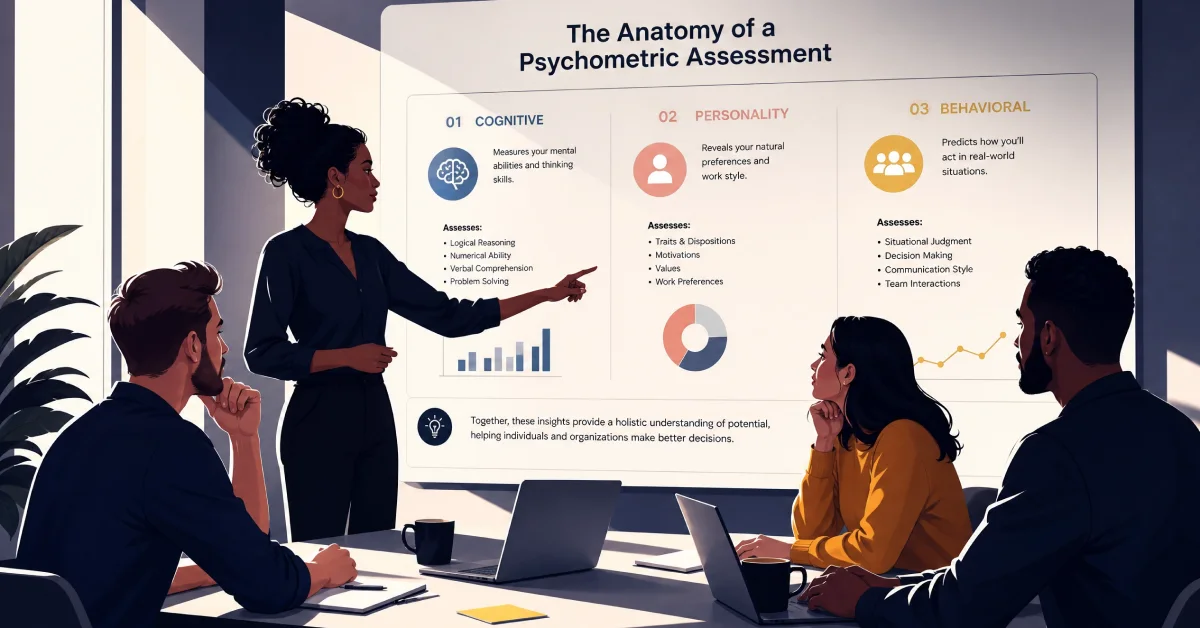
Different assessment formats are designed to examine different things. Cognitive ability tests may look at reasoning or problem-solving, while personality questionnaires explore patterns in preferences and typical behavior. Situational judgment items ask candidates to consider a work scenario and choose or rate possible responses. These formats can provide distinct kinds of information, so employers should be clear about the question each one is meant to answer.
How assessments relate to clinical and nonclinical roles
A clinical role and a healthcare support role can involve very different daily demands. A clinical position may call for careful information processing and sound decisions within the scope of the role, while a support position may put greater emphasis on coordination, service, or reliable task completion. A test should not be selected simply because it is commonly used in healthcare. Employers can use common assessment types as a starting point, then decide which measures actually relate to the job at hand.
What test scores can—and cannot—tell you
Scores summarize responses under particular test conditions; they are not direct observations of future workplace performance. Results may help identify areas to explore, but they do not prove that someone will act a certain way in every setting. A score is evidence, not a verdict. Consider the assessment’s purpose, the candidate’s opportunity to understand the instructions, and the limits of the measure before drawing conclusions.
Why results should complement, not replace, other selection methods
Interviews, references, work samples, and credential checks can each contribute different evidence. Structured psychometric testing may bring consistency to one part of selection, while a well-designed interview can explore experience and a work sample can demonstrate a specific task. Employers looking to combine methods can review guidance on job-related psychometric assessments. The goal is not to let a test make the decision, but to make the overall decision better informed.
Map assessments to role requirements
A useful assessment plan begins before a vendor or test format is chosen. Hiring teams should describe what employees actually do, what decisions they make, and which behaviors matter for effective performance. This is especially important when job titles cover different duties across facilities or teams. The resulting role profile gives the assessment a clear purpose and helps prevent irrelevant criteria from shaping selection.

Identify the decisions and behaviors the job requires
Ask people who understand the work to describe typical tasks, difficult situations, and the consequences of errors or delays. Translate those examples into observable requirements rather than broad labels such as “good fit.” For instance, specify whether the role requires prioritizing routine requests, following a defined process, or communicating changes to colleagues. Concrete requirements make it easier to judge whether a proposed assessment is relevant.
Distinguish essential competencies from preferred traits
Not every desirable quality should become a selection threshold. Separate the capabilities needed to perform the job from preferences that might be helpful but are not essential. If a trait is not tied to work outcomes, using it to screen candidates can add noise and unnecessarily narrow the pool. Make the distinction explicit so assessors do not treat an attractive profile as a substitute for job evidence.
Account for the demands of clinical and support roles
Healthcare teams include roles with different levels of patient contact, decision authority, and task variety. A role analysis should reflect those differences rather than assume that one healthcare profile fits every opening. Employers may also consult healthcare hiring considerations when thinking through judgement, teamwork, and the pressures of care settings. The assessment itself still needs to be judged against the specific duties and context of the position.
Build a consistent assessment plan for each position
A plan should state which requirements are assessed, when each measure is used, and how the evidence will contribute to a decision. For employers hiring at scale, the process needs enough structure to be repeatable while allowing for genuine differences between jobs. 9 LINKS describes its assessments as tailored to specific roles and hiring levels, supporting the principle that an assessment plan should start with the position rather than a generic template. A written plan also helps hiring teams apply the same standards from one candidate to the next.
Choose appropriate assessment tools
The best tool is not necessarily the longest or most sophisticated one. It is the tool that measures a relevant requirement in a dependable way and can be administered fairly to the people applying. Employers should compare the purpose, evidence, accessibility, and data practices of possible assessments before adopting one. A careful review helps avoid paying for measures that do not answer a meaningful hiring question.
Compare ability, personality, and skills-based assessments
Each format offers a different lens, so it helps to compare them by intended use rather than by label alone. The table below outlines common distinctions to consider when matching a measure to a job requirement.
| Assessment type | Main focus | Useful question for employers |
|---|---|---|
| Cognitive ability | Reasoning or problem-solving | Does the role require these capabilities regularly? |
| Personality | Typical preferences or behavioral tendencies | Is the measured pattern relevant to the work? |
| Situational judgment | Responses to work scenarios | Do the scenarios reflect realistic role situations? |
| Skills-based measure | Demonstrated task knowledge or ability | Does the task resemble work candidates will perform? |
No single format answers every question, and combining tests should have a clear rationale. 9 LINKS states that its assessments combine behavioural, cognitive, and integrity signals to help employers evaluate role fit. Employers should still establish which signals are relevant to each position and how they will be weighed alongside other evidence.
Check reliability, validity, and role relevance
Ask whether the tool produces sufficiently consistent results and whether there is evidence that it measures what it claims to measure. Then consider whether that evidence applies to the role, candidate population, and decision being made. A general claim of scientific quality is not enough to show that an assessment is suitable for a particular opening. A practical guide to choosing a psychometric assessment can help structure these questions.
Review accessibility, language, and candidate experience
Instructions should be understandable to the people taking the assessment, and the format should not introduce unnecessary obstacles. Consider the language used, the device or connection required, the time burden, and whether candidates can request an adjustment. A straightforward candidate experience does not mean making a measure less rigorous; it means ensuring that irrelevant friction does not interfere with the intended measurement.
Assess data privacy and vendor practices
Before using a tool, ask what candidate information is collected, who can access it, how long it is retained, and how results are protected. Check whether the vendor explains its data practices in clear terms and supports the organization’s obligations. Limit access to people who need assessment information for the hiring decision, and avoid collecting sensitive details that do not serve a defined purpose.
Use assessments fairly and responsibly
Fairness requires attention at every stage, from selecting a measure to acting on its results. An assessment can appear neutral yet still create barriers if its language, format, or scoring does not fit the role or candidate group. Employers should set up a process that candidates can understand and that hiring teams can apply consistently. Regular review helps identify problems that are not obvious from a test manual alone.

Reduce bias in test selection and administration
Start by checking whether each measure has a clear connection to job requirements. Use consistent instructions and conditions where practical, and avoid adding informal rules that only some candidates encounter. If a candidate needs an explanation of process logistics, provide the same core information to all applicants. Fair administration is not a one-time setup; it depends on repeatable practice.
Provide reasonable accommodations
Candidates may need an adjustment to access an assessment fairly. Employers should make the request process clear and consider reasonable accommodations without assuming that an adjustment changes a candidate’s underlying capability. Practical steps can include:
- Tell candidates how to request an accommodation.
- Ask only for information needed to consider the request.
- Determine whether an adjustment preserves the assessment’s purpose.
- Apply the agreed process consistently and protect candidate privacy.
The right response depends on the assessment and the individual circumstance, so decisions should be made thoughtfully rather than through a blanket rule. Employers should also check applicable requirements and document the process appropriately.
Monitor results across candidate groups
Review whether candidates from different groups experience the process differently and whether selection patterns raise questions that need investigation. A difference in outcomes does not, by itself, explain its cause, but it is a reason to examine the measure, administration, and decision rules. Use appropriate safeguards for any demographic data and follow applicable privacy and employment requirements. Monitoring is most useful when it leads to careful review and corrective action where warranted.
Set clear boundaries for sensitive or clinical conclusions
Employment assessments should not be treated as diagnoses or as substitutes for professional clinical evaluation. Keep interpretation within the stated purpose of the tool and the information it can support. Avoid making assumptions about a candidate’s health, character, or future conduct from a single response pattern. If a report raises a concern, return to job-related evidence and established selection procedures.
Integrate testing into the hiring process
Testing works best when it has a defined place in a broader selection process. Timing, communication, and scoring rules all affect how useful and fair the evidence will be. Employers should choose a point when the assessment can inform a real decision without creating needless effort for candidates. That decision should be made before applications arrive, not improvised for individual applicants.
Decide when candidates should take an assessment
An early assessment may help manage a large applicant pool, but it also asks candidates to invest time before they know whether the role is a realistic fit. A later assessment can reduce that burden, although it may require more interviewer time. Weigh the expected value of the information against candidate effort and hiring capacity. The chosen point should be consistent for candidates applying to the same position.
Explain the purpose and process to candidates
Tell applicants what the assessment is intended to measure, how it fits into selection, and what practical steps they need to take. Explain the expected time and any technical requirements in plain language. Candidates should know whom to contact if they encounter an access problem or need an accommodation. Clear communication supports trust without promising a particular outcome.
Combine scores with interviews and job-relevant evidence
A score is most informative when considered alongside evidence gathered through other relevant methods. A structured interview can ask the same core questions of each candidate, while references or work samples may help clarify specific experience. The combination should be planned in advance so that a strong or weak test result does not arbitrarily outweigh everything else. Keep the focus on evidence linked to the role.
Standardize scoring and decision rules
Before reviewing candidates, decide how each source of evidence will be interpreted and who is responsible for the decision. Use common scoring guidance for interviewers and document any role-specific thresholds with a clear rationale. Avoid changing the rules after seeing an individual candidate’s results. A consistent process makes decisions easier to explain and review.
Interpret results without overrelying on scores
Assessment reports can make complex information easier to discuss, but they do not remove the need for judgment. The hiring team should understand what a result represents and how much confidence it deserves in the context of the role. Reports should prompt focused questions rather than settle the decision on their own. This approach helps employers benefit from structured evidence while recognizing its limits.
Read reports in the context of the role
Begin with the role requirements and the assessment’s stated purpose, then read the report through that lens. A strength that matters in one job may be less important in another, and a lower result may warrant follow-up rather than automatic exclusion. 9 LINKS says its reports turn behavioural, cognitive, and integrity data into clear, actionable hiring insights. Hiring teams should interpret any report in light of the specific job and the rest of the candidate’s evidence.
Consider confidence ranges and measurement limits
A test result is an estimate, not a perfectly precise description of a person. Look for information about measurement error, score ranges, norms, and conditions that can affect interpretation. Small differences between candidates may not be meaningful, particularly when results sit close together. If uncertainty is material, gather another job-relevant source of evidence instead of treating a narrow score gap as decisive.
Resolve conflicting assessment and interview evidence
When an interview impression and assessment result point in different directions, pause before deciding which one to trust. Check whether the interview was structured, whether the candidate had a fair chance to demonstrate the relevant capability, and whether the assessment measured the same requirement. Follow up with consistent questions or a work-related task when appropriate. A disagreement between methods can reveal what still needs to be understood.
Document decisions consistently
Keep a concise record of which evidence was considered, how it related to the role, and why the final decision followed. Use the same documentation standard across candidates, including when the team chooses to override a score or threshold. Records should be factual and limited to information relevant to selection. This makes later reviews more reliable and discourages decisions based on vague impressions.
Evaluate and improve your assessment program
An assessment program should be reviewed after it is put into use, not treated as a permanent fixture. Roles change, candidate populations shift, and the hiring process may evolve in ways that affect a tool’s usefulness. Employers can learn from both hiring outcomes and candidate feedback. Regular review helps ensure that each measure continues to support a fair, role-relevant decision.
Track hiring outcomes and candidate feedback
Choose a small set of indicators that reflect the purpose of the program, such as completion rates, candidate feedback, and relevant post-hire outcomes where suitable data are available. Interpret patterns cautiously; outcomes can be influenced by many factors besides the assessment. Ask candidates whether instructions and access were clear, and note where they experienced avoidable difficulty. This provides practical evidence for improving the process.
Reassess tools as roles and requirements change
When duties, technology, or service expectations change, revisit the role profile and confirm that the assessment still measures something useful. A tool selected for a previous version of a job may no longer fit current requirements. Review the rationale for each measure and remove elements that have become irrelevant. Updates should be communicated to hiring teams before the revised process is used.
Train hiring teams to interpret results
Training should explain the purpose and limits of each measure, how to read reports, and how to combine results with other evidence. It should also cover consistent administration, candidate communication, and appropriate handling of assessment information. Short refreshers can help prevent familiar reports from being treated as self-explanatory. A shared interpretation standard gives decision-makers a common basis for discussion.
Review compliance and process quality regularly
Schedule periodic reviews of tool documentation, accommodations, data access, retention practices, and decision records. Check whether the process is being followed as designed and whether candidates receive consistent treatment. Involve the appropriate legal, privacy, and HR colleagues when questions arise. A clear review cycle helps identify gaps early and keeps the assessment program accountable.
Conclusion
Psychometric assessment for healthcare hiring is most useful when it starts with real role requirements and remains one part of a broader, human-led decision. With relevant tools, fair administration, clear interpretation, and regular review, employers can make selection more consistent without mistaking a score for the whole candidate.
Frequently Asked Questions
What is a psychometric assessment in hiring?
It is a structured measure designed to assess work-related characteristics such as reasoning, behavioral tendencies, or responses to job scenarios. Its usefulness depends on how closely it relates to the role and how responsibly results are interpreted.
Which psychometric tests are used in healthcare hiring?
Employers may consider cognitive ability, personality, situational judgment, or skills-based assessments. The appropriate choice depends on the job requirements and the specific question the employer needs to answer.
Should a psychometric test determine who gets hired?
No. Assessment results should contribute evidence alongside structured interviews, relevant work samples, references, and other appropriate information. A single score should not serve as a complete hiring decision.
How can employers make assessments fairer?
Choose measures linked to the job, use consistent administration and decision rules, explain the process, and provide reasonable accommodations. Employers should also review outcomes and candidate feedback for potential issues.
When should candidates take an assessment?
The timing should balance the value of early information against the time and effort asked of candidates. Set a consistent point in the process for applicants to the same position and explain the reason for it.
What should employers ask an assessment provider?
Ask what the assessment measures, what evidence supports its use, how results should be interpreted, and whether it fits the role. Also review accessibility, data collection, security, retention, and candidate support practices.
How often should an assessment program be reviewed?
Review it regularly and whenever role requirements or hiring processes change. Candidate feedback, completion patterns, and appropriate post-hire indicators can help determine whether tools and procedures remain relevant.
We Appreciate The Feedback From Our Clients.
It is always a joy to hear how our work has positively impacted them and how our assessments have helped in finding the right people.
We have used 9 LINKS psychometric tool in our Campus Placement Programme.The tool has helped us to identify right candidate as per our organisation requirements…

We have just started using it. It differentiates various personalities and helps in decision making. The clarity on its precision level will be gathered over a period of time…

Counselling test curated for NES has been very useful in identifying the skill sets and allotting appropriate job fitment to students as per their quotients. Multilingual tests developed by considering various key…

It is indeed great pleasure in my part to share complementing note to you & your team. Needless to say 9 LINKS is one of the best organisation to conduct skill gap analysis through assessment of Cognitive skills..

It is crucial that validating the quality of the candidates in recruitment. 9 LINKS is a service that we can confidently say does that. 9 LINKS online assessment precisely giving us the right candidates to pick and proceed on recruitment…

Read Our Blog For The Latest On Research & Insights.
Get Insights into latest developments in HR industry and psychometric assessments.


Take a Free Assessment


