

Key Takeaways
Assessments are most useful when they measure capabilities that matter for a specific role and are interpreted alongside other evidence. A fair process also makes the purpose, conditions, and limits of testing clear to candidates.
- Behavioral assessments can describe work preferences, while cognitive assessments examine job-related reasoning and learning.
- Neither type of assessment can determine a candidate’s full potential or guarantee future performance.
- Select tools based on role requirements, evidence of quality, accessibility, and candidate experience.
- Apply consistent criteria and combine results with interviews, work samples, and human judgment.
- Review hiring patterns over time and revisit assessment choices as job requirements change.
What behavioral and cognitive assessments measure
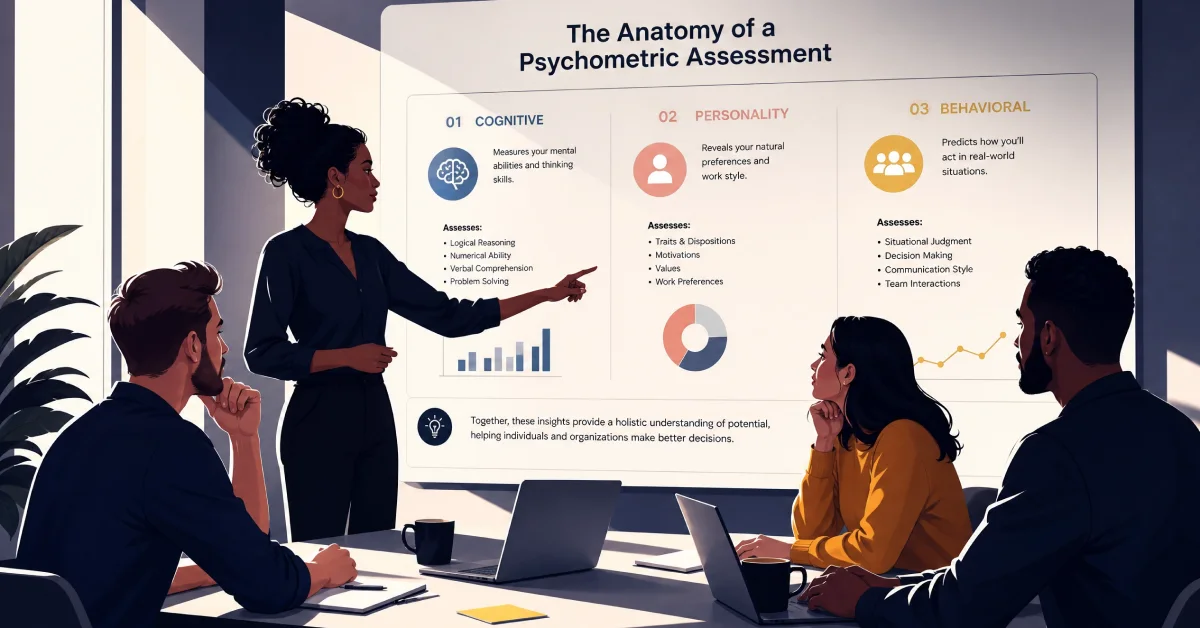
A search for “behavioral and cognitive assessment for hiring India” can lead to tools that sound similar but measure different things. Behavioral assessments describe patterns in how a person may prefer to work; cognitive assessments look at reasoning or learning-related abilities. Neither score is a complete portrait of a candidate. The useful question is whether a measure provides relevant evidence for the work at hand.
Behavioral assessments and work preferences
Behavioral assessments commonly describe tendencies such as how someone approaches collaboration, pace, or structure. These results can help a hiring team develop questions about work preferences, but they should not become fixed labels or assumptions about what a person can do. A candidate who prefers a particular way of working may still adapt to a role’s demands, especially when experience and support are considered.
The aim is to explore fit with real job conditions, not to search for a single ideal personality. For a broader overview of traits and use in recruitment, see this guide to behavioral assessments. A role-specific interpretation is more useful than a generic claim that one profile is universally better.
Cognitive assessments and job-related reasoning
Cognitive assessments may examine reasoning, problem-solving, or the ability to work with new information. Their relevance depends on what the job actually asks someone to do. If a role requires diagnosing problems or learning procedures quickly, a well-matched assessment may add evidence; if the work is primarily governed by established routines, a demanding abstract test may contribute little.
These tests are not all alike, and online quizzes should not be treated as equivalent to validated employment assessments. Readers comparing informal options can review how free IQ tests differ in design and evidence. The point for employers is to ask what a test measures, how it was evaluated, and whether that measure maps to the role.
For employers, this is also why it helps to distinguish cognitive reasoning from learned knowledge and job-specific skill. A test result should answer a defined hiring question, not stand in for every capability the job requires.
What these assessments can—and cannot—predict
Assessment results can contribute to a reasoned estimate of how a candidate may approach parts of a job, but they do not guarantee performance, retention, or success. Outcomes also depend on training, supervision, working conditions, team practices, and the candidate’s experience. For a balanced discussion of how different test types compare, see this overview of behavioral and cognitive assessments.
Use results as one piece of evidence rather than a verdict. A score should not be used to infer motivation, integrity, or future conduct unless the assessment was designed and supported for that purpose. Human skills such as judgment and adaptability also matter in changing roles; this discussion of career resilience offers a useful reminder that no single capability guarantees job security.
How assessment results complement interviews and work samples
Interviews and work samples show different kinds of evidence. A structured interview can explore examples from a candidate’s experience, while a work sample lets the candidate demonstrate a task that resembles the job. An assessment can add a more standardized measure, but it cannot replace direct evidence of relevant skills.
For Indian employers considering pre-employment tests, this guide to role-relevant assessments discusses combining assessment results with interviews and human judgment. In practice, the best approach is often to ask the same core questions of candidates, use realistic work evidence where possible, and interpret test results against defined job requirements.
When to use assessments in the hiring process
An assessment is worth adding when it answers a hiring question that other methods do not answer as clearly. It can make a process more consistent, but every extra step also takes a candidate’s time and may affect completion rates. Consider the work itself, the number of candidates, and the decision the hiring team needs to make. A test should earn its place in the process.

Roles that may benefit from behavioral insights
Behavioral information may be useful when the role depends on repeated interactions, coordination, or working within a particular operating environment. That can include frontline positions in healthcare, hospitality, manufacturing, BFSI, and IT, though the relevant behaviors will differ across jobs. A hiring team should define the actual demands—for instance, frequent customer contact or close coordination across shifts—before deciding whether a behavioral assessment adds value.
The purpose is not to select people who all behave in the same way. Instead, the assessment may give interviewers a basis for exploring how a candidate approaches situations that arise in the role. Answers still need to be considered alongside experience, skills, and other job evidence.
Roles where cognitive testing may add value
Cognitive testing may add value where reasoning through unfamiliar problems, learning processes, or interpreting information is central to the work. The test should reflect the level and kind of reasoning the job needs, not simply be difficult. For specialist technical roles, for example, cognitive evidence may sit alongside a realistic technical exercise and a structured interview rather than replace either one.
Choosing assessments for entry-level and experienced candidates
For entry-level hiring, candidates may have limited work histories to discuss, so job-related assessments can provide an additional, comparable source of evidence. They should not become a proxy for educational access or familiarity with test formats. For experienced applicants, assessments can complement a record of accomplishments, but the hiring team should still examine how those accomplishments relate to the role now being filled.
The balance may differ by seniority, but the standard should remain consistent: measure a capability only when it matters to the job. Keep the process proportionate, and explain to candidates how results will be considered.
Situations where testing may create unnecessary friction
Testing can create unnecessary friction when the assessment is long, poorly matched to the job, difficult to access, or scheduled before a candidate understands the process. It can also be a poor choice when the hiring decision is already supported by stronger, directly relevant evidence. Before adding a test, ask whether it could change the decision in a defensible way.
A short review can help teams decide whether to proceed:
- Identify the specific job requirement the test is intended to measure.
- Check whether another hiring step already provides that evidence.
- Estimate the time and access demands placed on candidates.
- Decide how the result will inform the decision before inviting applicants.
If the team cannot explain why the assessment is needed, candidates are likely to see it as an arbitrary hurdle. Removing an unnecessary step can make a process clearer without weakening the quality of the decision.
How to choose an assessment for hiring in India
Employers hiring across India may encounter differences in language, education, access to devices, and familiarity with formal testing. Those realities make tool selection more than a procurement decision: it is part of designing a fair, usable hiring process. A useful assessment has a clear connection to job requirements and evidence that supports its intended use. It should also be understandable to both candidates and the people interpreting the results.
Match the test to the role’s essential requirements
Start with the work, not the vendor’s catalogue. Identify essential tasks and the capabilities needed to perform them, then check whether the assessment measures one of those capabilities. When employers use a tool across different roles, they should confirm that its interpretation still makes sense for each role rather than assuming one score means the same thing everywhere.
For a practical overview of test selection and fair use, explore employment assessments in India. The guide can help frame questions about role relevance, accessibility, and how to combine scores with other evidence. A sound match should be explainable in plain language: what the test measures, why it matters, and how it will affect the hiring decision.
Check reliability, validity, and evidence of fairness
Reliability concerns whether a measure produces sufficiently consistent results; validity concerns whether the evidence supports the intended interpretation and use. Employers should ask what research or evaluation supports a test for the relevant purpose and population, and whether it has been reviewed for fairness. A polished report is not itself proof that an assessment is dependable.
A side-by-side review can keep vendor discussions focused on decision quality:
| Question | What to look for | Why it matters |
|---|---|---|
| What does the assessment measure? | A clear description tied to job requirements | Prevents using a score to answer a different question |
| What evidence supports its use? | Documentation on reliability and validity | Helps assess whether interpretations are defensible |
| How is fairness considered? | Information on evaluation and potential disparities | Signals whether impact is being examined |
| How will results be reported? | Explanations that hiring teams can understand | Reduces overinterpretation of scores |
Use the answers to determine whether the evidence is relevant to your own hiring context, not just whether a vendor can provide technical terms. If information is missing, ask for clarification before making the tool part of a selection process.
Evaluate language, accessibility, and candidate experience
Candidates should be able to understand the instructions and complete an assessment under reasonable conditions. Ask which languages are supported, whether accommodations are possible, and what device or connectivity assumptions the assessment makes. A test that measures language proficiency may be appropriate for a role where that skill is essential; it may be misleading if language is incidental to the work.
Candidate experience includes more than the test itself. Clear instructions, a realistic time estimate, and a way to ask for help can make the process more transparent. A general-interest travel guide such as activities in Lisbon is not hiring evidence, but it illustrates why content intended for a broad audience should not be confused with a role-specific measure; assessment content needs a clear purpose and context.
Ask vendors about data handling and reporting
Before using an assessment, ask what candidate information is collected, how it is used, who can access it, how long it is retained, and whether it is shared. Also establish what reports show, who can interpret them, and how hiring teams should handle uncertainty. A privacy notice can illustrate the kinds of issues to examine; this privacy notice example concerns a healthcare provider and is not a hiring-assessment standard.
Other online services raise questions about consent and handling of personal material too, including AI video workflows. That is a different context, but the practical point carries across: understand what data a tool uses and make the process clear to the person providing it. For hiring, vendors should answer these questions in relation to the specific assessment and deployment.
How to use assessments fairly and responsibly
Fair use begins before the first candidate takes a test. Hiring teams need a consistent reason for including an assessment, comparable conditions for candidates, and a clear plan for interpreting results. In India, a diverse candidate pool may have different language and access needs, so a process that appears uniform on paper can still create avoidable barriers. Regular review helps teams spot where the process needs adjustment.

Apply consistent criteria across candidates
Set the assessment, instructions, timing, and decision criteria in advance, and apply them consistently to candidates for the same role. If an adjustment is needed, record the reason and ensure it supports a fair opportunity to demonstrate the relevant capability. Consistency does not mean ignoring individual access needs; it means making decisions through a transparent and repeatable process.
Review local employment and data-protection requirements
Before collecting or using assessment data, check the employment and data-protection requirements that apply to the organization and the hiring context. Clarify who is responsible for access, retention, security, and responding to candidate questions. This article offers general guidance, not legal advice, so organizations should seek appropriate local review when setting policy or handling sensitive information.
Consider regional, language, and accessibility differences
Language, disability, device access, and connectivity can affect a candidate’s ability to complete an assessment, even when they do not affect performance in the role. Employers should check whether instructions are understandable, provide an appropriate way to request accommodations, and avoid making assumptions about a person’s ability based on where they live or what language they use. When language is a genuine job requirement, evaluate it directly and transparently.
Avoid treating scores as a standalone hiring decision
A score is a piece of evidence, not a complete account of a person. Consider it with interviews, work samples, relevant experience, and the conditions under which the candidate completed the assessment. For additional guidance on fair cognitive testing, review how job relevance, accommodations, and other evidence should inform interpretation.
The hiring team should be able to explain why a result matters for the role and what other evidence it considered. That discipline helps prevent a numerical result from acquiring more authority than the tool’s evidence supports.
How to build assessments into your hiring workflow
Assessment design is only part of the work; the steps around it shape whether results are useful. Decide where testing fits, what a result can change, and who will review it. Keep the candidate journey understandable and avoid creating a test step simply because a platform makes one available. For organizations hiring at volume, a well-defined process can support consistency without removing human review.
Decide when candidates should take each assessment
The right point depends on the time required, the role, and the amount of information already available. A short, relevant assessment may be used earlier to help manage a large applicant pool, while a more involved exercise may be better reserved for candidates who have passed initial criteria. Whichever sequence you choose, explain it and monitor whether it creates unnecessary drop-off.
Set role-specific scoring criteria before testing
Define how the assessment will contribute to a decision before candidates take it. Specify which results are relevant, how they will be weighed with other evidence, and what would prompt a closer review. Avoid changing the standard after seeing a particular candidate’s score; that makes outcomes harder to compare and explain.
Train recruiters and hiring managers to interpret results
Those reviewing results need to understand what the assessment measures, what it does not measure, and how much confidence to place in an interpretation. Training should cover the possibility of context effects and the danger of turning a result into a broad judgment about someone’s character. With 9 LINKS, the documented offering is validated, AI-enabled psychometric assessments for hiring India’s frontline workforce, combining behavioral, cognitive, and integrity signals to help employers evaluate role fit.
A report should guide useful follow-up questions rather than replace the hiring team’s judgment. Recruiters and managers can use it to probe relevant examples, then compare those examples with the role’s requirements and the other evidence collected.
Explain the purpose and process to candidates
Tell candidates why the assessment is included, what kind of activity to expect, how long it may take, and how results will be used. Give practical information about access, accommodations, and whom to contact with questions. Straightforward communication respects a candidate’s time and helps reduce confusion about what a score means.
How to interpret results and improve hiring decisions
Assessment programs need review after launch, not just approval before launch. Hiring teams can examine whether the evidence they collect is actually helping them make clearer decisions, while also checking for gaps or uneven outcomes. No single hire or score establishes that a tool works well. Over time, patterns can help organizations decide whether to retain, adjust, or stop using an assessment.
Combine scores with structured interviews and job evidence
Use the assessment to inform, not dictate, a broader evaluation. Compare its implications with structured interview responses, relevant work samples, and experience tied to the role. If those sources point in different directions, explore the discrepancy with job-related questions rather than simply choosing the most convenient result.
For organizations considering 9 LINKS, the documented scope is validated, AI-enabled psychometric assessments that combine behavioral, cognitive, and integrity signals for evaluating role fit. As with any assessment, hiring teams should interpret the available signals alongside other relevant evidence, not as a substitute for it.
Investigate mismatches without relying on stereotypes
A result that does not seem to fit a candidate’s interview or work sample is a reason to ask a better question, not to make an assumption. Check whether instructions were understood, whether the test conditions were suitable, and whether the assessment measures something that matters to the job. Then seek job-relevant evidence through a consistent follow-up process.
Do not explain a mismatch by guessing about a candidate’s background, personality, or motivation. That approach adds speculation instead of information and can reproduce the very inconsistency assessments are meant to reduce.
Track candidate outcomes and selection patterns
Organizations can review completion rates, candidate feedback, selection patterns, and later job-related outcomes, while taking care not to treat correlation as proof of cause. Look for differences across stages and groups, and consider whether they might reflect test design, access, instructions, or unrelated features of the hiring process. Any review should follow applicable privacy and data-protection requirements.
These checks are most useful when they lead to a concrete decision: retain the tool, modify the process, gather more evidence, or discontinue use. Record the reasoning so that future reviews can build on it.
Reassess tools as roles and business needs change
Jobs evolve. A measure that matched a role several years ago may no longer reflect its essential tasks, and a hiring process may change as workforce needs shift. Revisit the job requirements and assessment evidence periodically, especially when responsibilities, candidate populations, or operating conditions change.
With 9 LINKS, the stated focus is validated, AI-enabled psychometric assessments for hiring India’s frontline workforce. Employers should still review whether any tool they use—including one with a defined role-fit purpose—continues to match current requirements and supports fair, informed decisions.
Conclusion
Behavioral and cognitive assessments can add structure to hiring in India when they answer a specific, job-related question. Their value depends on careful selection, accessible and consistent use, and interpretation alongside interviews and work evidence. Treat scores as one input, explain the process to candidates, and revisit the evidence as roles change.
Frequently Asked Questions
What is the difference between a behavioral and a cognitive assessment?
A behavioral assessment describes work-related tendencies or preferences, while a cognitive assessment examines reasoning or other thinking-related abilities. Each can inform a different hiring question, depending on the job.
Should every candidate take a behavioral and cognitive assessment?
No. Use an assessment only when it measures a capability that matters to the role and adds useful evidence to the selection process. Unnecessary testing can create friction without improving a decision.
Are assessment scores a reliable way to predict job performance?
Scores may contribute evidence, but they cannot guarantee performance or retention. Their usefulness depends on the test’s quality, its fit with the role, and how results are interpreted with other information.
When should candidates take an assessment during hiring?
Timing depends on the length and purpose of the assessment and what the hiring team already knows. Explain the sequence to candidates and check that the timing does not create avoidable barriers.
How can employers make assessments fairer?
Use job-relevant tools, consistent criteria, clear instructions, and reasonable accommodations. Review candidate experience and selection patterns, and avoid relying on a score as the sole basis for a decision.
What should employers ask an assessment provider?
Ask what the assessment measures, what evidence supports its use, how fairness and accessibility are considered, and how candidate data is handled. Also clarify how reports should be interpreted and used.
Should assessment results be shared with candidates?
Employers should explain how results are used and what role they play in the decision. Any additional sharing should follow the organization’s policies and applicable privacy requirements, with communication that is clear and respectful.
We Appreciate The Feedback From Our Clients.
It is always a joy to hear how our work has positively impacted them and how our assessments have helped in finding the right people.
We have used 9 LINKS psychometric tool in our Campus Placement Programme.The tool has helped us to identify right candidate as per our organisation requirements…

We have just started using it. It differentiates various personalities and helps in decision making. The clarity on its precision level will be gathered over a period of time…

Counselling test curated for NES has been very useful in identifying the skill sets and allotting appropriate job fitment to students as per their quotients. Multilingual tests developed by considering various key…

It is indeed great pleasure in my part to share complementing note to you & your team. Needless to say 9 LINKS is one of the best organisation to conduct skill gap analysis through assessment of Cognitive skills..

It is crucial that validating the quality of the candidates in recruitment. 9 LINKS is a service that we can confidently say does that. 9 LINKS online assessment precisely giving us the right candidates to pick and proceed on recruitment…

Read Our Blog For The Latest On Research & Insights.
Get Insights into latest developments in HR industry and psychometric assessments.

Take a Free Assessment


