

Key Takeaways
A cognitive assessment can add useful evidence to hiring, but only when it is relevant to the role and interpreted alongside other information.
- Match the test to tasks and decisions the role actually involves.
- Treat results as one source of evidence, not a verdict on a candidate.
- Use clear instructions, consistent conditions, and reasonable access support.
- Combine test scores with structured interviews and job-related evidence.
- Review outcomes and fairness over time, then adjust the process when roles change.
What a cognitive ability test measures
A cognitive ability test samples how a person works with information, reasons through problems, or learns unfamiliar material. The exact abilities and question formats vary by assessment, so the label alone does not tell an employer what a test measures. For hiring in India, the useful question is whether the tasks reflect demands candidates will encounter in the job.
Core abilities assessed, from reasoning to problem-solving
Assessments may examine numerical, verbal, logical, or deductive reasoning, among other abilities. Some focus on interpreting information quickly; others ask candidates to identify patterns or reach a conclusion from rules and evidence. 9 LINKS cognitive ability tests, for example, are described as assessing numerical and verbal aptitude, reasoning, memory, attention, and processing skills. Employers should check which of these are actually included before connecting a score to a role.
A useful test is not simply one that feels challenging. Its content should provide evidence about thinking tasks that occur on the job, such as understanding instructions or comparing information. A cognitive assessment fairness guide can help hiring teams think through relevance, score interpretation, and access alongside the test itself.
How cognitive tests differ from personality and skills assessments
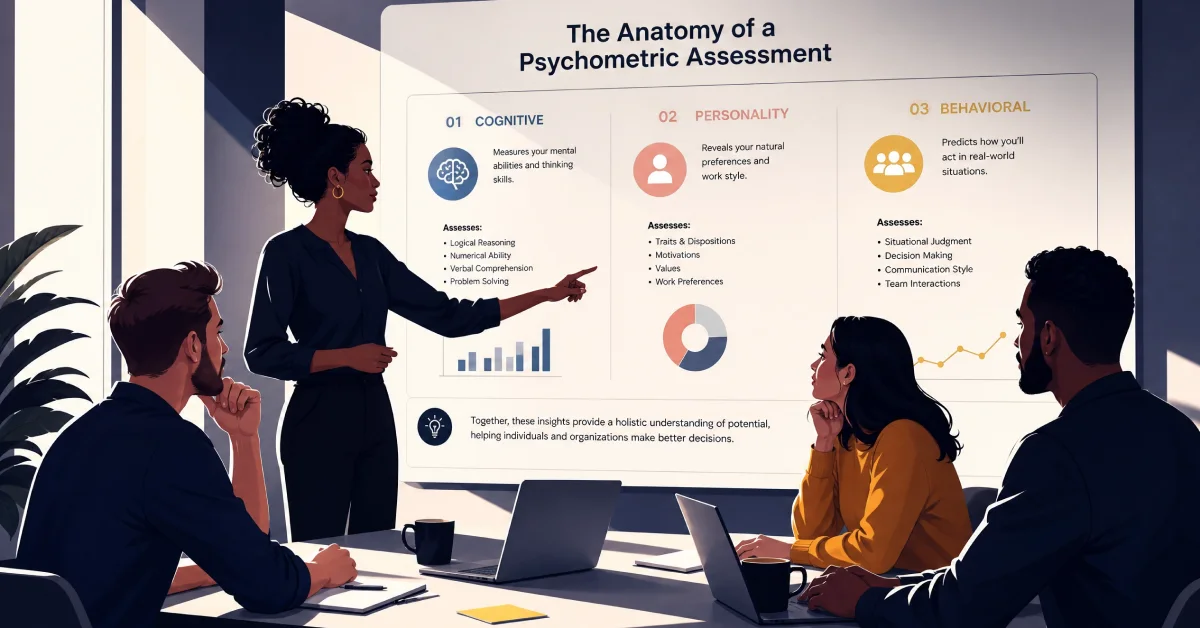
A cognitive test focuses on abilities involved in processing information and reasoning. A skills assessment asks whether someone can perform a particular task, while a personality assessment concerns typical patterns of behaviour or preference. These measures can complement one another, but they answer different questions and should not be treated as interchangeable.
For instance, a candidate may reason well but still need training in a specific system, or may have the required technical skill without that skill revealing how they approach unfamiliar problems. The distinction is similar to separating a reasoning measure from a domain-specific activity: a chess computer is associated with a particular game context, not a general measure of workplace capability. Keep test interpretation tied to the construct it was designed to assess.
What test scores can—and cannot—tell you about a candidate
A score offers a bounded piece of evidence about performance on a particular assessment under particular conditions. It does not, on its own, establish motivation, integrity, experience, communication style, or future performance in every workplace situation. Context matters as much as the score: the role, test design, candidate conditions, and other evidence all shape what a result can reasonably support.
For that reason, employers should avoid turning small score differences into confident rankings unless the test documentation and hiring design justify that interpretation. A cognitive ability testing overview discusses why employers consider these assessments, but any claimed value should be checked against the evidence and the requirements of the actual role. The hiring decision remains a judgement based on multiple relevant sources.
Why employers use cognitive tests in India
Employers recruiting at scale may need a consistent way to gather evidence before interviews or practical exercises. In India, roles and candidate populations can vary widely by location, language, experience, and access to technology, so a test needs to fit the hiring context rather than simply add another screening step. A cognitive ability test for hiring India can be useful when it measures abilities that matter for the work and is applied thoughtfully.

Roles and hiring stages where testing may add value
A test may help when a role regularly requires reasoning, interpreting information, or learning procedures, and when those demands are difficult to assess consistently from applications alone. It can be considered for high-volume hiring as one part of an early screen, or later as an additional source of evidence for shortlisted candidates. For example, 9 LINKS online cognitive ability test describes numerical, verbal, logical, and deductive reasoning as areas it measures for hiring in India.
The right stage depends on the burden placed on candidates and the value of the information for the decision. A short, clearly explained assessment may be reasonable when the role has a genuine need for the abilities measured; it is less defensible when it adds friction without changing what the employer learns. Test only where the role provides a sound reason to do so.
Potential benefits for consistency and predicting job performance
A common assessment can give candidates a more consistent opportunity to demonstrate selected abilities than an unstructured conversation alone. It may also provide evidence that is easier to compare when all candidates receive the same instructions and scoring approach. Those advantages are conditional: the assessment must be relevant, dependable, and interpreted within the limits of its evidence.
The table below shows how an employer can connect a possible benefit to a practical check rather than assuming that a test automatically improves hiring.
| Possible contribution | What to check | Practical use |
|---|---|---|
| Consistent evidence | Candidates receive comparable conditions | Apply the same process to the same role |
| Earlier insight | The ability is relevant to the work | Use results to guide further review |
| Better-informed decisions | Scores are supported by documentation | Combine them with other job evidence |
A result can make a decision more structured, but it cannot make the decision fair or accurate by itself. Employers should be cautious about general claims of predictive power and examine evidence that fits the test, job, and candidate population in question.
Risks of relying on test scores without other evidence
A score may reflect test familiarity, language demands, device access, or the testing environment as well as the intended ability. If a threshold is chosen without a job-based rationale, a screening tool can exclude candidates for reasons that are not central to successful performance. It may also narrow a hiring decision too early and overlook experience, practical skill, or a candidate’s capacity to learn.
Privacy and relevance deserve attention too. Employers should clarify what candidate data is collected, who can access it, and how it is used; a restraining order guide addresses a different employment-related issue and should not be mistaken for assessment guidance. Likewise, a privacy page such as Ioannis Finest illustrates a data-policy context, not a standard for hiring tests. Keep the assessment’s own data practices and applicable obligations under review.
How to choose a suitable test
Selection starts with the work, not a vendor catalogue. Identify the decisions the assessment should inform and the specific abilities required, then compare tests against those needs. This prevents a familiar or fashionable tool from becoming a substitute for defining what good performance means in a role.
Match test content and difficulty to the role
Translate the job into observable demands before selecting questions or score reports. A test intended to assess reasoning should not be used as a proxy for unrelated qualities such as dependability or interpersonal warmth. Compare the test’s content and difficulty with the actual responsibilities, level, and training expectations of the position.
A practical selection check can keep the discussion grounded in the role:
- Identify tasks that require the ability being measured.
- Decide what evidence the assessment should contribute to the hiring decision.
- Check that difficulty is suitable for the role and candidate population.
- Remove test content that does not have a clear job-related purpose.
These checks help distinguish a valid use case from simply adding another hurdle. A general collection of AI tools for leaders, for example, is not itself evidence that a particular hiring assessment measures a role requirement. Evaluate each instrument for the purpose you intend to use it.
Check language, accessibility, and candidate experience
An assessment’s language and format can affect who is able to show their ability. Consider whether instructions are understandable to the intended candidates, whether the device and connection requirements are realistic, and whether candidates can request an appropriate adjustment. A candidate experience that is confusing or unnecessarily burdensome can undermine both participation and the quality of the evidence gathered.
Give candidates clear notice of the expected time, format, and support channel. Where relevant, review whether examples or wording introduce unnecessary cultural or language familiarity demands. These details are not cosmetic; they shape whether the test is measuring the intended ability under reasonably consistent conditions.
Review reliability, validity, and vendor documentation
Ask for documentation explaining what the test measures, how scores are produced, and what evidence supports the intended use. Reliability concerns consistency of measurement; validity concerns whether the evidence supports the interpretation and decision being made. Neither can be inferred from polished reports or automated delivery alone.
Documentation should also explain appropriate score interpretation, limits, and any relevant validation evidence for the population and role context. If an assessment uses AI in its delivery or analysis, understand where it is used and how people review decisions; general discussions of AI hiring assessments can help frame those questions without replacing vendor-specific evidence. Choose a test only when its evidence and limitations are clear enough for responsible use.
How to use test results fairly
Fair use is a process, not a property a test can claim in isolation. Employers need to consider how candidates encounter the assessment, how results are interpreted, and what other evidence affects the final decision. Clear criteria and consistent application reduce avoidable variation while leaving room to review individual circumstances.

Set consistent testing conditions and clear instructions
Candidates should receive the same essential instructions, timing rules, and information about what to expect for the same role. Explain how to begin, what to do if a technical problem occurs, and whom to contact for help. Consistent conditions make score comparisons more meaningful, although they do not remove every difference in candidates’ circumstances.
A hiring team can make consistency more concrete by documenting the process before assessments begin. Record approved instructions and timing, train administrators, and establish a route for reporting disruptions. If conditions differ materially, pause before comparing results as though they were produced in the same way.
Consider accommodations and candidates’ access needs
A fair process anticipates that candidates may need different forms of access support. Employers should offer a clear way to request accommodations and consider whether the format creates barriers unrelated to the ability being assessed. The appropriate response depends on the assessment and role, so teams should seek suitable guidance rather than applying a one-size-fits-all rule.
When reviewing access, consider practical conditions that can affect participation:
- Whether candidates can use an appropriate device and connection.
- Whether instructions and test language are understandable to the intended group.
- Whether there is a process for requesting adjustments or reporting interruptions.
- Whether the assessment format creates barriers unrelated to the job requirement.
These steps support a more interpretable result; they do not mean every candidate must experience identical circumstances in every detail. The goal is to preserve the assessment’s purpose while giving people a reasonable opportunity to demonstrate the relevant ability.
Combine scores with structured interviews and job-related evidence
Use test results alongside evidence that captures other aspects of the role, such as structured interview responses, relevant experience, or a work sample. Ask candidates the same core questions and use defined criteria so that interview impressions do not quietly override the assessment—or the reverse. A guide to candidate assessment offers a broader hiring-process perspective on structured evidence and consistent scoring.
For Indian employers, 9 LINKS assessments are described in the brand context as combining behavioural, cognitive, and integrity signals to help evaluate role fit. That is one source of information, not a replacement for employer review or job-related evidence. Make the decision by considering what each source contributes and where its limits lie.
How to implement testing in your hiring process
Implementation works best when the assessment has a defined purpose, a place in the process, and an owner responsible for consistent use. Before launch, map the candidate journey from invitation through decision and check that the test does not duplicate other steps without adding useful evidence. A small, documented process is easier to review and improve than an informal practice that varies by hiring manager.
Decide when candidates will take the assessment
The right timing depends on how the result will inform the next decision. An early assessment may help manage a large applicant pool, but it can also create unnecessary effort for candidates who are not yet being seriously considered. A later stage can reduce that burden, while still giving the team time to use the result alongside interviews or practical exercises.
Choose a point where the assessment answers a real question and communicate that choice to candidates. Consider completion time, accessibility, and the likelihood of technical support being available. The test should fit the process rather than dictate it.
Set score thresholds using role requirements, not guesswork
A cut score should be supported by a clear rationale connected to the role and the assessment’s evidence. Avoid selecting a threshold simply because it produces a convenient number of candidates or because a vendor recommends it without context. Review whether the threshold is appropriate for the intended decision and whether other evidence can address uncertainty around borderline results.
Keep a record of how the threshold was selected and who approved it. If hiring outcomes or job requirements change, revisit that rationale instead of carrying a historical number forward automatically. Scores are only useful when the decision rule behind them is defensible.
Communicate the purpose, process, and use of results
Tell candidates why an assessment is part of the process, what it will involve, and how results contribute to a decision. Avoid implying that a single score determines whether someone is suitable. Clear information can reduce confusion and help candidates prepare to take the test under the intended conditions.
Also explain the practical points candidates need: timing, format, support for access needs, and whom to contact about technical difficulties. If data is collected or retained, provide the relevant information through the appropriate channels. Transparency is part of a credible hiring experience, not an afterthought.
How to evaluate and improve your approach
A testing process should be reviewed using evidence from both the candidate journey and later hiring outcomes. No single metric can establish that an assessment is fair or useful, but patterns can flag issues that deserve investigation. Assign responsibility for review and set a reasonable cadence so that the process does not remain unchanged as roles evolve.
Track outcomes such as completion rates and hiring performance
Track whether candidates complete the assessment, how long the process takes, and where candidates report difficulties. Where the data is available and appropriate, examine how assessment results relate to later job-relevant outcomes. Interpret those patterns carefully: small samples, changes in supervision, and differences in training can all affect what the numbers appear to show.
A useful review asks whether the test added information that improved the decision, not simply whether it produced a score. Combine quantitative review with feedback from recruiters, hiring managers, and candidates. That can reveal friction that a completion rate alone would miss.
Review results for potential adverse impact
Check whether the process appears to affect groups differently, using appropriate data, safeguards, and expert guidance. A difference in outcomes is a reason to investigate the assessment and its administration; it is not, by itself, an explanation of cause. Look at whether the test measures a genuine job requirement, whether access conditions were comparable, and whether score thresholds are justified.
Review the full process as well as the assessment. Interview practices, timing, candidate communications, and technical requirements may all contribute to patterns. Document findings and changes so that future reviews can assess whether the response helped.
Reassess the test and process as roles and requirements change
Jobs change, and a test selected for one version of a role may no longer fit after responsibilities, tools, or training expectations shift. Revisit the assessment’s content and use when the job changes, when candidate feedback signals a problem, or when the evidence no longer supports the same decision. Keep documentation current and involve the people who understand the work.
For broader comparison, pre-employment assessment software guidance can help employers think about role fit, vendor evaluation, and responsible use. Use such guidance as a prompt for review rather than a substitute for the evidence specific to your own test and process. Improvement is ongoing: retain what is useful, correct what creates barriers, and stop using measures that no longer serve a clear purpose.
Conclusion
A cognitive ability test can contribute useful evidence when it reflects real job demands, is supported by suitable documentation, and is applied consistently. Employers in India can make the process more thoughtful by explaining its purpose, considering access, and combining results with structured interviews and other job-related evidence. The aim is not to let a score make the decision, but to make a better-informed decision with evidence that fits the role.
Frequently Asked Questions
What does a cognitive ability test measure?
It measures selected abilities involved in reasoning and working with information, such as numerical, verbal, or logical reasoning. The specific abilities depend on the test.
Are cognitive ability tests the same as skills tests?
No. Cognitive tests assess selected reasoning or information-processing abilities, while skills tests typically assess the ability to perform a specific task. They can provide complementary evidence.
When should employers use a cognitive test?
Use one when the role requires the abilities being measured and the results will inform a defined hiring decision. Avoid adding a test that has no clear job-related purpose.
Should a test score decide who gets hired?
No. A score should be interpreted as one source of evidence and considered alongside structured interviews, experience, work samples, or other relevant information.
How can employers make testing more accessible?
Provide clear instructions, consider language and technology requirements, offer a way to request accommodations, and address technical problems consistently.
How should employers set a score threshold?
Base it on role requirements and relevant test evidence, document the rationale, and review it when the role or hiring process changes. Avoid choosing a threshold for convenience alone.
How often should an employer review its assessment process?
Review it periodically and whenever role requirements, candidate feedback, or outcome patterns suggest the existing approach may no longer be suitable.
We Appreciate The Feedback From Our Clients.
It is always a joy to hear how our work has positively impacted them and how our assessments have helped in finding the right people.
We have used 9 LINKS psychometric tool in our Campus Placement Programme.The tool has helped us to identify right candidate as per our organisation requirements…

We have just started using it. It differentiates various personalities and helps in decision making. The clarity on its precision level will be gathered over a period of time…

Counselling test curated for NES has been very useful in identifying the skill sets and allotting appropriate job fitment to students as per their quotients. Multilingual tests developed by considering various key…

It is indeed great pleasure in my part to share complementing note to you & your team. Needless to say 9 LINKS is one of the best organisation to conduct skill gap analysis through assessment of Cognitive skills..

It is crucial that validating the quality of the candidates in recruitment. 9 LINKS is a service that we can confidently say does that. 9 LINKS online assessment precisely giving us the right candidates to pick and proceed on recruitment…

Read Our Blog For The Latest On Research & Insights.
Get Insights into latest developments in HR industry and psychometric assessments.


Take a Free Assessment


