

Key Takeaways
AI can add useful evidence to employee selection, but only when assessments are tied to real job requirements and interpreted responsibly. For employers hiring at scale in India, a clear process matters as much as the assessment itself.
- Choose measures that reflect the skills and behaviours a role requires.
- Use assessment results alongside structured interviews and other relevant evidence.
- Check fairness, accessibility, privacy, and candidate communication throughout the process.
- Evaluate providers for validation, security, support, and fit with your hiring workflow.
- Pilot assessments and keep monitoring outcomes after implementation.
What AI employee selection assessment involves
An AI employee selection assessment uses automated methods to gather or interpret evidence relevant to a candidate’s suitability for a role. The methods vary: an assessment might score answers to structured questions, evaluate a skills task, or help organise results for recruiters. For Indian employers hiring across locations and workforce levels, the central question is not whether a process uses AI, but whether it measures something that matters for the work. A useful starting point is to distinguish assessment from simple application filtering.
How AI evaluates job-related skills and traits
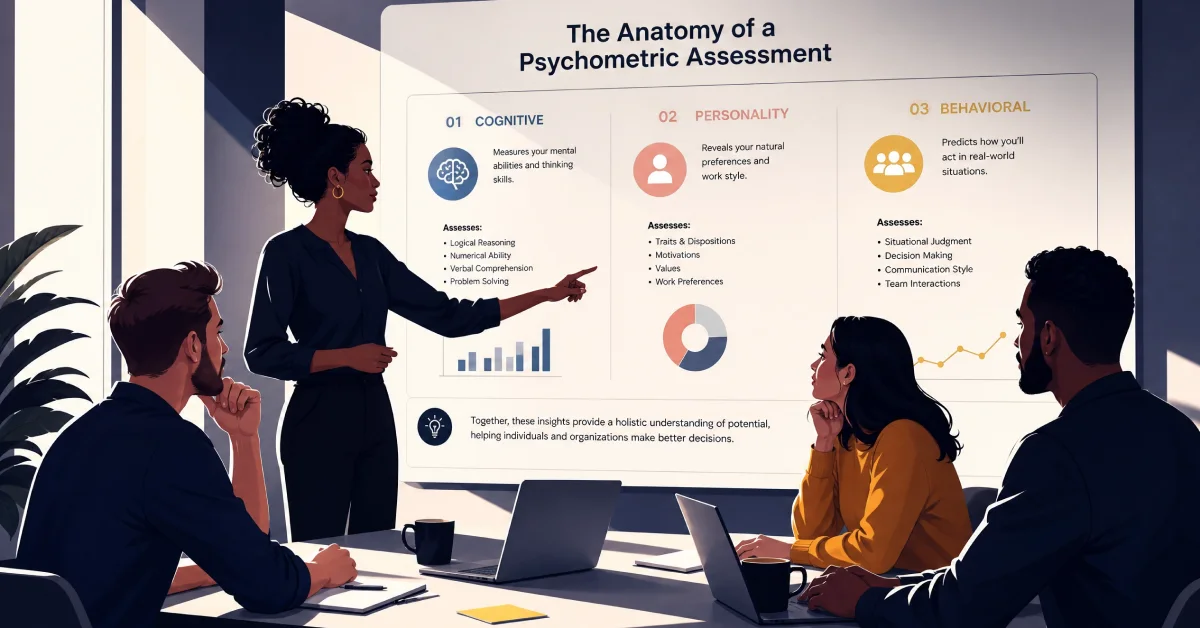
An assessment should begin with a role analysis: what must a person know, do, or demonstrate to perform well? Depending on the role and the tool, an AI-supported process may evaluate responses or test results against specified criteria. Psychometric assessments can also examine behavioural, cognitive, and integrity signals, but those measures need a clear connection to the work. The job-related evidence should be understandable to hiring teams, not hidden behind an unexplained score.
For example, a customer-facing role may require careful listening and steady decision-making, while a technical role may call for a different mix of skills. The point is not to label people broadly, but to identify relevant evidence and interpret it in context. Employers can use job-related assessment guidance to think through criteria, fairness, privacy, and human review when planning an AI-supported process.
Where assessments fit in the hiring process
Assessments can sit at different stages: early enough to help prioritise applications, or later after candidates meet essential eligibility requirements. The right point depends on the role, the candidate journey, and how much evidence the employer already has. If an assessment comes too early, candidates may spend time on a process before knowing whether they meet basic requirements. If it comes too late, the team may have invested heavily in candidates who do not meet key role needs.
A practical process makes clear what the assessment contributes and what it cannot decide on its own. Employers can review high-volume recruitment planning for ideas on connecting role-relevant tests with a manageable candidate journey and ongoing checks. In each case, recruitment teams should decide in advance how a result will affect the next step, rather than improvising after scores arrive.
How AI assessments differ from résumé screening
Résumé screening works with information candidates have chosen to present, such as work history, education, and stated skills. An assessment can add a more structured source of evidence by asking candidates to complete the same task or respond to the same job-related prompts. That does not make assessment automatically more accurate: test design, access, and scoring still matter, and a résumé can contain useful context that a short test cannot capture.
The two methods therefore answer different questions. A résumé may establish whether someone has relevant experience; a work sample or structured assessment may offer evidence about how they approach a task. Employers can combine them rather than treating one as a substitute for the other. A broader guide to employment assessments explains why role fit, validity, accessibility, and human judgment belong in the same decision process.
What candidates can expect during an assessment
Candidates should be told what the assessment is for, approximately how long it takes, what materials or device they need, and whom to contact if they encounter a problem. Instructions should be plain and available before a timed task begins. Where a process includes recorded or online responses, explain what will be evaluated and how the material will be used.
A short, clearly explained experience is more respectful than an opaque test that arrives without context. One useful comparison is the clarity needed when inviting someone to submit a short video: the video participation requirements show why eligibility, format, and conditions should be stated up front. Employers should similarly provide candidates with a route to ask questions or request an adjustment before the assessment window closes.
Choosing the right assessment approach
Assessment design should follow the work, not the latest tool on the market. Employers need to identify the tasks and decisions that distinguish competent performance, then select an appropriate way to gather evidence. In India’s varied hiring settings, one approach may not suit every role or location. When 9 LINKS is relevant, its validated, AI-enabled psychometric assessments combine behavioural, cognitive, and integrity signals to help employers evaluate role fit.

Match assessment methods to role requirements
A realistic work sample may be useful when performance depends on carrying out a task, while a structured assessment can help examine capabilities that are harder to observe in a short interview. The method should reflect the role’s actual demands and should not test knowledge candidates would only gain after joining. A simple mapping helps hiring teams explain why a particular method belongs in the process.
| Role requirement | Possible evidence | Useful caution |
|---|---|---|
| Applying a defined procedure | Work sample or scenario response | Keep the task close to real duties |
| Reasoning through a problem | Job-relevant cognitive measure | Confirm the level is needed for the role |
| Interacting with customers or colleagues | Structured questions or role-play | Score observable behaviours consistently |
| Following safety or ethical expectations | Scenario-based evidence and relevant checks | Avoid treating a single score as a verdict |
The table is a starting point, not a standard recipe. A hiring team should document which evidence it needs and why, then check that the format does not introduce avoidable barriers. For frontline roles especially, the assessment should reflect working conditions and the level of responsibility candidates will actually face.
Combine skills tests with structured interviews
A structured interview adds context that a test may miss. Recruiters can ask each candidate the same core questions, use defined scoring criteria, and probe relevant experience consistently. Pairing this evidence with skills tests can help distinguish a candidate’s demonstrated capability from the way they present themselves in a conversation. Employers should decide how evidence is combined before reviewing individual results.
A sound process does not let one strong or weak score eclipse everything else. This is consistent with structured interview and assessment guidance, which treats assessments as one part of a more informed hiring decision. When using psychometrics, 9 LINKS describes its assessments as tailored to specific roles and hiring levels; employers should still make sure their own criteria and interview process match the vacancy.
Decide when to use adaptive or proctored tests
Adaptive tests change the difficulty or sequence of questions based on prior responses; proctored tests add monitoring intended to confirm that the candidate completes the task under stated conditions. Neither format is automatically suitable. Consider whether the role requires a timed or controlled test, whether monitoring is proportionate, and whether a less intrusive format could provide the same evidence.
Explain any monitoring in advance and give candidates a way to raise technical or access concerns. Test conditions should be consistent enough that results can be compared fairly, without creating barriers unrelated to the job. A provider should be able to describe what its format changes and what safeguards are available.
Avoid assessing traits that do not predict job performance
An assessment can be technically polished and still measure the wrong thing. Avoid using vague ideas such as “culture fit” or personal preferences unless they have been translated into behaviours that are genuinely relevant to the work. If a trait cannot be connected to a job requirement and supported by evidence, it may add noise rather than improve a hiring decision.
Teams should also resist reducing a complex role to one broad score. The general principle is familiar in other kinds of evaluation: balancing player attributes is more informative than relying on one overall rating, and hiring decisions likewise benefit from looking at the capabilities a role actually calls for. That is an analogy, not evidence about assessment validity; employers still need role-specific validation.
Designing a fair and accessible process
Fairness is not a feature that can be assumed because a system is automated. It depends on the criteria, the assessment design, how results are used, and whether candidates can participate on reasonable terms. Employers should examine the whole process rather than only the final score. Human review, clear explanations, and accessible alternatives help make assessment decisions more accountable.
Check assessments for bias across candidate groups
Review whether assessment completion and results differ across candidate groups, while taking care not to treat a difference alone as proof of bias or fairness. Investigate whether language, device access, test timing, or an irrelevant task feature could explain a pattern. Validation should be relevant to the role and the population being assessed; evidence from a different context may not transfer neatly.
Set a regular review schedule and record what was examined, what was found, and what changed. A tool that performed acceptably in a small pilot may behave differently at higher volume or across regions. Fairness checks should therefore continue after launch.
Make accommodations available to candidates with disabilities
Candidates should have a clear way to request reasonable accommodations before an assessment, with enough time for the employer or provider to respond. Depending on the task, an adjustment could involve additional time, an accessible format, or an alternative way to demonstrate the same job-related skill. The goal is to remove barriers that are incidental to the work, without changing the requirement being assessed.
Recruiters should avoid making candidates disclose more information than needed to arrange an adjustment. Instructions should explain the contact route and any relevant deadlines. A process that offers help only after a candidate fails or abandons a test is unlikely to provide a fair opportunity to participate.
Explain how candidate data and assessment results are used
Before collecting assessment information, explain what data is gathered, why it is needed, who can view it, and how long it will be kept. Candidates should also know whether the result informs a decision directly or is reviewed alongside other evidence. Clear, limited explanations can build trust without promising that an assessment is error-free.
Privacy practices deserve the same attention as test design. Employers can use AI connector access safeguards as a general reminder to limit permissions and control sensitive data access; it concerns workplace AI connections, not hiring assessments, so it is not a substitute for reviewing an assessment provider’s own practices. Likewise, a health information privacy notice offers a useful example of communicating collection, use, sharing, and rights in a privacy context, though its rules are specific to that organization.
Keep human review in consequential hiring decisions
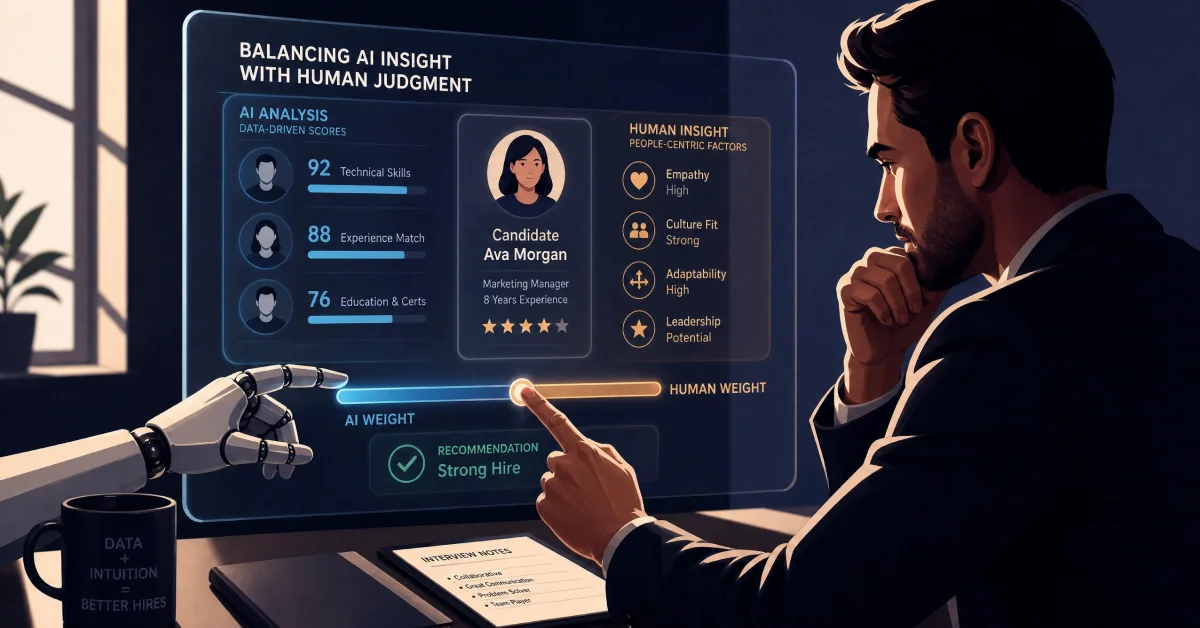
A hiring decision affects a person’s livelihood, so automated results should not become an unexplained verdict. Recruiters need to understand what a score represents, what its limits are, and whether other evidence conflicts with it. Where results are uncertain or a candidate raises a concern, a trained reviewer should have authority to investigate rather than simply repeat the system’s output.
Conversational and other AI-supported methods can help structure candidate interactions, but decision responsibility remains with the employer. This discussion of human involvement in AI hiring explores the value of assessing skills while keeping recruiters involved in consequential judgments. In practice, human review works best when it is planned, documented, and supported by clear escalation rules.
Navigating Indian hiring requirements
Employers recruiting across India may work with candidates in different languages, regions, and technology conditions, so a process that appears straightforward at headquarters may not be equally usable everywhere. Privacy and employment obligations also depend on the data collected, the employer’s role, and the current legal framework. This section offers practical issues to review, not legal advice. Organisations should confirm their obligations with qualified counsel and check for current rules before deployment.

Review applicable privacy and data protection obligations
Review the Digital Personal Data Protection Act, 2023, and any rules or commencement provisions that apply at the time of use, alongside other relevant laws and contractual obligations. Map the personal data involved, the purpose for processing it, and the parties that handle it. If a provider processes candidate information on the employer’s behalf, clarify responsibilities and safeguards in the agreement.
The review should cover assessment responses, identity or contact details, recordings if used, and any derived results. Do not assume that describing a tool as AI changes or removes privacy responsibilities. Legal and data-protection teams should assess the actual workflow and current requirements.
Set clear rules for consent, retention, and data access
Tell candidates what information is collected and how it will be used before they begin. Set a retention period based on a documented need, and define who may access raw responses, reports, and decision records. Access should be limited to people who need the information for recruitment or related governance tasks.
A short operational checklist can keep those commitments concrete:
- Identify the data collected at each assessment step.
- Explain the purpose and any relevant sharing with providers.
- Set access permissions and a retention schedule.
- Provide a contact route for questions or data-related requests.
These steps make privacy easier to review and maintain. They also help recruiters give candidates consistent answers instead of relying on informal explanations that vary from one hiring team to another.
Consider language and accessibility needs across India
A candidate’s performance should not be distorted by avoidable language or access barriers. Consider whether assessment instructions are available in a language candidates can understand, whether the test assumes a particular device or connection, and whether time limits are appropriate. If a role genuinely requires a language skill, assess it directly and consistently rather than allowing unrelated wording complexity to influence the result.
Test the candidate journey in the locations and conditions where recruitment will happen. For high-volume hiring, small obstacles can affect completion rates and can exclude capable applicants before the employer has gathered useful evidence. Accessibility is therefore both a fairness consideration and a practical part of process design.
Document assessment decisions for accountability
Keep a concise record of the role criteria, assessment version, scoring approach, reviewer involvement, and reasons for the hiring decision. Documentation helps teams explain decisions later and identify whether a process has changed without review. It is especially useful when multiple recruiters or locations are involved.
Records should be proportionate and protected, not an invitation to retain candidate data indefinitely. Define what belongs in the decision file and who can see it. A good record shows how evidence informed a decision without presenting a score as a complete account of a person.
Evaluating AI assessment providers
Provider selection is a due-diligence exercise, not a feature-counting contest. Employers should ask for evidence that the assessment measures relevant requirements, works for the intended candidate population, and can be administered responsibly. They should also understand how the provider handles data and supports the hiring team. 9 LINKS provides validated, AI-enabled psychometric assessments that combine behavioural, cognitive, and integrity signals to support role-fit evaluation; employers can assess this documented scope against their own needs.
Verify validation evidence for your roles and candidate population
Ask what evidence supports the assessment’s use for the roles you are hiring for and the population likely to take it. Find out what outcomes or criteria were used in validation, whether the evidence is current, and what limitations the provider identifies. A general claim of validation is less useful than an explanation of the method and its relevance to your context.
Check whether the assessment measures the requirements in your job analysis, not merely attributes that are easy to score. Employers may also compare role-specific assessment criteria with the evidence a provider says its tool produces. The match between the job and the measure is central to making results meaningful.
Ask how models are tested and updated
A provider should explain how it evaluates model performance, checks for differences across relevant groups, and reviews changes to assessment content or scoring. Ask whether updates can affect comparability with earlier results and how customers are notified. If a provider cannot describe its review process clearly, the employer may struggle to interpret results responsibly.
Also ask what happens when the system is uncertain, when a candidate reports a problem, or when a recruiter believes a result does not fit the other evidence. A responsible process should provide a way to investigate rather than treating every output as equally conclusive.
Review security controls and data handling practices
Ask where candidate data is processed and stored, how access is controlled, what security measures are in place, and how incidents are handled. Clarify whether information is shared with subcontractors or used for purposes beyond the hiring service. Employers should review the provider’s documentation and contract, not rely only on marketing assurances.
Also consider whether reports include more personal detail than recruiters need. A clear data-handling arrangement can limit unnecessary exposure and make responsibilities easier to manage. Any specific security or compliance claim should be confirmed against current provider evidence.
Compare integration, support, and total cost
A provider must fit the hiring workflow as well as the assessment objective. Compare implementation effort, candidate support, recruiter training, accessibility options, reporting, and ongoing costs. A low initial price may not reflect the staff time required to manage invitations, answer candidate questions, or interpret reports.
Shopping comparisons offer a simple, if imperfect, analogy for looking beyond a headline price: practical product comparisons encourage checking value and conditions as well as cost. For recruitment, the equivalent is to compare the complete service and operating effort, while giving the most weight to validity, fairness, and fit with the role.
Implementing and measuring assessment outcomes
A careful rollout starts small enough to reveal practical issues and continues long enough to test whether the approach is useful. Define success before launch, including what evidence should improve and what safeguards must remain in place. Recruiters need training, candidates need clear communication, and leaders need a way to review outcomes over time. The assessment should support better decisions, not become a new source of unexamined authority.
Pilot assessments before using them at scale
Run a pilot with a defined set of roles and locations before expanding. Check that candidates can complete the process, that recruiters understand the results, and that the assessment measures the intended requirements. Gather feedback from candidates and hiring teams, then make changes where the evidence points to friction or confusion.
A pilot is also a chance to confirm operational details: invitation timing, device compatibility, escalation routes, and how assessment results reach decision-makers. Keep a record of the setup so that any later comparison is meaningful. Expansion should follow evidence, not simply a launch date.
Train recruiters to interpret results responsibly
Recruiters should know what each score means, what it does not mean, and how it relates to the role criteria. Training should include examples of interpreting mixed evidence, recognising uncertainty, and explaining the process to candidates. It should also reinforce that a score is not a diagnosis or a complete description of a person.
When relevant, 9 LINKS provides psychometric assessments that produce behavioural, cognitive, and integrity signals for role-fit evaluation. Recruiters using such results still need to relate them to the vacancy and consider other evidence. A clear interpretation guide can reduce inconsistent use across teams.
Track hiring quality, completion rates, and candidate experience
Choose measures that reflect both decision quality and how the process operates. Hiring quality may require longer-term indicators, while candidate completion and feedback can reveal immediate problems. Consider reviewing a small set of measures together rather than allowing one convenient number to stand in for success.
| Measure | What it can reveal | How to interpret it |
|---|---|---|
| Assessment completion | Whether candidates can finish the process | Review by location, device, and candidate group |
| Candidate feedback | Clarity and perceived effort | Look for recurring points of confusion |
| Hiring outcomes | Whether selected candidates meet role expectations | Use relevant, consistently defined outcomes |
| Group-level patterns | Possible differences in access or results | Investigate context before drawing conclusions |
These measures are most useful when reviewed together and compared with a documented baseline. A high completion rate does not establish validity, and positive feedback alone cannot show that an assessment predicts performance. Interpret each measure in relation to the question it can actually answer.
Reassess performance and fairness over time
Roles, candidate populations, and assessment tools change. Revisit the role analysis when duties shift, review validation and fairness evidence periodically, and examine whether candidate feedback identifies a new barrier. If a tool or its scoring is updated, determine whether the change affects how results should be compared or explained.
Keep a route for recruiters and candidates to report concerns, and record how those concerns are resolved. Continuous review makes it possible to refine a process without confusing consistency with keeping an unsuitable method unchanged. The aim is a hiring system that remains relevant, understandable, and accountable.
Conclusion
AI employee selection assessment in India works best as one carefully governed source of job-related evidence, supported by accessible candidate experiences, appropriate privacy practices, and human judgment. Employers can build confidence by choosing measures that match the role, checking results in context, and reviewing outcomes over time. A practical, evidence-led process is more valuable than adding automation for its own sake.
Frequently Asked Questions
What is an AI employee selection assessment?
It is an assessment process that uses AI-supported methods to gather or interpret evidence about candidates in relation to job requirements. The specific method and evidence vary by tool and role.
Can AI assessments replace interviews?
Usually, they are better treated as one source of evidence alongside structured interviews, work samples, experience, and other relevant information. Hiring decisions should include appropriate human review.
How can employers choose an assessment for a role?
Start by identifying the tasks, skills, and behaviours the job requires. Then choose a method that measures those requirements and check its validity, accessibility, and suitability for the candidate population.
How can employers check whether an assessment is fair?
Review completion and outcome patterns across relevant candidate groups, investigate possible barriers, and examine whether the assessment measures job-related criteria. Continue monitoring after implementation.
What should candidates be told before an assessment?
Explain the purpose, format, expected time, data use, and any monitoring in clear language. Tell candidates how to request an accommodation or report a technical problem.
What privacy issues should employers consider in India?
Employers should review applicable data-protection requirements, explain the purpose of collecting candidate information, limit access, define retention, and check provider arrangements. Legal obligations should be confirmed against current rules and the specific workflow.
How should employers know whether an assessment is working?
Set measures before launch, such as completion, candidate experience, relevant hiring outcomes, and fairness indicators. Interpret measures together and reassess them as roles, tools, and candidate populations change.
We Appreciate The Feedback From Our Clients.
It is always a joy to hear how our work has positively impacted them and how our assessments have helped in finding the right people.
We have used 9 LINKS psychometric tool in our Campus Placement Programme.The tool has helped us to identify right candidate as per our organisation requirements…

We have just started using it. It differentiates various personalities and helps in decision making. The clarity on its precision level will be gathered over a period of time…

Counselling test curated for NES has been very useful in identifying the skill sets and allotting appropriate job fitment to students as per their quotients. Multilingual tests developed by considering various key…

It is indeed great pleasure in my part to share complementing note to you & your team. Needless to say 9 LINKS is one of the best organisation to conduct skill gap analysis through assessment of Cognitive skills..

It is crucial that validating the quality of the candidates in recruitment. 9 LINKS is a service that we can confidently say does that. 9 LINKS online assessment precisely giving us the right candidates to pick and proceed on recruitment…

Read Our Blog For The Latest On Research & Insights.
Get Insights into latest developments in HR industry and psychometric assessments.
Take a Free Assessment


