

Key Takeaways
An AI hiring assessment can add useful evidence to a selection process, but it cannot make a fair decision on its own. The best results come from matching the assessment to the role and reviewing its findings with care.
-
Choose tasks and measures that reflect the work candidates will actually do.
-
Treat AI scores as evidence to consider, not as automatic hiring decisions.
-
Ask vendors for relevant validation, accessibility, privacy, and security information.
-
Explain the process to candidates and provide reasonable accommodations.
-
Track outcomes over time and revise the assessment when the evidence calls for it.
What an AI hiring assessment is and how it works
An AI hiring assessment uses automated methods to help evaluate information about a candidate, such as answers, task performance, or application details. The system may organize or score responses against criteria set for a role, while recruiters use the results alongside other evidence. What the system measures—and how well it measures it—depends on its design and the quality of the underlying assessment.
How AI evaluates candidate responses and job-related skills
An assessment begins with a definition of the capabilities a role requires. Depending on the format, AI may process written or spoken responses, compare task results with a scoring rubric, or summarize patterns for a recruiter to review. The output is only as meaningful as the connection between the criteria and the actual work; a polished score cannot fix a poorly chosen measure.
For that reason, employers should ask what information the system uses, how a response becomes a score, and what a recruiter can inspect. A useful result offers job-related evidence that can be interpreted in context, rather than a mysterious ranking presented as a complete judgment of a person.
The difference between AI screening and skills assessment
Screening generally helps sort or prioritize applications using stated requirements. A skills assessment asks candidates to demonstrate a capability, for example by completing a work sample or responding to a role-specific scenario. Some hiring processes use AI in both steps, but the purpose differs: screening narrows attention, while an assessment gathers evidence about performance or potential.
That distinction matters when setting expectations. A system that organizes application information does not necessarily test whether someone can perform a task, and a test score alone does not establish that a candidate meets every requirement. Employers should be clear about which question each stage is meant to answer.
Where assessments fit in the hiring process
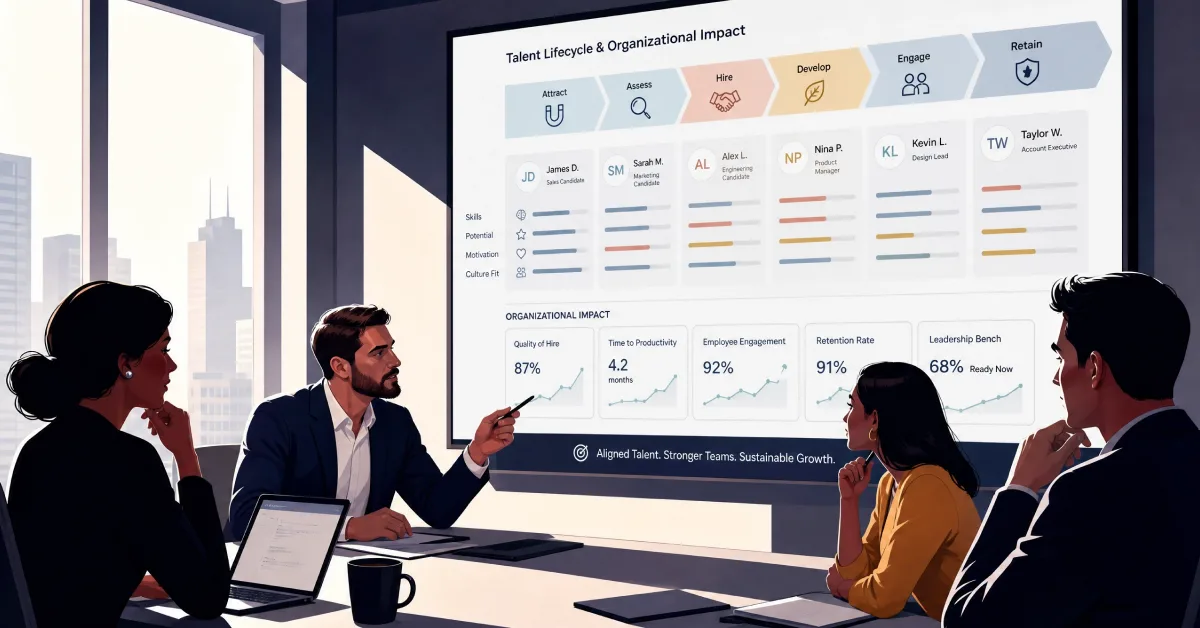
Assessments can sit at different points in a hiring process, from an early screen to a later work sample or structured interview. The right place depends on the time required, the number of applicants, and the consequences of excluding someone at that stage. A short early assessment may help focus recruiter attention, while a more detailed exercise may make sense once candidates have passed essential eligibility checks.
For high-volume teams, assessment-to-role alignment is a useful starting point for making the process measurable without losing sight of candidate experience. Whichever stage is chosen, candidates should know what to expect and how the result will be used.
Common types of AI hiring assessments
The term covers several different methods, and they do not all measure the same thing. Some ask candidates to perform a task; others interpret responses to structured questions or organize application information. Knowing the format helps hiring teams judge whether it fits the role and where its limitations may lie.

Skills and work-sample assessments
Work samples ask candidates to complete a task similar to one they may encounter on the job. A writing exercise, troubleshooting scenario, or simulated customer interaction can make expectations more concrete than a general claim on a resume. AI may assist with organizing or scoring results, but the task and rubric still need to reflect the work fairly.
A good work sample should test an essential capability without asking candidates to do excessive unpaid work. Keep instructions consistent, define what a strong response looks like, and make sure the exercise does not reward familiarity with an unrelated tool or setting.
Structured interviews analyzed with AI
Structured interviews use a consistent set of questions and scoring criteria for candidates applying to the same role. An AI-supported process may help organize responses or apply a defined rubric, but employers should confirm what the system actually analyzes rather than assume every tool evaluates the same signals. Voice- or text-based formats can be used for automated pre-screening, though the format alone does not establish that an assessment is valid or fair.
The strongest interview evidence comes from questions tied to the role and a shared standard for reviewing answers. Recruiters should also consider whether the format gives candidates a reasonable way to communicate their experience, including those who need an accommodation.
Cognitive and situational judgment assessments
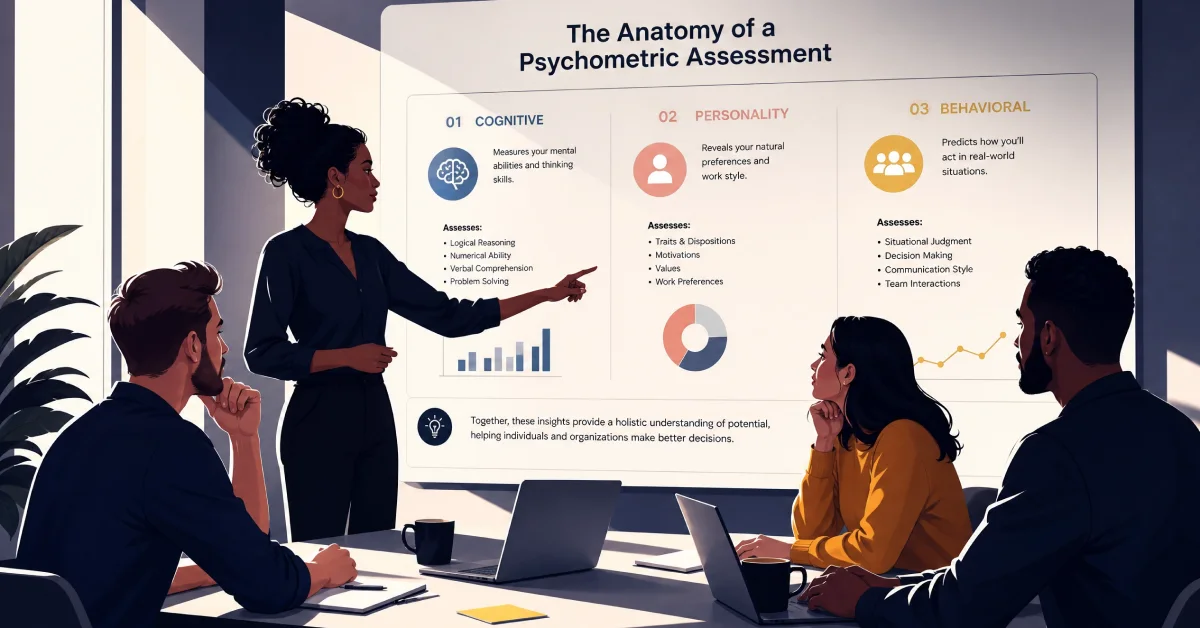
Cognitive assessments may evaluate abilities such as reasoning or problem solving, while situational judgment questions ask how a candidate might respond to a work-related scenario. Both can add a standardized source of information, but they should measure capabilities that matter for the specific job. Language level, time limits, and familiarity with test formats can affect results, so teams should review those factors before using a score to make decisions.
9 LINKS combines behavioural, cognitive, and integrity signals in its assessments to help employers evaluate role fit. These signals are not interchangeable: each should be interpreted in relation to the role and alongside other relevant evidence.
Resume and application screening
AI-assisted screening may help organize application details or compare them with stated criteria, which can be useful when a team is handling many submissions. Yet resumes vary in format, wording, and the way people describe equivalent experience. A system can overlook qualified candidates if its criteria are too narrow or if nontraditional career paths are not represented in the information it evaluates.
Teams should test screening rules against a range of realistic applications and make it possible to review borderline cases. Screening can support the first pass, but it should not quietly turn a formatting preference or an imperfect proxy into a requirement for the job.
Benefits and limitations for hiring teams
A well-designed assessment can make parts of hiring more consistent and give decision-makers evidence they might not get from a resume alone. It can also save time on repetitive review, especially when application volumes are high. Those benefits depend on a suitable measure, transparent use, and regular checks; automation does not by itself guarantee accuracy or fairness.
How assessments can improve consistency and efficiency
When candidates receive the same instructions and are evaluated against the same criteria, teams have a clearer basis for comparing evidence. This can reduce variation between interviewers and help recruiters focus their time on decisions that need human attention. Standardization also makes it easier to notice when a question, scoring rule, or process step is producing confusing results.
Efficiency should not be measured only by how quickly a team moves candidates through a funnel. A faster process that excludes suitable applicants or creates unnecessary friction may be a poor trade. Pair operational measures with evidence about candidate experience and the quality of decisions.
When AI can help reveal job-relevant strengths
A structured task can give candidates a chance to show skills that may not be obvious from job titles or interview fluency. This can be particularly useful when the work itself provides a clearer signal than a general conversation. For frontline and high-volume hiring, 9 LINKS provides validated, AI-enabled psychometric assessments for hiring India’s frontline workforce, with an emphasis on role fit.
Assessment results are most useful when they complement other evidence rather than stand in for it. A recruiter can use a score to guide follow-up questions, investigate a gap, or compare a candidate’s demonstrated strengths with the role’s needs.
Risks of inaccurate predictions and overreliance on scores
An assessment can be unreliable for a particular role, reflect irrelevant factors, or produce a result that is difficult to interpret. Even a well-designed measure captures only part of a person’s abilities and circumstances. Treating one number as a verdict can hide uncertainty and discourage a closer look at candidates whose experience does not follow a familiar pattern.
Hiring teams should avoid assuming that an AI-generated score predicts future performance simply because it is numerical. Review how the measure was validated, look for signs that outcomes differ across candidate groups, and keep a human decision-maker accountable for the final judgment.
How to choose an AI hiring assessment
Choosing an assessment starts with the job, not a vendor feature list. Identify the capabilities that matter, decide what evidence would demonstrate them, and then compare tools against that need. A practical review should also cover validation, accessibility, candidate experience, integrations, and data handling.

Match assessment methods to role requirements
Begin by separating essential capabilities from skills that can be learned after hiring. Then choose a method that gives candidates a fair opportunity to demonstrate the essentials. A work sample may suit a hands-on task, while a structured scenario can help explore judgment; neither is automatically appropriate just because it is easy to administer.
The table below illustrates how to connect a role requirement with a possible assessment method and a question to check before adoption.
|
Role requirement |
Possible method |
Question to ask |
|---|---|---|
|
Practical task execution |
Work sample |
Does the task reflect real job duties? |
|
Reasoning under defined conditions |
Cognitive assessment |
Is this ability necessary for the role? |
|
Response to common work situations |
Situational judgment questions |
Are the scenarios relevant and understandable? |
|
Clear communication |
Structured interview |
Are answers assessed using shared criteria? |
Use this mapping as a starting point, not a menu to apply wholesale. 9 LINKS tailors assessments to specific roles and hiring levels, an approach that underscores why the method should follow the requirements rather than the other way around.
Check validation evidence and vendor transparency
Ask for evidence that the assessment measures what it claims to measure and is appropriate for the jobs and candidate population in question. Validation should be relevant to the way your organization plans to use the results; a general product description is not enough. Also ask how scores are produced, what limitations are known, and whether recruiters can understand the output without treating it as a black box.
A vendor’s explanation should help your team make an informed decision, not just promise that a system is objective. Look for clear documentation about the assessment’s intended purpose, the evidence behind its use, and the circumstances where it may be less useful.
Compare accessibility, candidate experience, and integrations
An assessment that is hard to access can distort who completes it, regardless of how carefully it is scored. Review device and bandwidth requirements, language and timing, instructions, and how candidates can request an accommodation. Also consider how the assessment fits into existing recruitment workflows, so candidates do not face avoidable duplication or unclear next steps.
Before rollout, ask a small group to walk through the candidate journey from invitation to result. Their feedback can reveal confusing instructions or practical barriers that are easy to miss in a vendor demonstration.
Evaluate data handling and security practices
Before sharing candidate information, clarify what data is collected, why it is needed, who can access it, and how long it is retained. Ask how information is protected and what happens when an organization no longer needs it. These questions belong in vendor review, not as an afterthought once a hiring process is already underway.
Keep the review specific to your organization’s legal and operational requirements. Clear data practices help candidates understand the process and give hiring teams a more accountable basis for using assessment results.
How to use assessments fairly and responsibly
Fair use is a process, not a feature that can be assumed from the presence of AI. Employers need to examine whether an assessment is relevant, accessible, and applied consistently, then make room for context when interpreting its outputs. The following safeguards help turn those principles into practical checks.
Audit for bias across candidate groups
Review participation and outcomes across relevant candidate groups where lawful and appropriate, and investigate patterns that suggest the process may disadvantage some applicants. A difference in outcomes does not by itself explain the cause, but it is a reason to examine the assessment, its administration, and the criteria used. Track who progresses as well as who is screened out, so the review includes the entire funnel.
A useful audit routine can be modest and repeatable:
-
Compare completion and progression rates across relevant groups.
-
Check whether assessment instructions or time limits create avoidable barriers.
-
Review a sample of decisions, including candidates near a cutoff.
-
Document what was changed after a concern was identified.
Use the findings to investigate and improve the process, not to make unsupported conclusions about individuals. The same review should recur as roles, candidate pools, or assessment methods change.
Provide accommodations and alternative assessment options
Candidates may need an adjustment to access an assessment on equal terms. Make a clear way to request accommodations, consider alternatives where appropriate, and ensure that the adjustment preserves the job-related capability being assessed. A rigid process can confuse a format preference with a candidate’s ability to do the work.
Tell candidates how to raise a concern and who will respond. Recruiters and hiring managers should know how to handle requests consistently and discreetly, without asking candidates to disclose more information than necessary.
Explain how results inform hiring decisions
Candidates should receive a plain-language explanation of what the assessment is intended to measure and how its results fit into the selection process. Avoid presenting a score as a complete account of a person’s potential or implying that an automated result makes the final decision. Clear communication supports trust and helps candidates understand what to expect.
Internally, document how results are weighed alongside interviews, work samples, and relevant experience. The cognitive assessment guidance can help teams think through role relevance, accessibility, and communication when using cognitive tests.
Keep human review in the decision process
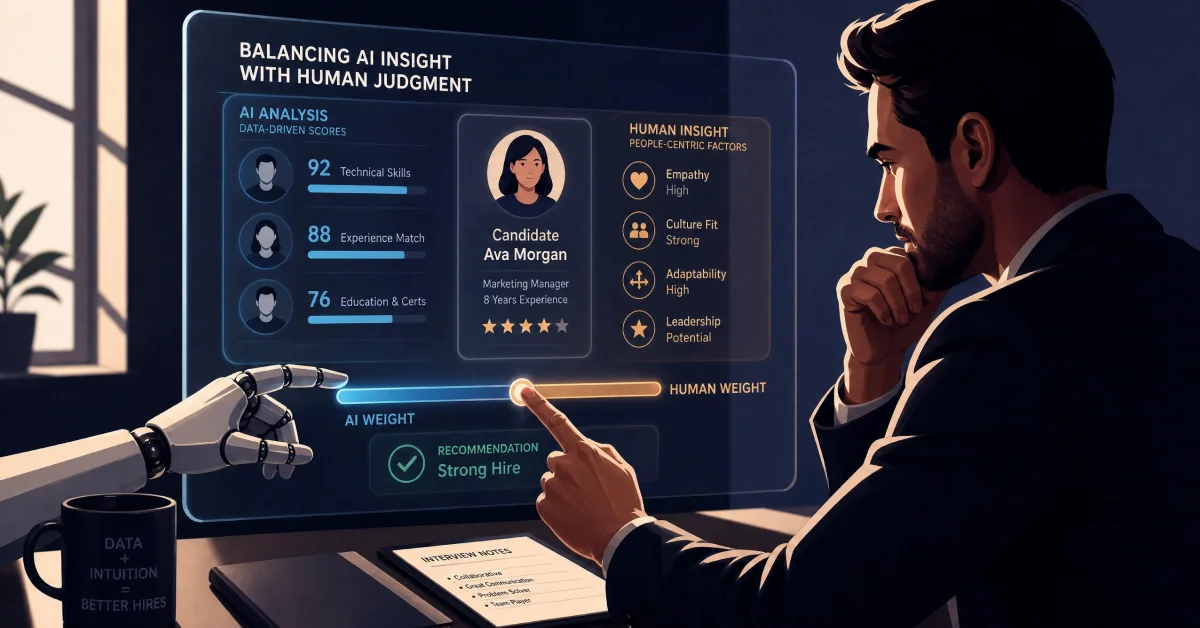
Human review provides context that an automated score may not capture, including relevant experience, an unusual career path, or an issue with how an assessment was completed. Reviewers should know what the score means and what it does not mean. Their role is not to rubber-stamp a recommendation, but to consider the evidence and remain accountable for the decision.
A defined review point is especially useful when results are close, inconsistent with other evidence, or affected by an accommodation. That creates a practical check against treating the model as the decision-maker.
How to implement and measure an assessment program
A responsible program begins with a clear purpose and a plan to check whether the assessment is helping. Start with a limited use case, establish how decisions will be reviewed, and involve the people who will administer and interpret the process. The system should be adjusted when evidence or candidate feedback shows that it is not working as intended.
Define success metrics before rollout
Choose measures that reflect both hiring outcomes and the experience of candidates. Depending on the role and process, teams might track completion, time spent in review, progression rates, the consistency of scoring, and later indicators of job performance or retention. Define each measure in advance so the team is not tempted to select only the results that look favorable.
A small set of balanced measures is often more useful than a long dashboard. Pair speed or volume indicators with checks for fairness and decision quality, and decide who will review the results and how often.
Pilot the assessment with relevant roles
A pilot gives the team a chance to test instructions, logistics, and scoring before applying an assessment at greater scale. Use roles that genuinely match the assessment’s intended purpose, and collect feedback from both candidates and hiring staff. A pilot should reveal practical problems as well as whether the results appear relevant to the job.
The format also shapes the candidate experience, so it is worth understanding what participation involves before launch.
After the pilot, review the evidence and feedback together. If candidates misunderstand a prompt or managers cannot interpret the output consistently, address those problems before expanding use.
Train recruiters and hiring managers to interpret results
Training should cover what the assessment measures, how to read its output, and where the evidence is limited. Recruiters and hiring managers also need practice applying the same criteria and explaining results without overstating their meaning. This shared understanding reduces the risk that different reviewers will use one score in different ways.
A short decision guide can help teams record how evidence informed a recommendation. It should support judgment, not replace discussion when results conflict or a candidate’s circumstances call for closer review.
Review outcomes and update the process regularly
Once the assessment is in use, compare outcomes with the success measures set before rollout. Look for shifts in completion, candidate feedback, group outcomes, and job-related indicators, while remembering that no single measure explains the whole process. Revisit the assessment when job requirements change or when results suggest that the tool is no longer a good fit.
Regular review makes the program more accountable and helps teams respond to evidence instead of treating the original setup as permanent. Keep a record of changes and the reasons for them so future reviewers can understand how the process evolved.
Conclusion
An AI hiring assessment is most useful when it measures a capability that matters for the role, is accessible to candidates, and contributes evidence rather than issuing a verdict. Employers can build a more consistent process by validating their choices, explaining how results are used, and keeping people accountable for hiring decisions. Ongoing review then helps the assessment remain relevant as roles and workforce needs change.
Frequently Asked Questions
What is an AI hiring assessment?
It is an assessment process that uses AI to help evaluate candidate information, such as application details, responses, or task results. Its purpose and accuracy depend on the method and how it is used.
How is AI screening different from an assessment?
Screening typically helps sort applications against stated criteria. An assessment gathers evidence about a capability, such as through a work sample or structured scenario, though some tools may support both functions.
Can an AI assessment make a hiring decision on its own?
It should not be treated as a complete decision-maker. Scores need context, and a responsible process keeps human review and accountability in place.
How can employers check whether an assessment is fair?
Review its connection to job requirements, examine outcomes across relevant candidate groups, and check whether instructions, timing, or access create unnecessary barriers. Revisit the process when evidence points to a problem.
What should an employer ask an assessment vendor?
Ask what the tool measures, how results are generated, what validation evidence supports the intended use, and what limitations are known. Also ask about accessibility, data handling, and security practices.
Should candidates be told how assessment results are used?
Yes. Candidates should understand what the assessment is intended to measure and how its results fit into the broader selection process.
How often should an assessment program be reviewed?
Set a regular review schedule and revisit the process when roles, candidate populations, or outcomes change. Use both hiring measures and candidate feedback to guide updates.
We Appreciate The Feedback From Our Clients.
It is always a joy to hear how our work has positively impacted them and how our assessments have helped in finding the right people.
We have used 9 LINKS psychometric tool in our Campus Placement Programme.The tool has helped us to identify right candidate as per our organisation requirements…

We have just started using it. It differentiates various personalities and helps in decision making. The clarity on its precision level will be gathered over a period of time…

Counselling test curated for NES has been very useful in identifying the skill sets and allotting appropriate job fitment to students as per their quotients. Multilingual tests developed by considering various key…

It is indeed great pleasure in my part to share complementing note to you & your team. Needless to say 9 LINKS is one of the best organisation to conduct skill gap analysis through assessment of Cognitive skills..

It is crucial that validating the quality of the candidates in recruitment. 9 LINKS is a service that we can confidently say does that. 9 LINKS online assessment precisely giving us the right candidates to pick and proceed on recruitment…

Read Our Blog For The Latest On Research & Insights.
Get Insights into latest developments in HR industry and psychometric assessments.
Take a Free Assessment


