
Key Takeaways
A high-volume recruitment assessment should help employers make faster decisions without turning candidates into numbers. The strongest processes are job-related, consistent, accessible, and reviewed against real hiring outcomes.
-
Start with the tasks and behaviors the role actually requires.
-
Use a short, structured funnel that respects candidate time.
-
Combine assessment evidence with human judgment rather than replacing it.
-
Monitor fairness, completion, pass-through, and hiring outcomes.
-
Improve the process continuously as evidence accumulates.
Understand the role of assessment in high-volume recruitment
High-volume recruitment creates a different operating problem from filling one specialist role. Recruiters may need to review hundreds or thousands of applications while vacancies remain urgent and candidates have other options. A well-designed high volume recruitment assessment creates a common, job-relevant way to compare applicants before the process becomes dependent on rushed resume reviews. It should make decisions clearer, not simply move uncertainty to a later stage.
What makes high-volume hiring different
The scale changes nearly every part of selection. A small inconsistency in instructions, scoring, or scheduling can affect a large number of applicants, while a slow step can cause capable candidates to leave the funnel. High-volume hiring also often covers frontline roles across multiple locations, shifts, languages, and levels of prior experience.
The process therefore needs repeatability. Recruiters should be able to administer the same assessment, explain the same next steps, and interpret results using the same criteria whether the applicant is in a metropolitan office or a smaller regional market.
When assessments add value to the hiring funnel
Assessment is most useful when a resume offers limited evidence of the capability that matters on the job. A short ability, situational, or skills-based exercise can reveal how someone reasons, prioritizes, communicates, or applies a procedure. It can also give hiring teams a more consistent starting point for interviews.
This does not mean every applicant needs a long test battery. A structured job analysis should identify the few signals that matter most, then place an appropriate assessment early enough to reduce wasted recruiter time but late enough that candidates understand the role and its expectations.
The trade-offs between speed, quality, and candidate experience
Speed is valuable only when it preserves decision quality. A process that rejects candidates quickly but measures the wrong thing may create more vacancies, retraining, and attrition later. Conversely, an assessment that is scientifically careful but unnecessarily long can lose candidates before it produces useful evidence.
Candidate experience is part of the operating model, not a decorative extra. Clear instructions, mobile-friendly access where appropriate, realistic time expectations, and prompt communication all reduce avoidable friction. Guidance on high-volume hiring challenges is useful here because drop-off and recruiter capacity are closely connected.
Common risks of poorly designed assessments
Poor design can introduce barriers that have little relationship to performance. Examples include confusing instructions, irrelevant questions, excessive test length, unvalidated cut scores, and a failure to provide reasonable accommodations. These flaws can reduce completion while also excluding people who could succeed in the role.
There is also a risk of false precision. A numerical score may look objective while reflecting test familiarity, language demands, or access conditions rather than the target capability. Treat results as evidence with limits, and make the final decision using the full selection picture.
Define assessment goals and success criteria
Before choosing a platform or writing questions, define what the assessment must help you decide. The goal might be to identify candidates ready for training, distinguish customer-facing judgment, or check a safety-critical behavior. A clear purpose keeps the process focused and makes later validation possible.
For employers hiring across India, role context matters: education, language, regional experience, and access to technology can affect how an assessment is experienced. Role-relevant assessment guidance offers a useful reminder to match evaluation methods to job demands while keeping human judgment in the process.

Connect assessments to job requirements
Begin with the work itself rather than a preferred test format. List the recurring tasks, decisions, tools, interactions, and standards that define acceptable performance. Then identify which of those elements can be measured reliably before hiring and which require an interview, work sample, or manager observation.
A simple job analysis can prevent a common mistake: measuring an attractive trait that is not necessary for success. For example, a role may need accurate information processing and calm customer handling, but not advanced abstract reasoning unrelated to its daily tasks.
Choose the skills and behaviors to measure
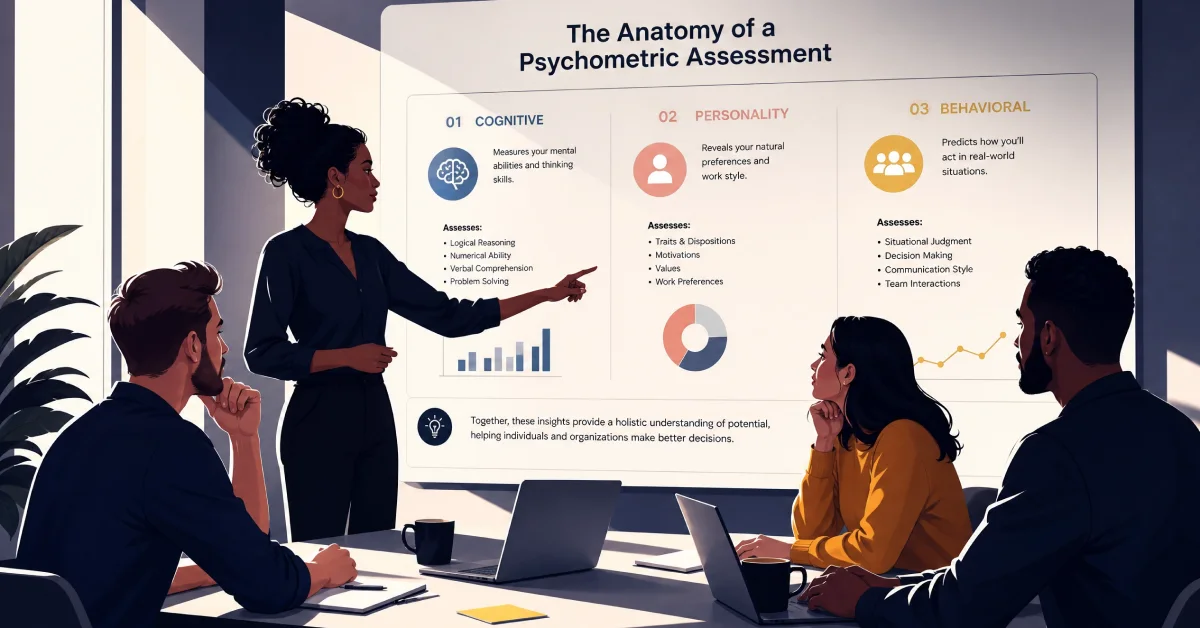
Separate capabilities into distinct categories so that the assessment remains interpretable. Cognitive ability may address learning and problem-solving; skills tests may address role-specific knowledge; behavioral or situational measures may examine judgment, reliability, or responses to typical work events.
The skills-based hiring approach is especially relevant when degrees and prior job titles do not provide a reliable picture of capability. Define each target in observable terms, such as following escalation steps accurately or prioritizing competing customer requests, rather than using broad labels like “culture fit.”
Set measurable hiring KPIs
A good measurement plan includes both funnel metrics and outcome metrics. Completion and pass-through show whether the process is usable; quality of hire, training progress, early performance, and retention show whether it is useful. Track them by role and hiring campaign so averages do not hide local problems.
The following measures provide a practical starting point:
-
Assessment invitation-to-completion rate.
-
Time from application to assessment decision.
-
Pass-through rate by location, channel, and candidate group.
-
New-hire performance or training milestones.
-
Early attrition among assessed and hired candidates.
These measures should be read together. A high pass-through rate may indicate an easy assessment, while a low completion rate may indicate poor communication rather than low candidate interest.
Balance predictive value with completion rates
An assessment has limited value if many suitable candidates abandon it. Review the time required, device and connectivity demands, instructions, and the perceived connection to the job. Where a longer assessment is justified, explain why and use staged evaluation so candidates do not face unnecessary effort at the first step.
Predictive value also needs evidence. Do not assume that a difficult test is a good test, or that a high score guarantees success. Compare results with later work outcomes and revise the process when the relationship is weak or uneven across groups.
Choose the right high volume recruitment assessment format
There is no universal assessment format for every high-volume role. The right choice depends on the decisions employees make, the evidence available, and the amount of time candidates can reasonably give. A mix of brief methods may be stronger than one long battery, provided each component has a defined purpose.
Use the format that resembles the capability you need to observe. A written reasoning test, a customer scenario, a practical task, and a structured interview each answer different questions. Avoid adding formats simply because a vendor makes them available.
Situational judgment tests for decision-making
Situational judgment tests present realistic work scenarios and ask candidates to select or rank responses. They can help assess prioritization, customer handling, ethical judgment, and escalation choices without requiring a full live simulation.
Their value depends on realistic scenarios and defensible scoring. Use subject-matter experts to identify appropriate responses, check that the situations reflect the role, and avoid relying on cultural assumptions that are unrelated to job performance.
Skills tests for role-specific ability
Skills tests work well when the role has a clearly defined capability, such as basic data handling, technical knowledge, language use, or process accuracy. They should reflect the level and tools candidates will encounter rather than test advanced material that belongs to later training.
Instructions should make the task understandable without teaching the answer. When the role permits more than one valid method, scoring should recognize accurate outcomes and relevant reasoning rather than rewarding one arbitrary path.
Work simulations for practical performance
Work simulations ask candidates to complete a task that resembles the job. They can be useful for roles where practical execution matters more than self-description, such as handling a customer interaction, checking a record, or following a production procedure.
Keep the simulation proportionate. A realistic exercise does not need to reproduce every pressure of the workplace, and it should not require unpaid work that creates an unreasonable burden. Score observable behaviors using a structured rubric.
Structured video interviews for communication skills
Structured video interviews can provide evidence about communication when the role requires verbal explanation, customer interaction, or remote collaboration. The questions should be the same or meaningfully equivalent for candidates, with defined scoring anchors and consistent time limits.
Video is not a substitute for job relevance. Appearance, accent, background, or production quality should not influence scoring unless they are directly connected to an essential job requirement. Offer an alternative where technology or disability makes video participation difficult.
Personality and cognitive assessments: benefits and limitations
Personality and cognitive measures can add useful evidence when their constructs are related to the job and the instruments have appropriate reliability and validity evidence. Cognitive measures may help assess learning or reasoning; behavioral measures may clarify work preferences or typical responses.
They should not be treated as a complete profile of a candidate. A score is not a diagnosis, a culture verdict, or a guarantee of retention. The psychometric assessment selection guide is a helpful reference for weighing validity, usability, candidate experience, and role relevance before selecting a test.
Design an efficient candidate assessment process
Process design determines whether a sound assessment works at volume. Candidates need a clear invitation, a reasonable sequence, and timely information about what happens next. Recruiters need controls that prevent manual follow-up from becoming the bottleneck.
The best funnel is usually short, predictable, and easy to explain. It should also work across the channels and locations through which candidates apply. Small improvements in instructions and scheduling can have a large effect when multiplied across a campaign.

Decide when to assess candidates
Assess too early and candidates may lack enough context to engage; assess too late and recruiters may spend hours screening people who do not meet essential requirements. A practical sequence often begins with basic eligibility, followed by a focused assessment, then structured human review.
The exact order depends on the role. If a minimum technical skill is essential, measure it early. If the assessment requires substantial candidate effort, first provide enough information for applicants to make an informed choice.
Create a streamlined screening funnel
Define each stage by the decision it supports and the evidence it adds. Remove duplicate questions across the application, assessment, and interview. Candidates should not have to repeat the same information because systems or teams are not aligned.
A simple funnel might include eligibility checks, one core assessment, a structured review, and a focused interview. This structure keeps the process manageable while leaving room for human consideration where context matters.
Set appropriate time limits and instructions
Time limits should reflect the task, not an arbitrary desire to create pressure. Tell candidates how long the assessment will take, whether pauses are allowed, what device or connection is recommended, and whom to contact if something goes wrong.
Instructions should be tested with people who were not involved in writing them. If several readers misunderstand the same direction, the problem is probably the instruction rather than the candidates.
Automate invitations, reminders, and scoring
Automation is most useful for repetitive administration: sending invitations, recording completion, issuing reminders, and applying pre-agreed scoring rules. It gives recruiters more time to review exceptions and communicate with candidates.
Automation should not hide the decision path. Keep an audit trail showing which version of an assessment was used, when it was completed, and how the result was calculated. Candidates and hiring teams need a route to resolve technical or procedural errors.
Provide accessibility and accommodation options
Accessibility should be planned before launch rather than handled only after a complaint. Consider screen-reader compatibility, keyboard navigation, readable contrast, language clarity, alternative formats, and additional time where appropriate.
A reasonable accommodation should preserve the competency being measured while removing an irrelevant barrier. Document requests consistently, protect candidate privacy, and train recruiters so an accommodation is not mistaken for preferential treatment.
Improve fairness, validity, and consistency
Fairness is built through relevance, consistency, and monitoring. A process can be identical for everyone and still be unfair if it measures factors unrelated to the job or creates avoidable barriers for particular groups. Employers should examine both the content of the assessment and its practical delivery.
Validation is not a one-time label attached to a vendor. It is an ongoing question: does this method measure what it claims to measure, and does the evidence support the decisions being made? That question should remain visible as roles, locations, and applicant populations change.
Use job-relevant questions and scoring criteria
Write questions from real work demands and define what good performance looks like before reviewing candidate responses. Scoring anchors should describe observable differences, not vague impressions such as “seems confident” or “looks suitable.”
For interviews and simulations, use the same core prompts and rating scale. Structured methods make comparisons more defensible and reduce the influence of whichever candidate happened to speak most fluently or build the quickest rapport.
Reduce bias in assessment design
Bias can enter through language, examples, assumptions about education, or the format itself. Review every item for unnecessary cultural references, specialist vocabulary, and access requirements that are not essential to performance. Include reviewers with different perspectives and relevant knowledge of the workforce.
9 LINKS provides validated, AI-enabled psychometric assessments for hiring India’s frontline workforce, combining behavioural, cognitive, and integrity signals to help employers evaluate role fit. That kind of multi-signal approach can support a fuller decision, but it still needs to be matched to the specific role and used alongside appropriate human review.
Monitor adverse impact across candidate groups
Compare completion, score distributions, pass rates, and progression across relevant candidate groups where lawful and ethically appropriate. Differences do not automatically prove that an assessment is invalid, but they are a reason to investigate content, access, language, cut scores, and administration conditions.
Do not wait until the end of a campaign. A dashboard that surfaces unusual drop-off by location or device can prompt a practical fix while candidates are still in the process.
Combine assessment results with human review
Assessment data should inform judgment, not remove it. Recruiters and hiring managers can consider motivation, experience, accommodations, and evidence from structured conversations that a test cannot capture. Human review should follow defined criteria so it does not simply reintroduce the subjectivity the assessment was intended to reduce.
A useful decision record states what evidence was considered, where it was strong or limited, and why the final decision followed. This makes calibration easier and supports later review of hiring outcomes.
Protect candidate data and assessment integrity
Limit access to candidate information and retain it only as long as policy and law require. Explain what data is collected, how it is used, and who can see results. Security also includes protecting question banks, scoring rules, and assessment links from unauthorized use.
Integrity controls should be proportionate. Excessive surveillance can damage trust and exclude candidates with legitimate technical constraints. Use practical safeguards, clear communication, and a review path when an unusual result may reflect a problem rather than misconduct.
Use technology to manage assessment at scale
Technology can connect the assessment experience to the wider hiring workflow, but it does not replace process design. The useful question is not whether a tool has the most features; it is whether it reduces avoidable work while preserving transparency, security, and candidate access.
Choose technology around the operating realities of the campaign: volume, locations, languages, devices, reporting needs, and recruiter capacity. Pilot the full journey before inviting a large applicant pool.
Integrate assessments with an applicant tracking system
An integration should reduce duplicate data entry and keep candidate status visible to the people who need it. Define which fields move between systems, when a status changes, and what happens when a candidate withdraws or requests support.
Test failure cases as well as the normal path. A missing score, duplicate profile, interrupted session, or delayed webhook should have a clear owner and recovery process rather than silently blocking a candidate.
Apply automation and AI responsibly
Automation can handle invitations, reminders, routing, and consistent application of predefined rules. AI may help process large volumes of information, but its use should be bounded by documented purpose, human oversight, and ongoing checks for error or uneven impact.
9 LINKS explores the relationship between AI and human judgment in hiring: technology can process large candidate volumes and provide consistent insights, while people contribute context, emotional understanding, and ethical discretion. That division is a useful design principle for assessment workflows.
Prevent cheating without creating unnecessary friction
Assessment integrity matters, particularly when decisions affect safety, trust, or access to scarce roles. Possible safeguards include randomized items, time controls, identity checks, or supervised sessions, depending on the risk and the assessment format.
Every safeguard has a cost. Explain what candidates should expect, provide technical checks before the session, and make it possible to review suspicious results rather than rejecting them automatically. The aim is credible evidence, not an intimidating experience.
Manage high-volume reporting and analytics
Reporting should serve decisions at two levels. Recruiters need operational views of invitations, completion, and exceptions; leaders need trends in pass-through, time to decision, quality of hire, and retention. Filters by role, location, source, and campaign can reveal where a process is working differently than expected.
Keep definitions stable. If “completion” or “quality of hire” changes from one campaign to another, apparent improvement may simply reflect a change in measurement.
Evaluate vendors, security, and scalability
A vendor review should cover validation evidence, data handling, accessibility, integration, support, uptime, reporting, and the ability to handle peak demand. Ask how scoring works and what the employer can configure without compromising comparability.
9 LINKS documents secure, remote proctoring with face recognition and combined behavioural, cognitive, and integrity signals. Those capabilities may be relevant when a role requires stronger assessment integrity, but buyers should still test the experience and confirm that the controls fit their legal, operational, and candidate needs.
Optimize assessment performance over time
A recruitment assessment is a working system, not a finished document. Applicant behavior, role requirements, labor markets, and technology all change. Regular review helps employers keep useful measures while removing steps that create friction without improving decisions.
Set a review rhythm before launch. Monthly operational checks may suit a large campaign, while deeper validity and outcome reviews can happen quarterly or after enough new hires have reached meaningful performance milestones.
Track completion, pass-through, and drop-off rates
Build a funnel view from invitation to hire. Look for the point at which candidates leave, then segment the result by device, location, source, language, time of day, and role. A sudden change after a new instruction or platform release is often more informative than a broad average.
Interpret rates alongside candidate feedback. A low completion rate may reflect assessment length, unclear communication, technical access, or weak perceived relevance. Each cause requires a different response.
Compare assessment scores with on-the-job outcomes
Link assessment results to later evidence such as training completion, supervisor ratings, productivity, quality, attendance, or early retention, using appropriate privacy controls. The goal is to understand whether the assessment adds useful signal beyond basic eligibility and experience.
Avoid overclaiming from small samples. Results should be checked across cohorts and roles before changing cut scores or presenting a relationship as reliable.
Gather candidate and recruiter feedback
Candidates can identify confusing instructions, inaccessible features, and points where the process feels disconnected from the role. Recruiters can identify manual work, ambiguous reports, and situations where the assessment does not support a clear decision.
Ask focused questions immediately after completion and again after the hiring cycle. Feedback is most useful when it is paired with behavior data rather than treated as a popularity contest.
Test and refine questions and workflows
Change one meaningful element at a time where possible: an instruction, question, time limit, reminder schedule, or stage order. Compare completion, score quality, candidate feedback, and downstream outcomes before adopting the change across all roles.
Retire questions that are ambiguous, redundant, or weakly related to outcomes. Refresh scenarios when the work changes, but preserve version records so results from different campaigns remain interpretable.
Build a continuous improvement process
Assign ownership for assessment governance across recruitment, hiring managers, technology, legal or compliance, and workforce analytics. Keep a decision log covering changes, evidence, approvals, and follow-up dates.
The process becomes sustainable when review is routine rather than triggered only by complaints. Over time, this creates a clearer connection between demonstrated capability, hiring decisions, training needs, and workforce performance.
Conclusion
A faster hiring process is not defined by how quickly applications disappear from a queue. It is defined by whether employers can make consistent, job-relevant decisions at scale while treating candidates fairly. Start with the work, choose only the evidence you need, protect access and privacy, and keep checking results against real performance. That is how assessment becomes a practical operating advantage rather than another screening hurdle.
Frequently Asked Questions
What is a high volume recruitment assessment?
It is a structured method for evaluating many candidates against job-relevant requirements within a compressed hiring process. It may include skills tests, situational questions, work samples, cognitive measures, or structured interviews.
When should candidates complete an assessment?
The best point depends on the role and the effort required. Basic eligibility usually comes first, while a focused assessment often works before extensive human review so recruiters can spend time on the strongest evidence.
How long should a high-volume assessment take?
It should take only as long as needed to measure the target capabilities reliably. Tell candidates the expected duration in advance and review completion and drop-off data to identify unnecessary burden.
Are online assessments fair?
They can be fair when they are job-related, consistently administered, accessible, and monitored for uneven outcomes. Online delivery alone does not guarantee fairness; content, language, technology, and scoring all matter.
Should assessment results replace interviews?
Usually not. Assessment results can provide structured evidence, while interviews and human review add context that a test may not capture. The strongest process defines how each source of evidence contributes to the decision.
How can employers reduce candidate drop-off?
Use clear instructions, realistic time limits, simple scheduling, mobile or low-bandwidth access where suitable, timely reminders, and transparent next steps. Measure drop-off by stage so the specific source of friction can be addressed.
How often should an assessment process be reviewed?
Operational metrics should be checked regularly during active campaigns, while predictive validity and hiring outcomes need review after enough hires have progressed into the job. The review schedule should reflect hiring volume, role risk, and the speed at which work changes.
We Appreciate The Feedback From Our Clients.
It is always a joy to hear how our work has positively impacted them and how our assessments have helped in finding the right people.
We have used 9 LINKS psychometric tool in our Campus Placement Programme.The tool has helped us to identify right candidate as per our organisation requirements…

We have just started using it. It differentiates various personalities and helps in decision making. The clarity on its precision level will be gathered over a period of time…

Counselling test curated for NES has been very useful in identifying the skill sets and allotting appropriate job fitment to students as per their quotients. Multilingual tests developed by considering various key…

It is indeed great pleasure in my part to share complementing note to you & your team. Needless to say 9 LINKS is one of the best organisation to conduct skill gap analysis through assessment of Cognitive skills..

It is crucial that validating the quality of the candidates in recruitment. 9 LINKS is a service that we can confidently say does that. 9 LINKS online assessment precisely giving us the right candidates to pick and proceed on recruitment…

Read Our Blog For The Latest On Research & Insights.
Get Insights into latest developments in HR industry and psychometric assessments.

Take a Free Assessment


