

Key Takeaways
An AI recruitment assessment platform can add structured evidence to hiring, but its value depends on how well that evidence fits the role and how carefully it is used.
- Start with the hiring problem you need to solve, not a list of software features.
- Choose assessments tied to real job requirements and explain how results are interpreted.
- Compare validation, accessibility, integrations, privacy controls, and implementation support.
- Use assessment results alongside interviews and other evidence, with people accountable for consequential decisions.
- Pilot the process and track hiring quality, speed, and candidate experience before expanding it.
What an AI recruitment assessment platform does
An AI recruitment assessment platform helps employers collect structured evidence about candidates during hiring. It may use digital assessments and automated analysis to make results easier to compare, while leaving decisions to the hiring team. The specific methods and outputs vary, so buyers should look closely at what a platform actually measures. For frontline and high-volume roles, the assessment should reflect the demands of the job rather than general impressions.
How AI supports candidate assessment
AI can support the organization and interpretation of candidate responses, but the usefulness of its output depends on the quality of the assessment behind it. A score is not a verdict: it is one piece of evidence to consider with interviews, work samples, and role requirements. For employers in India, 9 LINKS provides validated, AI-enabled psychometric assessments for hiring frontline workers. Its approach centers on evidence tied to the role, not on treating an automated result as a substitute for judgment. A practical guide to responsible AI assessment use can help teams think through the benefits, limitations, and appropriate use of scores.
Assessments the platform may offer
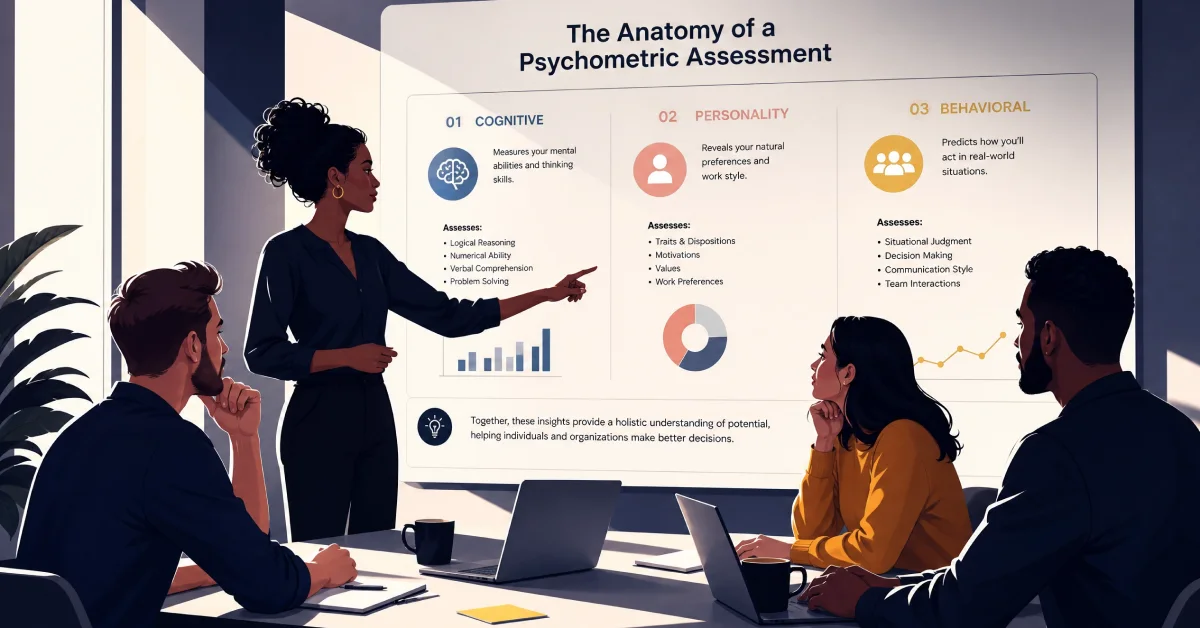
Platforms can vary in the kinds of assessments they make available. Common formats include skills tests, cognitive assessments, behavioral assessments, and structured questions or work samples; not every tool offers every format. The right choice depends on what candidates need to do in the job and what evidence will help the hiring team evaluate that work. 9 LINKS combines behavioural, cognitive, and integrity signals in its assessments.
Treat a format as a means of gathering evidence, not as proof of future performance by itself. A psychometric testing guide offers further context on choosing validated assessments and interpreting results alongside interviews and references.
How it differs from applicant tracking software
Applicant tracking software typically organizes applications and coordinates steps such as communication, review, and scheduling. An assessment platform focuses on gathering and evaluating evidence about candidates against criteria. Some employers use both, with the assessment process forming one part of a broader hiring workflow. When comparing systems, clarify which tool owns each step so recruiters do not have to re-enter information or reconcile conflicting records.
When it may be a good fit
An assessment platform may help when application volume makes consistent review difficult, when a role calls for evidence that interviews alone may not reveal, or when hiring teams need a repeatable way to compare candidates. It is less useful if the assessment is disconnected from the job or if the organization cannot explain how results affect decisions. Consider whether recruiters have time to review the evidence and whether candidates can complete the process accessibly. The best fit is a clear hiring need paired with a measure that genuinely addresses it.
How AI assessment works across the hiring process
An AI assessment process usually begins before candidates receive an invitation: the employer defines what matters in the role and selects a way to assess it. Candidates then complete an assessment, and the platform presents results for review. Recruiters interpret those results with other information rather than treating a score as a hiring decision. Clear criteria and communication make each stage more consistent.

Setting role-specific criteria
Start with the tasks and expectations that distinguish successful performance in the role. A criterion should be observable enough to assess and relevant enough to matter in the work. For example, a team might examine whether a role requires accurate processing, careful communication, or practical problem-solving, then select measures that fit those requirements. This is more useful than choosing a test simply because it is available.
A simple map can keep the link between job requirements and assessment methods visible:
| Role requirement | Possible evidence | Question to ask |
|---|---|---|
| Role-specific knowledge | Skills test or work sample | Does the task resemble real work? |
| Reasoning demands | Cognitive assessment | Is this ability relevant to the role? |
| Interaction expectations | Structured questions or behavioral assessment | Are criteria clear and job-related? |
| Required work standards | Role-specific scenario | Can candidates access the task fairly? |
Use the map to check that each assessment has a purpose and that important job requirements are not represented by a vague proxy. Employers seeking role-aligned methods can also review role fit assessment criteria when defining measures and workflow needs.
Inviting candidates and collecting responses
Candidate instructions should explain what the assessment involves, how long it is expected to take, and whom to contact if a technical or accessibility issue arises. Keep the invitation straightforward and avoid surprising applicants with an assessment that has not been described in the process. The platform should make it practical for candidates to respond using the devices and access they have. A smoother experience begins with plain language and realistic expectations.
Scoring assessments and interpreting results
A platform may score or organize responses according to its assessment design, but teams still need to understand what the outputs mean. Ask how scores relate to the assessment criteria, what limitations apply, and whether results can be reviewed in context. At 9 LINKS, reports turn behavioural, cognitive, and integrity data into clear, actionable hiring insights. Recruiters should use a report to guide further review, not to assume it captures every relevant quality of a person.
Connecting results to recruiter decisions
Assessment results are most useful when they connect to a defined decision point, such as choosing whom to invite to an interview or what to explore in a structured conversation. Recruiters can compare results with other evidence and document why a decision was made. The balance between AI and human judgment is especially relevant here: technology can support consistent screening, while people add context and remain responsible for the final call. A consistent process makes that division clear to candidates and hiring teams alike.
Which capabilities to evaluate
A platform comparison should focus on whether the product supports a sound assessment process, not on the length of its feature list. Begin with the assessment itself, then look at how results are explained, how the system fits into existing hiring tools, and whether candidates can use it. The requirements may differ across roles and hiring volumes. A capability matters when it solves a real process need without making evaluation harder to understand.
Job-relevant assessment design
Look for assessments that map to specific role requirements and can be explained in plain language. Ask whether the tasks or measures reflect the work candidates would actually do, and whether the assessment is appropriate for the hiring level. 9 LINKS tailors assessments to specific roles and hiring levels rather than relying on off-the-shelf templates. When comparing options, make the vendor show how the proposed measures connect to the role your team is hiring for.
Explainable scoring and reporting
Recruiters and hiring managers should be able to understand what a score represents and how it should inform a decision. Useful reporting makes the relevant evidence visible without implying certainty beyond what the assessment supports. Ask for sample reports and have the people who will use them explain what they would do next. If the report cannot be interpreted consistently, additional scoring detail may not improve the process.
Integrations with your hiring tools
An integration can reduce repetitive work, but only if it fits the way your team handles applications and decisions. Clarify what information moves between systems, which steps remain manual, and who can access assessment results. Ask vendors to demonstrate the workflow rather than relying on a general statement that an integration exists. The answer should help you see whether the tools work together in practice.
Candidate accessibility and user experience
A candidate-friendly process is clear, usable, and appropriate for the people applying. Review instructions, device requirements, language needs, time expectations, and how candidates can request an accommodation or report a problem. Accessibility is not a final polish step; it affects whether candidates can show relevant evidence in the first place. A candidate-accessible assessment design also considers reasonable accommodations and the risks of using a single score as the whole decision.
How to compare platforms
Comparing platforms works best when the team agrees on its needs before seeing product demonstrations. Identify the hiring challenge, the roles in scope, and the evidence recruiters need to make better decisions. Then check the quality of the assessment, the practical costs of adopting it, and how the vendor supports a trial. For a broader market overview, see a wider assessment-tool comparison, while keeping your own hiring requirements at the center of the evaluation.

Define your hiring goals and requirements
Write down what should improve if the platform works: perhaps greater consistency in early screening, clearer role-fit evidence, or a more manageable process for a high-volume team. Separate essential requirements from preferences, and include the needs of candidates as well as recruiters. Be specific about which roles and hiring stages are in scope. A short requirements brief makes vendor conversations easier to compare.
Check validation evidence and outcome data
Ask what evidence supports the assessment for the roles and candidate population you plan to evaluate. Understand how the assessment was developed, what it measures, and what the available validation information does and does not establish. Request evidence in a form your team can review, rather than relying on broad claims about accuracy. A useful assessment validation review also weighs reliability, usability, cost, and how results will be interpreted.
Review pricing, support, and implementation needs
The purchase price is only one part of the effort involved. Consider configuration, training, ongoing administration, candidate support, and the internal time needed to review results. Ask who will help resolve technical issues and what assistance is available during rollout. A realistic estimate makes it less likely that an apparently simple purchase becomes an unplanned workload.
Run a structured vendor pilot
A pilot can show how an assessment fits actual roles and recruiter routines before the organization expands its use. Set the same evaluation questions for each vendor and collect feedback from the people who will use the results. A compact pilot review can cover:
- Whether the assessment reflects the role’s real requirements.
- Whether candidates understand and can complete the process.
- Whether recruiters can interpret reports consistently.
- Whether the workflow fits current hiring tools and timelines.
After the pilot, compare the evidence against the goals set at the outset, not just the impressions from a product demonstration. Note what worked, what needs adjustment, and what remains unknown before deciding whether to proceed.
How to manage fairness, privacy, and compliance
Assessment technology should be governed as part of the hiring process, with clear responsibilities and regular review. Fairness depends on the measures, the way they are administered, and how results influence decisions. Privacy depends on what data is collected, who can see it, and how it is handled. Employers should confirm applicable legal and regulatory obligations for their locations and the way they use candidate data.
Test for bias across candidate groups
Review whether the assessment process produces patterns that warrant investigation across relevant candidate groups. Differences in results do not, by themselves, explain why a pattern exists, so examine the measure, instructions, accessibility, and decision rules. Set a regular review schedule and document what the team checks and how it responds. Fairness is an ongoing practice rather than a one-time vendor assurance.
Protect candidate data and limit access
Before implementation, establish what candidate information is collected, where it is stored, how long it is retained, and who can view it. Limit access to people who need the information for their hiring responsibilities, and make sure internal procedures match the platform’s settings. Ask vendors about data handling and security practices in terms your organization can assess. Data minimization and clear retention rules help keep the process disciplined.
Communicate how assessments are used
Tell candidates why an assessment is part of the process and how its results may be considered. Use accessible language rather than relying on general statements about technology. Candidates should know whether the assessment is one input among several and where they can ask questions or seek support. Clear communication helps people understand what is being evaluated and what happens next.
Keep human oversight in consequential decisions
People should review assessment evidence in the context of the role and the rest of the candidate’s application. Define when a score triggers further review, how exceptions are handled, and who is accountable for the decision. Human oversight is meaningful when reviewers can question an output rather than simply approve it. Documenting decisions also helps teams examine whether the process is being applied consistently.
How to implement and measure results
Implementation is more manageable when it begins with a focused use case and expands only after the team understands how the assessment works in practice. Set expectations for recruiters, hiring managers, and candidates before the first invitation goes out. Track both process measures and the experience of the people using the system. Then use the evidence to refine the approach instead of assuming the initial setup is final.
Start with a focused role or hiring team
Choose a role or hiring team where the assessment has a clear purpose and the workflow can be monitored. Define the decision point it will support, who will review results, and what other evidence will be considered. A contained start helps surface practical issues without changing every hiring process at once. It also gives the team a clearer basis for deciding whether to expand.
Train recruiters and hiring managers
Training should cover what the assessment measures, how to interpret its outputs, and what it cannot tell the team. Use examples to practice connecting results to role criteria and other evidence. Make sure recruiters know how to answer candidate questions and where to escalate technical issues. Shared understanding reduces the chance that different hiring managers will use the same report in conflicting ways.
Track quality, speed, and candidate experience
Choose a small set of measures before launch and review them consistently. Possible measures include time spent at the assessment stage, completion rates, candidate feedback, and how often assessment evidence informs a later-stage conversation. Hiring quality is harder to assess quickly, so be clear about the limits of early indicators. Track results in context and avoid presenting one metric as proof that a platform caused an outcome.
Review results and refine the process
Schedule a review after the team has enough experience to identify recurring patterns. Ask recruiters what they found useful, where candidates encountered friction, and whether the assessment criteria still match the role. Adjust instructions, workflow, or measures when the evidence supports a change, then document why. Regular review keeps the process connected to the work rather than to the original software setup.
Conclusion
An AI recruitment assessment platform can make candidate evaluation more structured when it measures relevant requirements and produces evidence people can interpret. Choose with the role, candidate experience, validation, and data practices in view; then pilot carefully and preserve human responsibility for decisions. That combination makes assessment a practical part of hiring, not a shortcut around judgment.
Frequently Asked Questions
What is an AI recruitment assessment platform?
It is software that helps employers administer and interpret structured candidate assessments, sometimes using AI to organize or analyze results. The assessment methods and outputs vary by platform.
How is an assessment platform different from an applicant tracking system?
An applicant tracking system generally organizes applications and hiring steps, while an assessment platform gathers and evaluates evidence about candidates. Some organizations use both as parts of the same workflow.
Which assessments can be used in recruitment?
Depending on the role, employers may use skills tests, cognitive assessments, behavioral measures, structured questions, or work samples. The choice should follow the job requirements rather than the availability of a particular format.
How can employers tell whether an assessment is job-related?
Ask the provider to explain what the assessment measures and how those measures connect to the role. Compare the proposed tasks and criteria with actual job responsibilities, and review available validation evidence.
Can assessment scores make hiring decisions on their own?
Scores are best treated as one source of evidence. Employers should consider them alongside other relevant information and keep people accountable for consequential decisions.
How should candidate data be protected?
Define what information is collected, who can access it, how long it is retained, and how it is handled. Review vendor practices and confirm that internal procedures meet applicable requirements.
What should a platform pilot measure?
A pilot can examine role fit, candidate completion and feedback, recruiter usability, workflow fit, and relevant process timelines. Set goals beforehand and interpret early results with care.
We Appreciate The Feedback From Our Clients.
It is always a joy to hear how our work has positively impacted them and how our assessments have helped in finding the right people.
We have used 9 LINKS psychometric tool in our Campus Placement Programme.The tool has helped us to identify right candidate as per our organisation requirements…

We have just started using it. It differentiates various personalities and helps in decision making. The clarity on its precision level will be gathered over a period of time…

Counselling test curated for NES has been very useful in identifying the skill sets and allotting appropriate job fitment to students as per their quotients. Multilingual tests developed by considering various key…

It is indeed great pleasure in my part to share complementing note to you & your team. Needless to say 9 LINKS is one of the best organisation to conduct skill gap analysis through assessment of Cognitive skills..

It is crucial that validating the quality of the candidates in recruitment. 9 LINKS is a service that we can confidently say does that. 9 LINKS online assessment precisely giving us the right candidates to pick and proceed on recruitment…

Read Our Blog For The Latest On Research & Insights.
Get Insights into latest developments in HR industry and psychometric assessments.

Take a Free Assessment


