

Key Takeaways
A role fit test is most useful when it measures something the job genuinely requires. Treat it as one source of evidence in a clear, consistent process—not as a shortcut to a hiring decision.
- Define the role’s essential skills and outcomes before selecting a test.
- Match the assessment method and depth to the work and seniority level.
- Give candidates consistent instructions and accessible ways to participate.
- Interpret results alongside interviews, work samples, and other relevant evidence.
- Explain data practices, limit access, and review assessment outcomes over time.
What a candidate role fit test measures
A candidate role fit test India employers use should connect observable evidence to the actual work, rather than to a vague picture of an ideal employee. It can help teams compare candidates against shared criteria, but it cannot predict every aspect of future performance. Start by deciding which capabilities matter for the role and which can be learned after hiring. That distinction makes the results easier to interpret and the process easier to explain.
Skills, behaviors, and role-specific competencies
Different jobs call for different evidence. A healthcare role might require accurate procedure-following and calm communication, while a manufacturing role may place more weight on quality checks and dependable work habits. The assessment should reflect the demands of the job, not simply what is convenient to test.
9 LINKS provides validated, AI-enabled psychometric assessments for hiring, combining behavioural, cognitive, and integrity signals to help employers evaluate role fit. Those kinds of signals can inform a decision, but each one still needs a clear connection to a real job requirement. A result is more useful when hiring teams can explain what it measures and how that evidence relates to the role.
Job fit versus culture fit
Job fit asks whether a person’s demonstrated capabilities and work behaviors align with role requirements. Culture fit is less precise unless it is translated into observable, job-related behaviors, such as giving constructive feedback or following agreed safety procedures. Otherwise, it can become a proxy for personal similarity and exclude people who could do the work well.
If values or working norms matter, define what they look like in practice and assess them consistently. For a broader discussion of values-based evaluation, see this guide to culture fit hiring. A shared standard should describe how work gets done, not who feels familiar to the interviewer.
How assessments complement interviews and resumes
A resume summarizes a candidate’s experience, while an interview captures responses to questions. An assessment can add another kind of evidence, such as how someone approaches a realistic task or responds to a work-related scenario. Used together, these sources can help teams distinguish evidence from impression.
For example, a candidate may have limited experience with a particular process but show sound judgment in a realistic work sample. That does not settle the decision; it gives the interviewer a more focused point to explore. A fair assessment process keeps human review central while making evidence easier to compare.
When to use a role fit test in India
A test is worth adding when it answers a hiring question that resumes and interviews do not answer reliably enough. In India, high-volume hiring can involve many applicants, varied work histories, and teams making decisions across locations. A consistent assessment may help make comparisons clearer, especially when the role has repeatable requirements. The method should still fit the candidate population and the stage of hiring.

Roles and hiring stages that benefit most
Assessments can be helpful for roles where a specific skill, behavior, or decision pattern is important and can be evaluated consistently. They may be particularly useful when hiring teams need to compare many candidates for similar frontline roles. The best point to use one depends on whether it screens for a basic requirement or provides deeper evidence for a later-stage decision.
A practical way to think about timing is to place the assessment where its result can still inform the process. An early, short test may help identify candidates who meet a clear threshold; a more involved work sample may suit a smaller group later on. For additional context on job-fit decisions, consider how role outcomes and assessment criteria can be connected before reviewing applicants.
Matching test depth to role seniority
Assessment depth should reflect the role’s responsibilities and the decision being made. A brief, job-related check may be sufficient for a role with standardized tasks, while a position involving complex judgment may call for more than one source of evidence. Seniority alone is not a reason to make a test longer or more intrusive.
A useful check is whether each added step provides information that could change a hiring decision. If it does not, it may add burden without improving the evidence. Keep the time asked of candidates proportionate to the role and to the value of the information sought.
Situations where testing may add little value
A test may add little when the relevant skill is already demonstrated through a reliable, recent work sample or when there is no clear job-related question for it to answer. It may also be a poor choice if the method creates barriers unrelated to the work, or if results cannot be interpreted consistently. A hiring process should not include assessment simply because a tool is available.
In those cases, a structured conversation or a short demonstration may provide enough evidence. Avoid turning a test into a substitute for defining the role, training interviewers, or resolving inconsistent hiring criteria. The aim is better evidence, not more steps.
How to choose the right assessment
Assessment formats reveal different things, so begin with the decision you need to make rather than the name of a test. A work sample can show how a candidate handles a task; a psychometric measure can provide structured information about relevant characteristics. Interviews and situational questions help explore reasoning and experience. Choose the least burdensome method that provides useful, job-related evidence.
Job simulations and work sample tests
A work sample asks candidates to perform a task resembling the work, such as reviewing a simple case or following a procedure. Its strength is practical relevance: candidates can show what they do, not just describe what they might do. The task should be realistic, time-limited, and suitable for the stage of hiring.
A small comparison can help clarify what a simulation should include and what it should avoid:
| Design choice | More useful approach | Less useful approach |
|---|---|---|
| Task | Reflects a real role outcome | Tests an unrelated skill |
| Time | Proportionate to the task | Requires excessive unpaid effort |
| Scoring | Uses shared, observable criteria | Depends on general impression |
| Instructions | Explain the task and constraints | Leave candidates guessing |
The point is not to reproduce an entire shift or project. A focused exercise gives candidates a fair chance to show relevant skills while keeping effort reasonable. Review the task periodically to confirm that it still represents the work.
Cognitive and psychometric assessments
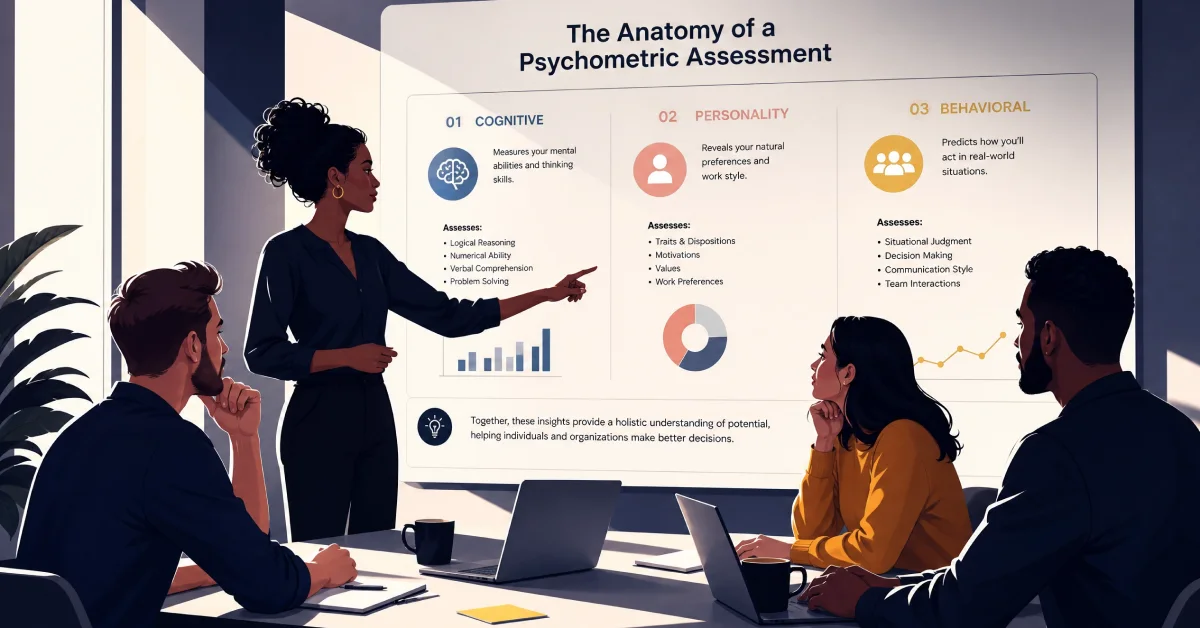
Cognitive and psychometric assessments can offer structured evidence, but a score only has meaning in context. Check what the measure is intended to assess, whether that construct is relevant to the role, and how results should be interpreted. Avoid treating a score as a complete profile of a person or as a guaranteed forecast of performance.
9 LINKS applies validated, AI-enabled psychometric assessments and tailors assessments to specific roles and hiring levels. Its assessments combine behavioural, cognitive, and integrity signals, and its reports turn those data into clear, actionable hiring insights. Employers should still make the decision through human review and consider how assessment evidence relates to other information about the candidate.
Structured interviews and situational judgment tests
Structured interviews give candidates comparable opportunities to respond to the same core questions. Situational judgment tests present work-related scenarios and ask candidates how they would respond. Both formats work best when questions and scoring criteria are set before interviews begin.
For instance, a scenario might ask how someone would handle a service issue while following a stated procedure. Score the response against defined behaviors, such as identifying the immediate concern and communicating a next step. This is more informative than deciding whether the answer simply “sounds right.”
How to build a fair and reliable process
Fairness is built into the design and administration of an assessment, not added after scores arrive. Candidates should be evaluated against job-related standards using instructions and scoring that do not change from person to person. Hiring teams also need to consider accessibility and whether a test measures the intended capability rather than an unrelated barrier. A role fit assessment tool should support clear, practical insights that remain one part of a broader decision.

Define job-related criteria before testing
Before choosing a test, turn the role description into a short set of outcomes and requirements. Separate what is essential on day one from what can be learned with training. This prevents a familiar credential or personal preference from quietly becoming a screening rule.
A concise role profile can identify the evidence the process needs to collect:
- Name the work outcomes that matter most.
- Identify the skills or behaviors needed to achieve them.
- Separate essential requirements from useful preferences.
- Decide what evidence would demonstrate each requirement.
Once those points are clear, each assessment item should map to at least one criterion. If the link is hard to explain, reconsider whether that item belongs in the process. This keeps the test focused and gives interviewers a shared basis for discussing results.
Use consistent instructions and scoring
Candidates need the same core instructions, time limits, and scoring standards for a fair comparison. Explain what the task involves and what materials are allowed. If conditions have to change for an individual candidate, record the adjustment and consider whether it affects how results should be interpreted.
Consistency also applies to the people scoring responses. Use a rubric with observable criteria, and train reviewers on how to apply it. Where practical, have more than one reviewer examine uncertain results so that a single person’s first impression does not carry the whole decision.
Check for accessibility and potential bias
A test can be job-related in theory and still create avoidable barriers in practice. Check whether its language, format, timing, device requirements, or testing environment could interfere with a candidate’s ability to show the capability being measured. Ask what adjustments may be appropriate while preserving the purpose of the assessment.
Accessibility is a design concern in many settings; North Georgia Mobility describes solutions intended to support independence, safety, and social inclusion. In hiring, the practical lesson is to consider access before candidates encounter the test, rather than waiting for a problem to arise. Review outcomes across groups where appropriate, and investigate patterns that may indicate a mismatch between the assessment and the job.
How to run the test and interpret results
A well-designed assessment can still produce poor evidence if candidates do not understand the task or hiring teams overread the score. Explain the purpose, process, and next steps in plain language. Then interpret results alongside other relevant evidence, keeping a record of how the final decision was reached. The goal is a defensible judgment, not a single number that appears to decide everything.
Set expectations and give candidates clear instructions
Before the assessment, tell candidates what it measures in general terms, how long it is expected to take, and what they need to complete it. Set out any technical or logistical requirements and provide a contact route for questions or access needs. Clear instructions reduce avoidable uncertainty and help candidates focus on the task itself.
Be straightforward about what happens after completion and when candidates can expect an update. If an exercise is a simulation rather than a full work task, say so. A predictable process respects candidates’ time and helps the hiring team apply the assessment consistently.
Combine test scores with other evidence
Test results are most useful when considered with interviews, experience, and relevant demonstrations of work. They may point to a topic worth exploring, but they do not explain every reason behind a candidate’s response. 9 LINKS reports provide actionable hiring insights from behavioural, cognitive, and integrity signals; those insights should be weighed alongside other evidence and human judgment.
A decision record can note which role criteria were met, what evidence supports that view, and where uncertainty remains. If a score appears inconsistent with a work sample or interview, investigate the difference rather than automatically favoring one source. This makes the final decision more transparent to the people responsible for it.
Handle borderline results and retesting
A borderline result is a prompt to review the evidence, not an automatic rejection or pass. Check whether the assessment was completed under the intended conditions and whether the scoring criteria were applied consistently. If an additional step could resolve a meaningful uncertainty, choose one that is relevant and proportionate.
Retesting should have a clear reason and consistent rules, such as a technical interruption or a material change in testing conditions. Repeating a test simply until a candidate gets a preferred score can undermine the process. Keep a record of the rationale and consider all available evidence before deciding.
Privacy and implementation considerations in India
Candidate information should be handled with care from the moment it is collected. Employers need to be clear about what information an assessment gathers, why it is needed, and who can see it. Practical safeguards include limiting access, setting retention practices, and reviewing service providers. Check applicable requirements with appropriate legal or privacy advisers, since obligations can depend on the circumstances and may change.
Explain what candidate data you collect and why
Give candidates a plain-language explanation of the data collected through the assessment and how it relates to hiring. Avoid gathering information that is not needed for the stated purpose, and distinguish required fields from optional ones. A clear notice helps candidates understand the process and gives the organization a reference point for handling questions.
For comparison, Bridge Bagels publishes a privacy policy that describes collection, use, sharing, retention, and rights. The details of any policy should match the organization and the applicable requirements; a general example is not a substitute for reviewing your own practices. Make the explanation easy to find before candidates submit their information.
Limit access, retention, and sharing
Only people with a legitimate hiring role should be able to view candidate assessment information. Decide how long records are needed, how they will be securely removed or archived, and whether any information will be shared outside the organization. Documenting these boundaries helps prevent casual access and unnecessary retention.
A privacy notice is only one part of the process. Make sure internal practices reflect what candidates were told, including how hiring teams discuss and store results. Review permissions and retention arrangements periodically, especially when responsibilities or systems change.
Review vendors, security, and applicable requirements
Before adopting an assessment service, understand what information it processes, what security measures are in place, and how the provider handles access, retention, and sharing. Confirm the test’s scope and reporting format, and ask how candidates can complete it accessibly. Keep a human decision-maker responsible for interpreting results and making hiring decisions.
Vendor checks are a procurement discipline across sectors. For example, AAAT’s VS3 describes carrier and insurance checks, driver and truck verification, secure pickup protocols, and documented handoffs in vehicle shipping. Those are not hiring procedures, but they illustrate the value of knowing what a process verifies and what records it leaves. When comparing service providers, a directory such as LANLocksmith.com also reminds buyers to confirm a provider’s scope and availability directly; do not assume a listing answers every due-diligence question.
Conclusion
A candidate role fit test is most valuable when it measures work that matters, gives each candidate a fair opportunity to demonstrate relevant evidence, and supports—not replaces—human judgment. Define the role criteria first, select a proportionate method, and review both the results and the candidate experience. With clear communication and careful data practices, employers can make more consistent decisions while keeping the focus on the work people will actually do.
Frequently Asked Questions
What is a candidate role fit test?
It is an assessment used to gather evidence about how a candidate’s skills, behaviors, or other job-related characteristics align with a role’s requirements. The format should depend on what the employer needs to evaluate.
Is a role fit test the same as a personality test?
No. A role fit test is a broad term for an assessment used to evaluate role-related evidence. A personality measure may be one possible component, but other methods include work samples, structured interviews, and situational questions.
When should employers use a role fit test?
Use one when it can answer a specific hiring question that other evidence does not answer well enough. It should be relevant to the work, proportionate to the role, and introduced at a stage where its results can inform a decision.
How can employers make assessments fair?
Define job-related criteria in advance, use consistent instructions and scoring, check accessibility, and review results alongside other evidence. Monitor the process for patterns that may indicate an avoidable barrier or inconsistent application.
Should assessment scores determine who gets hired?
A score should not be treated as the whole decision. Hiring teams should consider what the assessment measures, how the candidate completed it, and how the result fits with interviews, work samples, and other relevant evidence.
What should candidates be told before a test?
Explain the assessment’s purpose, expected time, instructions, technical requirements, and next steps. Candidates should also know how to ask questions or raise an access need.
How should employers handle candidate assessment data?
Tell candidates what data is collected and why, restrict access to people who need it, and set clear practices for retention and sharing. Review vendor arrangements and applicable requirements with appropriate advisers.
We Appreciate The Feedback From Our Clients.
It is always a joy to hear how our work has positively impacted them and how our assessments have helped in finding the right people.
We have used 9 LINKS psychometric tool in our Campus Placement Programme.The tool has helped us to identify right candidate as per our organisation requirements…

We have just started using it. It differentiates various personalities and helps in decision making. The clarity on its precision level will be gathered over a period of time…

Counselling test curated for NES has been very useful in identifying the skill sets and allotting appropriate job fitment to students as per their quotients. Multilingual tests developed by considering various key…

It is indeed great pleasure in my part to share complementing note to you & your team. Needless to say 9 LINKS is one of the best organisation to conduct skill gap analysis through assessment of Cognitive skills..

It is crucial that validating the quality of the candidates in recruitment. 9 LINKS is a service that we can confidently say does that. 9 LINKS online assessment precisely giving us the right candidates to pick and proceed on recruitment…

Read Our Blog For The Latest On Research & Insights.
Get Insights into latest developments in HR industry and psychometric assessments.

Take a Free Assessment


