

Key Takeaways
Cognitive assessments can add useful evidence to hiring decisions when they are tied to real job demands. Their value depends on thoughtful selection, fair administration, and interpretation alongside other evidence.
- Use a cognitive test only when the abilities it measures matter to the role.
- Check evidence of validity, reliability, language relevance, and accessibility before choosing a test.
- Give candidates consistent instructions and reasonable accommodations.
- Treat scores as one part of a decision, not as a complete picture of a person.
- Review outcomes over time to identify fairness concerns and improve the process.
What a cognitive assessment test measures
A cognitive assessment samples how a person processes information, reasons through problems, or learns from new material. For employers, the point is not to label candidates, but to understand whether particular thinking demands are relevant to a role. A cognitive assessment test for candidates India should therefore be chosen with the job, language context, and candidate population in mind.
Reasoning, problem-solving, and learning agility
Reasoning involves drawing conclusions from information, spotting relationships, and working through unfamiliar questions. Problem-solving tasks may show how a candidate approaches a defined challenge, while learning-oriented items can offer a limited indication of how readily someone handles new material. These are related abilities, but they are not interchangeable, and a short test cannot reproduce the full complexity of learning on the job.
A useful first step is to identify the decisions or tasks in the role that call for these abilities. A test may be more relevant when people regularly interpret changing information or resolve unfamiliar issues than when the work follows a fixed sequence with little variation. The job analysis, rather than a broad assumption about who is “smart,” should determine what to measure.
Verbal, numerical, and abstract reasoning
Cognitive assessments can include verbal, numerical, or abstract reasoning tasks. Verbal items may ask candidates to interpret written information; numerical items may involve understanding quantities or patterns in data; abstract items may test the ability to infer a rule from shapes or symbols. The mix should reflect the role rather than simply include every available question type.
For example, a job that requires checking numerical records may justify a relevant numerical component, while a role with frequent written instructions may make verbal comprehension more pertinent. Keep in mind that scores can be affected by reading fluency, familiarity with a format, and the language used. A test result is most informative when those factors are understood rather than mistaken for the target ability.
Cognitive ability versus personality and job knowledge
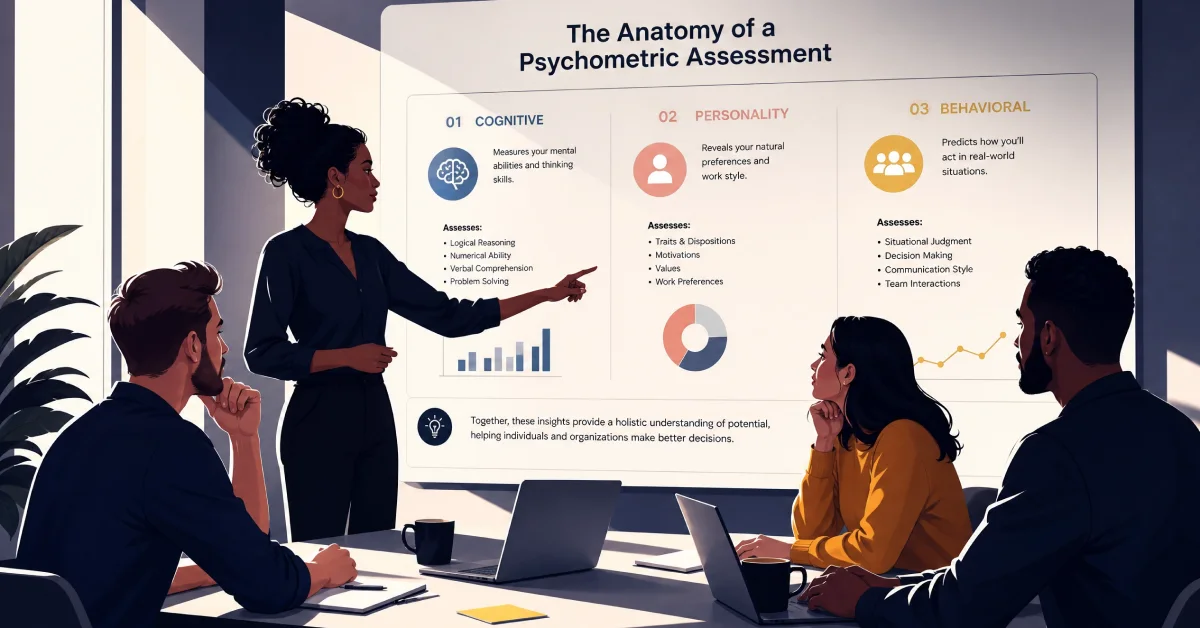
Cognitive ability concerns thinking and information processing; personality assessments explore patterns in preferences or behaviour, and job-knowledge tests check what someone already knows about a specific field. They answer different questions. Treating one as a substitute for another can create a mismatch between the evidence collected and the hiring decision.
For instance, someone may reason effectively but have limited experience with a particular system, or have deep job knowledge but need more time with unfamiliar problems. 9 LINKS describes its assessments as combining behavioural, cognitive, and integrity signals to help employers evaluate role fit and make clearer hiring decisions. That describes a broader set of signals; it does not mean any one score answers every question about a candidate.
What test scores can—and cannot—predict
Scores can offer evidence about performance on the tasks included in a particular assessment. They may help compare candidates on a relevant ability when the test has suitable evidence and is administered consistently. But they do not establish future performance with certainty, and they should not be read as a complete measure of potential, character, motivation, or fit.
The limits become clearer when employers separate assessment from other business decisions. A cognitive score does not tell a team how to attract candidates, just as real-estate lead generation is a separate concern from assessing applicants. Nor does it evaluate an employer’s website for AI crawlability, measure the cost of mental-health training, or guide Boston workspace selection. Those topics sit outside the construct a cognitive test is designed to measure.
A candidate’s score should be treated as one observation with a particular context and margin of uncertainty. If it conflicts with strong evidence from a structured interview or work sample, investigate the discrepancy rather than allowing a single number to decide the outcome. That is a more careful use of measurement than assuming the score tells the whole story.
When to use cognitive assessments in hiring
A cognitive assessment is most useful when it addresses a real hiring question that other methods may not answer as clearly. It can help structure comparisons across a large applicant pool, but only if the tested ability is needed in the job. Employers should also consider candidate effort, time, and the consequences of using the result at each stage.

Roles and hiring stages where assessments may help
Assessments may be useful in roles where people need to interpret information, learn procedures, or solve unfamiliar problems. They can also support early screening in high-volume recruitment, provided the test is job-related and candidates are given a fair chance to complete it. A test should not be added just because an employer has many applications; it should help distinguish evidence that matters for the work.
Timing matters. An early-stage test can reduce the number of candidates moving to later steps, but a high-stakes screen calls for particular care with relevance, accessibility, and review of outcomes. Recruitment marketing and applicant follow-up are separate parts of the funnel; for example, Growbi describes hiring ads, applicant screening, follow-up, and interview booking as recruitment marketing services, not as cognitive measurement.
Matching assessment content to real job demands
Start with the tasks people actually perform, then identify the thinking demands those tasks involve. If a role requires interpreting written procedures, a verbal component may be relevant; if it requires regular work with quantities, numerical reasoning may deserve attention. Avoid testing abilities that sound impressive but have no clear connection to expected work.
This simple mapping keeps the assessment focused and gives hiring teams a reason for each component. A compact comparison can make that reasoning easier to review before choosing a test.
| Job demand | Possible assessment focus | Hiring question |
|---|---|---|
| Interpreting written instructions | Verbal reasoning | Can the candidate draw meaning from text? |
| Working with quantities or records | Numerical reasoning | Can the candidate understand relevant numerical information? |
| Solving unfamiliar problems | Abstract or logical reasoning | Can the candidate identify patterns or infer a rule? |
The examples are starting points, not automatic prescriptions. Confirm the actual level and frequency of each demand with people who know the role, and check that the test asks candidates to use a comparable ability. A test is easier to justify when its content and purpose can be explained in plain language.
Situations where a cognitive test may not be appropriate
A cognitive test may add little when the role involves highly routine work and the tested abilities are not central to success. It may also be a poor fit if candidates need specialist knowledge or practical skill that a general reasoning test does not measure. In those cases, a work sample, structured questions, or another job-related method may provide more direct evidence.
Consider whether the assessment could create barriers unrelated to the job, including language demands, limited access to a suitable device, or an unnecessarily restrictive time limit. If those barriers cannot be addressed, the result may say more about the test conditions than about a candidate’s capacity to do the work. This is a reason to reconsider the method, not simply to lower expectations of candidates.
Combining test results with other selection methods
A cognitive score is stronger as part of a wider evidence base. Structured interviews can ask every candidate the same job-related questions, while work samples show how someone handles a realistic task. These methods answer different questions and can help explain what a test score does not capture.
The broader guidance on cognitive ability assessments also emphasizes matching the test to the job and interpreting results alongside interviews and work samples. A hiring team can use that principle to avoid making any one tool the sole gatekeeper. The aim is not to collect more measures for their own sake, but to assemble evidence that is relevant, consistent, and understandable.
How to choose an assessment for candidates in India
Choosing an assessment involves more than comparing question counts or test duration. Employers need to understand what the test measures, what evidence supports its use, and whether candidates can access it under workable conditions. In India, language and candidate circumstances can vary substantially across roles and locations, so local suitability deserves attention.
Checking validity and reliability evidence
Validity concerns whether the available evidence supports the intended interpretation and use of a score. Reliability concerns how consistently the assessment measures what it is intended to measure. Ask the provider what evidence is available for the test, the relevant population, and the kinds of hiring decisions the employer plans to make.
The evidence should fit the use case. A test designed for one context is not automatically suitable for another role or candidate group, and a general claim of scientific quality is not enough to evaluate a specific use. 9 LINKS describes its approach as applying validated psychometrics to hiring India’s frontline workforce and tailoring assessments to specific roles and hiring levels rather than relying on off-the-shelf templates. Employers should still examine the evidence and fit for their own intended use.
Evaluating language and cultural relevance
Language affects what a test measures in practice. If a candidate is being assessed on reasoning, unnecessary complexity in the test language can turn the result into a measure of language proficiency instead. Review instructions, examples, vocabulary, and any translation process; then ask whether those choices suit the actual job requirements.
Cultural relevance also deserves review. Items should not depend on background knowledge unrelated to the work, and examples should be understandable to the candidates expected to take the assessment. When a test is offered in different languages, check that those versions are comparable rather than assuming that translation alone makes them equivalent.
Comparing online, proctored, and supervised formats
Online testing can be convenient for distributed hiring, while proctored or supervised formats may offer more control over administration. Each format has trade-offs around access, identity checks, test conditions, and candidate experience. Choose based on the level of security needed and the realities of the recruitment process, not on convenience alone.
Before deciding, map the practical conditions candidates will face: device availability, internet reliability, location, and access to help if a technical problem occurs. An online cognitive ability test is one example of a digital format; employers should still check its content, evidence, and administration requirements rather than treating online delivery as proof of suitability.
A format that works for one hiring population may not work equally well for another. If the process spans multiple sites or candidate groups, test the logistics in advance and offer a clear route for reporting problems. Those steps make administration more predictable and help avoid confusing technical friction with ability.
Reviewing accessibility and candidate experience
Accessibility should be reviewed before a test is introduced, not only after a candidate asks for help. Consider whether instructions are clear, whether the interface works with assistive technology, and whether timing or other conditions create avoidable barriers. Seek feedback from candidates and recruiters about friction points that might affect completion.
Candidate experience is also shaped by the way an assessment is presented. A concise explanation of its purpose, expected duration, and next steps can reduce uncertainty. Treat these details as part of a sound assessment process: they help candidates understand what is being asked and allow employers to receive more interpretable results.
How to design a fair assessment process
Fairness depends on decisions made before, during, and after testing. Employers should define the job-related criteria first, then provide consistent conditions and a way to address legitimate access needs. A process that is clear on paper but varies widely in practice can undermine the meaning of the results.

Setting job-related criteria before testing
Write down which abilities matter for the role and why, using job tasks and input from people familiar with the work. Define in advance how assessment evidence will be used and what other information will contribute to a decision. This helps prevent criteria from shifting after the hiring team sees individual scores.
A short set of checks can make the design review more concrete:
- Identify the job tasks that call for the ability being tested.
- Explain how each assessment component relates to those tasks.
- Decide how test evidence will be combined with other selection evidence.
- Record who will review results and how exceptions will be considered.
Once agreed, apply the criteria consistently across candidates and document any planned changes. If a test component cannot be connected to the work, remove it or find a more direct method. Clear criteria make the process easier to explain and review later.
Standardizing instructions, timing, and conditions
Candidates should receive the same core instructions, comparable time limits, and equivalent opportunities to complete the assessment. Explain what materials or tools are permitted and how to seek support if a technical issue interrupts the test. Where practical, record deviations so the hiring team can interpret results in context.
Standardization does not mean ignoring circumstances that warrant an adjustment. It means defining the usual conditions clearly and managing permitted exceptions deliberately. If recruiters improvise instructions or apply different rules from one candidate to another, score comparisons may become less meaningful.
Providing reasonable accommodations
An accommodation can help a candidate demonstrate the ability the assessment is intended to measure without an unrelated barrier getting in the way. The right adjustment depends on the person and the format; it may involve a different presentation of instructions or an adjustment to administration conditions. Employers should have a private, straightforward way for candidates to raise a need.
Plan who will consider requests, what information is necessary, and how the decision will be communicated. Keep the focus on access to the assessment rather than asking candidates to share more personal information than the process requires. Consistent, respectful handling supports both fairness and candidate trust.
Monitoring for adverse impact across candidate groups
Review outcomes across relevant candidate groups where lawful and appropriate, and use suitable safeguards when handling sensitive information. Look for differences in completion rates, score distributions, and progression through the hiring stages. A difference does not by itself prove the cause, but it can signal that the test or its administration needs closer examination.
If a pattern appears, investigate the assessment content, language, timing, access conditions, and decision rules. Consider whether the ability is genuinely required and whether another method would provide a better job-related signal. Monitoring should lead to documented review and practical adjustments, rather than a one-time check that is never revisited.
How to administer tests and interpret results
Good administration protects the usefulness of the evidence. Candidates need to understand the purpose and conditions, and hiring teams need guidance on what a score means and where its limits lie. Results should be handled carefully, with access restricted to people who need them for the hiring decision.
Communicating the purpose and process to candidates
Tell candidates why the assessment is being used, what kind of tasks to expect, how long it is likely to take, and what will happen afterward. Avoid implying that the test can determine whether someone will succeed on its own. A straightforward explanation gives candidates a fairer understanding of the process and reduces avoidable uncertainty.
Communication should also cover practical details such as the deadline, the device or setting needed, and whom to contact if something goes wrong. If a candidate requests an accommodation, explain how to raise that request without making them guess which person to approach. Consistency in communication is part of consistent administration.
Using benchmarks and cut scores responsibly
A benchmark compares a candidate’s score with a defined reference, while a cut score sets a threshold for a decision. Neither should be treated as self-explanatory. Employers should understand how the benchmark was created, whether it fits the role and candidate population, and what evidence supports using a threshold in the intended way.
Avoid choosing a cut score simply because it produces a convenient number of shortlisted candidates. Set decision rules before reviewing individual results, and make sure there is a defensible job-related rationale. When a score is close to a threshold, other relevant evidence and the uncertainty of measurement deserve careful consideration.
Considering measurement error and score context
Any assessment score has some uncertainty. A small difference between two candidates may not represent a meaningful difference in their underlying ability, particularly if it is within the expected measurement error. Employers should ask how scores are reported and what guidance is available for interpreting differences.
Also consider conditions that may have influenced performance, including interruptions, technical trouble, language demands, or unfamiliarity with the test format. Those details do not automatically invalidate a result, but they may affect how much weight it deserves. Context turns a score from a bare number into evidence that can be judged appropriately.
Protecting candidate data and limiting access
Assessment results are candidate data and should be handled with care. Decide who needs access, why they need it, and how long the information should be retained under the employer’s policies and applicable requirements. Share only what supports the hiring process, and avoid circulating full reports more widely than necessary.
Candidates should receive clear information about how their assessment information will be used. Keep records secure, use defined access controls, and establish a process for correcting or addressing a data-handling concern. Responsible handling is part of a credible and respectful selection process.
How to use results in hiring decisions
The purpose of an assessment is to inform a decision, not to replace judgment or remove accountability from the hiring team. Results are most useful when interpreted alongside evidence that addresses other parts of the role. A clear process makes it easier to explain why a candidate advanced or did not.
Combining scores with structured interviews and work samples
Use assessment results alongside structured interviews, work samples, and other relevant evidence. Each method offers a different view: a test samples particular reasoning tasks, an interview explores examples through consistent questions, and a work sample shows performance on a practical activity. Agreement across methods can add confidence, while disagreement can identify a question worth exploring.
For example, a candidate whose score is lower than expected may still demonstrate strong role-related performance in a work sample. Rather than ignoring either result, consider whether the assessment measured an essential demand and whether test conditions were suitable. 9 LINKS says its reports turn behavioural, cognitive, and integrity data into clear, actionable hiring insights; employers should still apply those insights with human judgment and the full evidence available.
Training hiring teams to interpret results consistently
Hiring teams need shared guidance on what a score can and cannot support. Train decision-makers to distinguish cognitive evidence from job knowledge or personality, use established decision rules, and avoid reading more into a result than the assessment warrants. The training should include examples of how to discuss conflicting evidence without defaulting to intuition.
A short calibration session before a hiring round can help interviewers and assessors align on the criteria. Review a few sample scenarios, agree on how to record reasoning, and make clear who can answer questions about the assessment. Consistency grows from practice, not simply from sending a report to the team.
Documenting decisions and reviewing outcomes
Record the criteria used, the evidence considered, and the reason for the decision in a concise and job-related way. Documentation helps teams explain their choices, spot inconsistent use of results, and respond to later questions. It should capture the rationale without reproducing sensitive candidate details unnecessarily.
Review patterns across hiring stages as well as individual decisions. For instance, compare how many candidates complete the assessment and progress afterward, and examine whether the process is working as intended. A record of decisions is useful only if someone returns to it and asks what the results reveal about the process.
Improving the process through ongoing validation
Treat assessment use as something to review over time. Check whether the test remains relevant as job tasks change, whether hiring outcomes support the intended use, and whether candidate feedback identifies avoidable barriers. If the role or process changes substantially, revisit the assessment criteria rather than assuming the old setup still fits.
Ongoing review should include evidence quality, fairness, candidate experience, and the consistency of decision-making. Adjust the process when findings justify it, then document what changed and why. That cycle helps employers use assessment evidence thoughtfully rather than treating a test as a permanent answer to a changing hiring need.
Conclusion
A cognitive assessment can make hiring decisions clearer when it measures abilities that matter to the role and is administered fairly. Employers in India can get more value from these tools by checking evidence, accounting for candidate context, and combining scores with structured interviews and practical work evidence. The score should inform a decision, while responsibility for that decision remains with the hiring team.
Frequently Asked Questions
What does a cognitive assessment test measure?
It samples abilities such as reasoning, interpreting information, and solving problems. The specific abilities depend on the test and should be relevant to the job.
Are cognitive assessment tests suitable for every role?
No. They are most appropriate when the abilities measured are important to the work. For some roles, a practical work sample or job-knowledge assessment may provide more direct evidence.
Should a cognitive test be used as the only hiring filter?
Usually, it is better treated as one source of evidence. Structured interviews, work samples, and other job-related information can provide a broader basis for a decision.
How can employers check whether an assessment is suitable?
Review the evidence for validity and reliability, the fit between test content and job demands, and the assessment’s language, accessibility, and administration conditions.
How should employers set a cut score?
Set decision rules before reviewing individual results and require a job-related rationale for any threshold. Consider the evidence supporting the benchmark and the uncertainty around scores.
What if a candidate needs an accommodation?
Provide a clear, private way to request an adjustment and consider what will allow the candidate to demonstrate the ability being assessed. Handle requests consistently and respectfully.
How often should an assessment process be reviewed?
Review it periodically and whenever job requirements or hiring conditions change. Examine fairness, candidate experience, completion patterns, and whether the assessment remains relevant to the intended decision.
We Appreciate The Feedback From Our Clients.
It is always a joy to hear how our work has positively impacted them and how our assessments have helped in finding the right people.
We have used 9 LINKS psychometric tool in our Campus Placement Programme.The tool has helped us to identify right candidate as per our organisation requirements…

We have just started using it. It differentiates various personalities and helps in decision making. The clarity on its precision level will be gathered over a period of time…

Counselling test curated for NES has been very useful in identifying the skill sets and allotting appropriate job fitment to students as per their quotients. Multilingual tests developed by considering various key…

It is indeed great pleasure in my part to share complementing note to you & your team. Needless to say 9 LINKS is one of the best organisation to conduct skill gap analysis through assessment of Cognitive skills..

It is crucial that validating the quality of the candidates in recruitment. 9 LINKS is a service that we can confidently say does that. 9 LINKS online assessment precisely giving us the right candidates to pick and proceed on recruitment…

Read Our Blog For The Latest On Research & Insights.
Get Insights into latest developments in HR industry and psychometric assessments.


Take a Free Assessment


