

Key Takeaways
A well-designed employee selection assessment adds useful evidence to a hiring decision without replacing human judgment. The strongest process is job-related, consistent, accessible, and reviewed over time.
- Define success in the role before choosing a test.
- Match each assessment to a specific job requirement.
- Use clear scoring standards for comparable candidates.
- Consider results alongside interviews and work samples.
- Protect candidate data and monitor the process for fairness.
What employee selection assessment involves
An employee selection assessment is a structured way to gather evidence about a candidate’s fit for a particular role. It can include tests, work samples, structured interviews, or a combination of methods. For employers hiring at volume across India, the aim is not to find a single score that settles every decision; it is to make decisions more consistent and better grounded in role requirements.
How assessments fit into the hiring process
Assessments are usually most useful after basic eligibility checks and before a final hiring decision. A recruiter might use an initial test to identify candidates who meet a stated requirement, then use an interview or work sample to explore relevant evidence in more depth. This sequencing helps keep the process focused without asking every candidate to complete a lengthy exercise.
A clear process also makes it easier to explain what candidates can expect. Employers can describe when an assessment happens, how it relates to the role, and how the result will be considered. For a practical overview of the stages involved, see this guide to candidate assessment.
What they can measure beyond résumés and interviews
A résumé records what a candidate says they have done, while an interview captures their responses in a particular setting. Depending on the method, an assessment can add evidence about job knowledge, task performance, reasoning, work-related behaviours, or responses to realistic scenarios. Role-relevant evidence is the point: a test should tell the hiring team something useful about the work, not simply produce a score.
No method reveals a person completely, and results can be affected by factors such as familiarity with a test format, language, or access to technology. A thoughtful process therefore treats assessment data as one part of a broader picture rather than a definitive label.
When assessments add value—and when they may not
Assessments can help when a role has clear requirements that are difficult to evaluate consistently through résumé review alone. They may be especially useful in high-volume hiring, where interview time is limited and multiple hiring managers need a common basis for comparison. A broader discussion of employee selection methods can help teams consider where a test fits among other screening steps.
They may add little when the exercise does not reflect the job, when results cannot be interpreted reliably, or when the hiring team has not decided how the evidence will affect a decision. In those cases, a new test may add friction without improving selection. The useful question is not whether an assessment is available, but whether it will improve a specific part of the decision.
Common assessment methods used in India
Employers in India use a range of assessment formats, from short knowledge checks to role-based simulations. The right choice depends on what a candidate will actually need to do, the volume of hiring, and the time available to assess people fairly. It also helps to understand what each method can—and cannot—show before combining it with other evidence.

Job-knowledge and skills tests
Job-knowledge tests check whether candidates understand material that is directly relevant to the role. Skills tests ask them to demonstrate a task, such as entering information accurately or working through a job-specific problem. A test is more informative when its content reflects real work rather than abstract knowledge that the person may never use.
For instance, an employer might assess a candidate’s familiarity with a required procedure, then confirm practical ability through a supervised task. The content and scoring should be set in advance so that the same standard applies across candidates. A guide to customized hiring assessment offers further ideas for connecting test design to role requirements.
Cognitive and aptitude assessments
Cognitive or aptitude assessments are designed to measure abilities such as reasoning or learning-related skills. Their relevance depends on the demands of the job: a score has limited value if it does not connect to tasks the employee will perform. Employers should also consider whether language, time limits, or test access could affect how candidates demonstrate their ability.
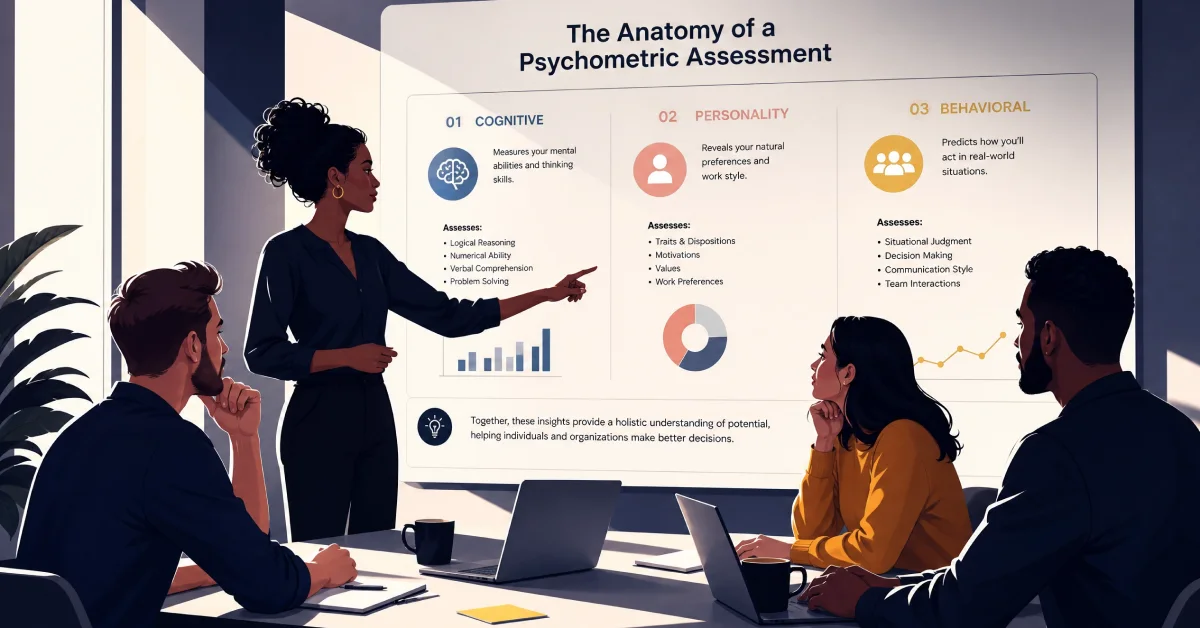
A cognitive result is best treated as one data point, not a prediction of a person’s entire future at work. For example, hiring teams can check whether it aligns with evidence from a structured interview or a relevant work sample. 9 LINKS offers validated, AI-enabled psychometric assessments for hiring India’s frontline workforce, combining behavioural, cognitive, and integrity signals to help employers evaluate role fit.
Personality and situational judgment assessments
Personality assessments describe patterns in work-related preferences or behaviours, while situational judgment assessments ask candidates how they might respond to a work scenario. Neither should be used to declare someone universally suitable or unsuitable. Their value depends on whether the measured information is relevant to the role and interpreted with care.
A scenario can be particularly useful when it reflects a genuine decision employees face, such as responding to a service issue or following a safety procedure. Hiring teams should agree in advance what a strong response demonstrates. The method should complement direct evidence rather than turn a preferred style into an unwritten hiring requirement.
Work samples, simulations, and structured interviews
Work samples and simulations let candidates demonstrate parts of a job in a controlled setting. Structured interviews, meanwhile, give candidates comparable prompts and use agreed criteria to assess responses. These methods can provide concrete evidence, though they take time to design and should avoid asking candidates to complete unnecessary unpaid work.
A useful way to compare the formats is to look at what each can contribute and where its limits lie.
| Method | Useful for | Watch for |
|---|---|---|
| Knowledge test | Checking role-specific information | Content that does not match actual duties |
| Work sample | Observing a relevant task | Unreasonable time or equipment demands |
| Situational judgment | Exploring responses to a work scenario | Scoring based on unstated preferences |
| Structured interview | Comparing evidence across candidates | Inconsistent prompts or informal scoring |
No method is automatically better than another. Select the one that produces relevant evidence at a reasonable cost to candidates and hiring teams, then explain how it fits into the overall decision.
How to choose the right assessment
Choosing an assessment starts with the work, not with a vendor catalogue. Employers should identify the capabilities a role requires, then decide which evidence would help show whether a candidate can meet those demands. This is particularly important when a method will be used across a large or varied applicant pool.
Start with role requirements and success criteria
Translate the job description into a small set of observable requirements. These might include accuracy, a technical skill, communication in a defined context, or the ability to follow a process. When criteria are specific, it becomes easier to decide whether an assessment is useful and to explain that decision to candidates.
Before selecting a method, hiring teams can use a short sequence of questions to make the role connection explicit:
- Which tasks are essential from the start?
- What evidence would show a candidate can perform them?
- Which requirements can be assessed fairly before hiring?
- How will the result inform the final decision?
This simple exercise helps prevent teams from testing for traits that sound desirable but have no clear connection to the work. It also gives interviewers a shared basis for evaluating candidates.
Check reliability, validity, and relevance to the job
Reliability concerns whether an assessment produces consistent results under comparable conditions. Validity concerns whether the evidence supports the interpretation the employer wants to make. Both questions matter, but neither removes the need to check fit with the actual role and candidate population.
Ask what the assessment measures, how it was evaluated, and whether its use is appropriate for the job in question. A general behavioral assessment guide can help teams consider what such measures can and cannot reveal. Practical evaluation standards also appear in other fields, such as guidance on qualifying gummy testing labs, though hiring assessments require their own job-related evidence and review.
Consider accessibility, language, and candidate experience
A candidate’s result should reflect relevant ability as far as possible, not avoidable barriers in the testing process. Consider whether instructions are clear, the language is appropriate to the role, and candidates have a reasonable way to access the assessment. Where accommodations are needed, provide a consistent route for requesting them.
Candidate experience also affects whether people understand and complete the process. Tell applicants how long an assessment is expected to take, what it involves, and whom they can contact with questions. These steps help make the process more transparent without promising that every candidate will find the test easy.
Compare in-house tools with external assessment providers
An in-house test can offer close control over content, while an external provider may bring assessment expertise or administration support. In either case, employers should understand the method, evidence behind it, data handling, and the practical support available to candidates. Make the comparison against the role requirements and the organisation’s capacity to manage the process responsibly.
9 LINKS applies validated psychometrics and AI to hiring, with assessments tailored to specific roles and hiring levels. Its reports turn behavioural, cognitive, and integrity data into hiring insights. These capabilities may be relevant when an employer is evaluating assessment options for frontline hiring, but every organisation should still check whether a given method fits its roles and process.
How to design a fair and consistent process
Fairness is not achieved by using the same test and then assuming the process is neutral. It requires clear criteria, comparable conditions, appropriate interpretation, and room for relevant context. A consistent approach makes it easier for hiring teams to explain decisions and to identify where the process may need adjustment.

Set scoring rubrics before reviewing results
A scoring rubric describes what different levels of performance mean before the hiring team sees candidate results. It reduces the risk that expectations will shift to fit a particular applicant and helps interviewers focus on evidence rather than general impressions. Rubrics work best when they describe observable behaviours or task outcomes in plain language.
For a practical example, a team assessing written responses might define what counts as complete, accurate, or unclear before reviewing submissions. The same principle applies to interview answers and work samples. Agreeing the standards early creates a common reference point without requiring every candidate to give identical responses.
Use the same assessment standards for comparable candidates
Comparable candidates should receive the same core instructions, assessment conditions, and scoring criteria. Some adjustments may be appropriate to support access, but they should be handled consistently and documented. Teams should also avoid introducing new assessment steps for only a subset of applicants without a clear, job-related reason.
Consistency supports fair comparison, but it does not mean ignoring meaningful differences in experience or evidence. Hiring managers can record relevant context and explain how it affected their assessment. The aim is to apply the same standard, not to force every candidate into an identical profile.
Combine assessment results with other selection evidence
Assessment results are more useful when interpreted alongside other relevant evidence, such as a structured interview, work sample, or verified qualifications. If a score conflicts with other evidence, the team should investigate rather than automatically favoring one source. This helps prevent a single result from becoming an unintended hiring verdict.
A balanced decision process can ask whether the candidate has shown the required skill, how the assessment relates to day-to-day work, and what uncertainties remain. The pre-employment assessment guide discusses using tests with interviews and other evidence. A useful assessment supports judgment; it does not remove the need for it.
Train hiring teams to interpret scores responsibly
Hiring teams need a shared understanding of what a score represents, what it does not represent, and how it should affect a decision. Training can cover basic interpretation, the limits of assessment results, and the importance of recording evidence against agreed criteria. This is especially helpful when several people take part in high-volume hiring.
Clear guidance can reduce overconfidence in a number or label. It also gives recruiters a way to raise questions when a result seems inconsistent with other information. The goal is not to turn every hiring manager into a psychometric specialist, but to ensure that assessment evidence is handled carefully.
Privacy, fairness, and compliance considerations in India
Candidate information should be collected and used for a clear hiring purpose. Employers need to consider who can see assessment results, how long they are kept, and how candidates are informed about the process. Policies and legal obligations may vary with context, so organisations should seek appropriate advice rather than rely on assumptions.
Explain what candidate data is collected and why
Tell candidates what information an assessment gathers, why it is needed, and how it may inform the hiring decision. Keep the explanation understandable and consistent with the actual process. If data is used for an additional purpose, such as later analysis, explain that separately and handle it under applicable requirements.
Transparency is easier when the hiring team knows exactly what the tool collects and what the results mean. Organisations can also review general practices for communicating personal information handling, while ensuring their own notices accurately describe their own process and responsibilities.
Limit access, retention, and sharing of assessment data
Only people who need assessment information for a legitimate hiring task should have access to it. Set a retention period, make clear how results are shared internally, and review arrangements with any external provider. Avoid keeping candidate data indefinitely simply because storage is convenient.
Good information practices also require practical controls: decide who can export or forward results, and what happens when a hiring process ends. Clear procedures make it less likely that sensitive candidate information will circulate beyond its original purpose. Apply the same care to paper records and informal notes as to digital systems.
Review assessments for bias and adverse impact
A method can appear neutral yet create barriers or produce different outcomes across candidate groups. Review how candidates experience the assessment and whether results show patterns that merit investigation. Where concerns arise, examine the test content, administration conditions, and interpretation rather than assuming the score alone explains the difference.
Regular review is especially useful as hiring volume grows or assessments are used for different roles. Employers can also consult guidance on AI assessment fairness when automated tools are part of the process, while keeping human review and job relevance central.
Check applicable Indian employment and data-protection requirements
Requirements can depend on the type of data, how it is processed, and the circumstances of hiring. Employers should review the rules that apply to their organisation and assessment process, including any relevant employment and data-protection obligations. This article is a practical overview, not legal advice.
A short internal review can help identify who owns compliance questions and when specialist guidance is needed. It is also useful to check whether candidate notices, vendor arrangements, and retention practices match the organisation’s current process. A careful approach protects candidates and gives hiring teams a clearer basis for their decisions.
How to implement and improve assessments
An assessment process should be treated as something to test and maintain, not a one-time purchase. Roles change, candidate populations shift, and a method that worked well for one job may not suit another. A measured rollout gives employers a chance to find problems before they affect a large number of applicants.
Pilot assessments with representative candidates
A pilot lets the team check whether instructions are clear, the assessment is practical, and the results are usable in the decision process. Include people who reflect the candidates likely to take the assessment, and note where access, language, or technology causes friction. Avoid drawing strong conclusions from a small pilot; its first purpose is to identify issues and improve administration.
After the pilot, review candidate questions, completion patterns, and recruiter experience. Make changes where the method or instructions create unnecessary obstacles. Document what changed so future hiring teams understand which version they are using.
Track job-related outcomes and hiring KPIs
Useful measures may include completion rates, time to complete hiring steps, candidate withdrawal, and later job-related indicators. Choose measures that are meaningful for the role and interpret them cautiously; a change in one hiring metric does not prove that an assessment caused it. Keep comparisons grounded in consistent definitions and an appropriate time period.
9 LINKS describes its approach as supporting role fit, clearer hiring decisions, and reduced attrition. Those are aims to evaluate in context, not guaranteed outcomes. Employers can track their own results to see whether an assessment is contributing useful evidence for the roles where it is used.
Gather feedback from candidates and hiring managers
Candidate and recruiter feedback can reveal issues that numbers alone miss. Candidates may flag unclear instructions or technical barriers, while hiring managers can describe whether results help them make a better-informed decision. Ask focused questions and look for recurring themes rather than treating a single comment as conclusive.
It may help to separate feedback about the assessment itself from feedback about the wider hiring process. For instance, people can report an easy-to-use test that was scheduled poorly, or a well-run process with an irrelevant test. Keeping those questions distinct makes improvements more precise.
Reassess tools as roles and business needs change
Review an assessment when job duties change, the hiring population shifts, or evidence suggests the method is no longer useful. Revisit the content, instructions, scoring, and administration conditions instead of assuming the original setup remains appropriate. Keep a record of the reason for each change and who approved it.
A short recurring review can prevent an old test from becoming a default requirement without fresh justification. Teams can also compare the assessment with current work practices and candidate feedback. That keeps the process practical as business needs evolve.
Conclusion
A useful employee selection assessment is tied to the work, applied consistently, and interpreted alongside other evidence. Employers in India can make the process more effective by defining role requirements first, choosing methods carefully, protecting candidate data, and reviewing results as hiring needs change.
Frequently Asked Questions
What is an employee selection assessment?
It is a structured method for gathering evidence about whether a candidate meets requirements for a particular role. It may involve a test, work sample, structured interview, or a combination of methods.
Which assessment method is best for hiring?
There is no single best method for every role. Choose the format that measures an important job requirement and can be administered and interpreted fairly.
Should assessment results determine the hiring decision?
No single score should automatically decide a hiring outcome. Assessment results are most useful when considered with relevant interviews, work samples, qualifications, and human judgment.
How can employers make assessments fairer?
Use job-related criteria, give comparable candidates consistent instructions and conditions, set scoring standards in advance, and review outcomes for barriers or patterns that may need attention.
When should an employer use a work sample?
A work sample can help when a candidate can demonstrate an important task in a realistic, controlled setting. Keep the exercise proportionate and avoid asking for unnecessary unpaid work.
What should candidates know before taking an assessment?
Candidates should receive clear information about what the assessment involves, how long it may take, why it is being used, and how they can ask questions or request appropriate support.
How often should employers review their assessments?
Review assessments when roles or hiring needs change, and periodically check whether the method remains relevant, accessible, and useful. Candidate feedback and job-related outcomes can inform that review.
We Appreciate The Feedback From Our Clients.
It is always a joy to hear how our work has positively impacted them and how our assessments have helped in finding the right people.
We have used 9 LINKS psychometric tool in our Campus Placement Programme.The tool has helped us to identify right candidate as per our organisation requirements…

We have just started using it. It differentiates various personalities and helps in decision making. The clarity on its precision level will be gathered over a period of time…

Counselling test curated for NES has been very useful in identifying the skill sets and allotting appropriate job fitment to students as per their quotients. Multilingual tests developed by considering various key…

It is indeed great pleasure in my part to share complementing note to you & your team. Needless to say 9 LINKS is one of the best organisation to conduct skill gap analysis through assessment of Cognitive skills..

It is crucial that validating the quality of the candidates in recruitment. 9 LINKS is a service that we can confidently say does that. 9 LINKS online assessment precisely giving us the right candidates to pick and proceed on recruitment…

Read Our Blog For The Latest On Research & Insights.
Get Insights into latest developments in HR industry and psychometric assessments.


Take a Free Assessment


