

Key Takeaways
A well-designed employment assessment should clarify job-related evidence, not replace thoughtful hiring judgment. These principles can help employers build a process candidates can understand and hiring teams can use consistently.
- Begin with the actual tasks and success criteria of the role.
- Choose assessment formats that measure the skills and behaviors the job requires.
- Apply consistent standards and provide accessible ways to participate.
- Interpret scores alongside interviews, work samples, and other relevant evidence.
- Review outcomes over time to identify bias, improve candidate experience, and keep tests current.
What employment assessment means in India
An employment assessment is a structured way to gather evidence about whether a candidate can meet the requirements of a role. In India, where hiring may span different regions, languages, industries, and workforce levels, the process needs to reflect the work people will actually do. Assessments are most useful when they add relevant evidence to a broader hiring decision, rather than acting as a shortcut. A practical guide to pre-employment assessments offers a related overview of role relevance, candidate diversity, and combining tests with structured interviews.
How assessments fit into the hiring process
Assessments can appear at different points in recruitment, from an early screening stage to a later step for shortlisted candidates. The right timing depends on the role, the number of applicants, and the kind of evidence needed. For high-volume hiring, a brief, relevant assessment may help teams decide who should proceed; for a specialist role, a work sample may be more informative after an initial conversation. Explain the step and its purpose before candidates begin, so they know what to expect.
Which roles and hiring needs benefit most
Assessments can be useful when a role has observable skills, repeated tasks, or work demands that interviews alone may not reveal. This often applies to frontline and high-volume recruitment in areas such as healthcare, hospitality, manufacturing, BFSI, and IT, though the appropriate measure will differ by job. For a customer-facing position, communication and judgment may matter; for an operational position, accuracy or task knowledge may be central. In apparel retail or textile work, a role-specific scenario might reflect the product context; a general Indian fashion guide illustrates the range of garments and styles a customer-facing team could encounter.
How assessments differ from interviews and background checks
An assessment measures performance or responses against a defined task or set of criteria. An interview helps a hiring team explore experience, reasoning, and examples through conversation, while a background check is a separate process for verifying specified information. Each can contribute different evidence, and none should be treated as a complete picture of a person. A useful overview of pre-employment testing also frames testing as one part of candidate screening rather than a stand-alone hiring decision.
Common types of employment assessments
The label “assessment” covers several methods, and they do not answer the same question. Some show how a candidate performs a task; others explore reasoning, behavioral tendencies, communication, or responses to work situations. Employers should choose based on what they need to learn, not simply on what is easiest to administer. Knowing the difference makes it easier to set expectations with candidates and interpret results appropriately.

Job-specific skills and work-sample tests
A work sample asks candidates to complete a task similar to something they would encounter on the job. This might involve prioritizing a service request, checking a set of records, or explaining a process, depending on the role. Because the task is tied to actual work, it can provide concrete evidence of job-related skills; it should still be scoped fairly and take a reasonable amount of time. Use instructions and scoring criteria that match what the role truly requires.
Cognitive and aptitude assessments
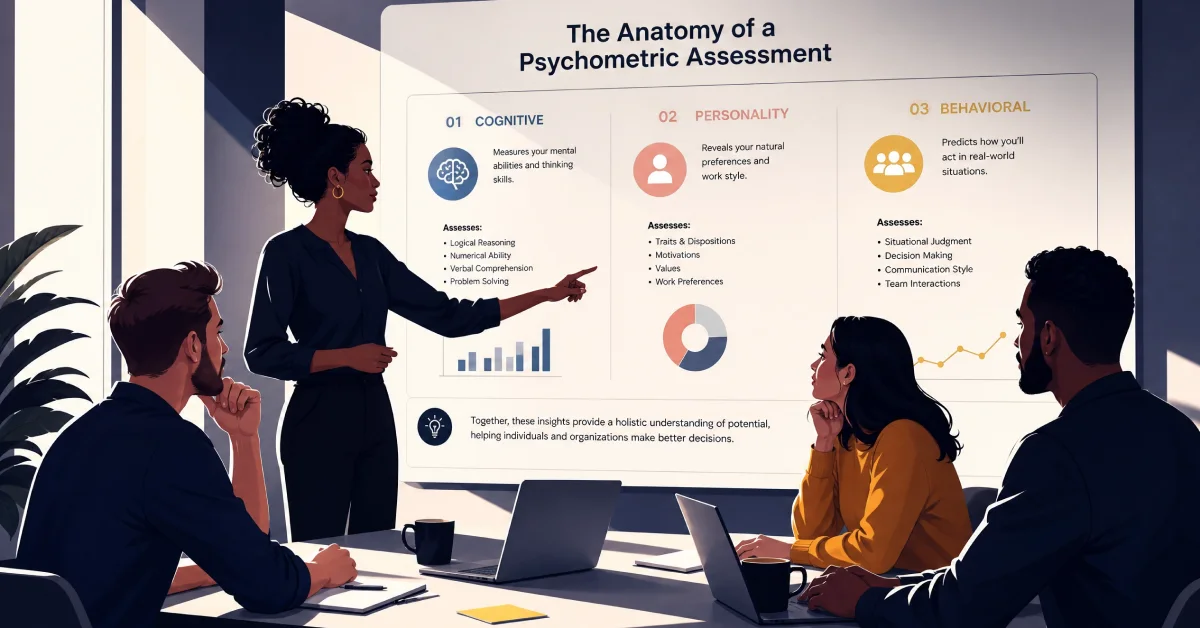
Cognitive and aptitude assessments can measure abilities such as reasoning, learning, or problem-solving, depending on the test. Their relevance depends on whether the ability matters in the role and whether the assessment has been evaluated for that purpose. A score should not be treated as a universal measure of potential or competence. 9 LINKS provides validated, AI-enabled psychometric assessments that combine behavioural, cognitive, and integrity signals; use of any such evidence should remain tied to role requirements and human review.
Personality and behavioral assessments
Personality and behavioral assessments describe patterns in how a person may approach situations, interact, or make decisions. They can support discussion of role fit, but they do not establish that someone will behave one way in every setting. The job context, the quality of the assessment, and the limits of interpretation all matter. 9 LINKS applies psychometric assessments to hiring and its reports turn behavioural, cognitive, and integrity data into hiring insights; employers should still weigh those insights with other evidence.
Language, communication, and situational judgment tests
Language and communication tests can be appropriate when those skills are genuinely needed for the role, such as explaining instructions or responding to a customer. Situational judgment tests present a work scenario and ask candidates to choose or describe a response, giving employers a way to explore practical judgment. The language, reading level, and scenario should reflect the actual job rather than introduce an unnecessary barrier. A test designed for one region or customer group may not transfer cleanly to another without review.
How to choose the right assessment
Choosing a test starts with the hiring decision you need to make. A test can look polished and still be a poor fit if it measures something unrelated to the work, takes too long, or produces results that hiring teams cannot interpret. Consider the role, the candidate experience, and how the result will be used before comparing tools. This guide to assessment software in India covers role matching, vendor evaluation, candidate data, and fair use of results.
Start with role requirements and success criteria
Describe the work before choosing the test. Talk with people who understand the role, identify its important tasks, and define what acceptable performance looks like in observable terms. Separate essential requirements from preferences, and avoid measuring a trait simply because it is easy to score. A short role profile with clear success criteria gives the hiring team a sound basis for evaluating formats and vendors.
Match assessment formats to the skills being measured
Different formats suit different questions: a work sample can show task execution, a structured reasoning test can assess problem-solving, and a situational judgment exercise can explore responses to realistic scenarios. Comparing formats side by side can make the choice more concrete.
| Hiring question | Possible format | What to check |
|---|---|---|
| Can the candidate complete a core task? | Work sample | Similarity to real work and scoring consistency |
| Does the role rely on a defined reasoning skill? | Cognitive or aptitude test | Job relevance and appropriate interpretation |
| How might the candidate respond to a work scenario? | Situational judgment test | Realistic scenarios and clear scoring criteria |
| Is a specific communication skill needed? | Language or communication test | Required level and accessible instructions |
The format should provide evidence that is useful for the role, not just a convenient number. For roles recruiting across locations or worksites, practical constraints also deserve attention; a workspace options comparison considers access, location, and terms in a different context, while hiring teams should apply the same careful comparison to assessment access and administration.
Evaluate validity, reliability, and accessibility
Validity concerns whether an assessment measures what it is intended to measure for the hiring purpose at hand. Reliability concerns whether the results are sufficiently consistent under comparable conditions. Ask vendors for clear evidence and explanations rather than relying on broad claims, and consider whether instructions, timing, language, and technology requirements could affect candidates unevenly. Employers can explore fair cognitive assessment practices when a role calls for a cognitive measure.
Compare vendors, costs, and integration options
Compare vendors on job relevance, evidence for the assessment, candidate support, data handling, reporting, and the practical work required to administer it. Ask how results are explained to hiring teams and what training or support is available. Costs should include more than a quoted fee: consider setup, administration, accessibility, and the time needed to review results. 9 LINKS provides assessments tailored to roles and hiring levels, with reports intended to turn behavioural, cognitive, and integrity data into clear hiring insights; employers should confirm that a specific offering fits their needs before adopting it.
How to run a fair and compliant assessment
Fair administration depends on more than selecting a suitable test. Candidates should receive clear instructions, comparable opportunities to complete the assessment, and a reasonable way to ask questions or request support. Employers should also establish how results will be used and who can access them. These steps make the process easier to explain and review, especially when many candidates are being assessed.

Set consistent criteria for all candidates
Candidates applying for the same role should be assessed against the same job-related criteria, with consistent instructions and scoring rules. Document any approved variations, such as an accommodation, so that adjustments support equal access without changing the underlying requirement being assessed. For a high-volume process, write down the sequence and decision points in advance; this reduces the risk that standards shift from one applicant to another. Consistency makes results easier to interpret and decisions easier to explain.
Protect candidate data and explain how it will be used
Tell candidates what information the assessment collects, why it is needed, who may review it, and how it will inform the hiring process. Limit access to people who need the information for that purpose, and follow a defined retention and deletion approach. A published ShoeResidence privacy notice is an example of a consumer-facing explanation of personal-data practices; it is not a substitute for a hiring-specific notice or legal advice. Clear communication helps candidates understand what they are being asked to share.
Provide reasonable accommodations and accessible formats
Assessments should give candidates a fair opportunity to demonstrate the skills required for the job. Review whether the format creates avoidable barriers, and provide reasonable accommodations or accessible alternatives where appropriate. Some roles involve emotionally demanding work; candidate selection should be kept distinct from employee support, such as Mental Health First Aid training. Explain how candidates can request an adjustment and handle requests consistently and respectfully.
Review applicable Indian employment and data-protection requirements
Requirements may depend on the assessment, the role, the employer, and the data involved, so organizations should seek qualified advice for their circumstances. Establish internal review for how assessments are administered, what information is collected, and how decisions are documented. For site-based roles, understand the working environment that candidates may enter; information about modular buildings for worksites can serve as a reminder that work settings vary, though it does not determine hiring or legal requirements. Review policies periodically rather than assuming a process remains appropriate indefinitely.
How to use assessment results in hiring decisions
Assessment results are evidence, not a verdict. Their value comes from how well they relate to the role and how carefully the hiring team combines them with other information. Decide in advance what each measure can and cannot tell you, then apply that interpretation consistently. This keeps a score in perspective and gives interviewers a clearer basis for follow-up questions.
Combine test results with interviews and other evidence
Use assessment results alongside structured interviews, relevant work samples, and other job-related evidence. Each method offers a different view: a test may capture a particular skill or response pattern, while an interview can clarify examples and context. Compare evidence against the same role criteria rather than letting one result quietly outweigh everything else. When accounts differ, investigate the discrepancy fairly instead of assuming the score or the interview is automatically correct.
Set score thresholds and decision rules in advance
If a score threshold is part of the process, define it before reviewing candidates and connect it to the demands of the job. Decide how results will be used: as a screening criterion, a prompt for interview questions, or one factor among several. Record the reasoning and identify who can approve exceptions. A guide to role-fit assessment discusses the value of clear criteria, realistic work samples, and consistent scoring standards.
Interpret results in the context of each role
The same result may have different relevance across jobs. A measure that is useful for one position may not predict success in another, even within the same organization. Consider the work environment, required tasks, and level of responsibility, and be cautious about treating broad labels as precise descriptions of an individual. The hiring team should be able to explain how a result connects to the job in plain language.
Avoid common mistakes such as overreliance on a single score
A single score can hide uncertainty, context, or the limits of the test itself. Avoid using a measure that has no clear job connection, changing standards after seeing results, or treating a personality description as a fixed prediction. Scores should help teams ask better questions and compare evidence, not remove the need for judgment. A decision is stronger when its logic is documented and the evidence is proportionate to the role.
How to measure and improve assessment outcomes
A hiring assessment should be reviewed after it is introduced, not treated as a permanent fixture. Track whether candidates can complete it, whether hiring teams find the results useful, and whether the measure relates to performance in the role. Look for patterns that suggest unnecessary friction or uneven effects. Regular review helps keep the process grounded in current work rather than old assumptions.
Track completion rates and candidate feedback
Monitor how many candidates start and finish the assessment, how long completion takes, and where people appear to drop off. Invite feedback on clarity, relevance, accessibility, and technical difficulties, and review it alongside operational data. Low completion may point to poor communication, a burdensome format, or an access issue rather than a lack of candidate interest. Use the information to test practical improvements and check whether they help.
Compare assessment scores with job performance
Where appropriate, compare assessment results with meaningful indicators of performance after hiring. Choose measures that reflect actual work and interpret patterns carefully; a small or unrepresentative group can produce misleading conclusions. Also consider whether onboarding, management, or working conditions shaped the outcome. The aim is to find out whether the assessment contributes useful evidence, not to claim that it alone caused success or difficulty.
Monitor adverse impact and potential bias
Review outcomes across relevant candidate groups where lawful and appropriate, and investigate differences that may indicate barriers or bias. Examine the test content, administration conditions, scoring rules, and each step of the hiring funnel. Do not assume a tool is fair simply because it is standardized or automated. When a concern appears, involve qualified reviewers, consider less exclusionary alternatives, and document any changes.
Update assessments as roles and business needs change
Roles evolve as processes, technologies, and customer expectations change. Revisit assessment content when job tasks or required skills shift, and check whether scoring guidance still matches current expectations. Candidate and hiring-team feedback can help identify stale scenarios or confusing instructions. Keep a record of changes and their rationale so that future reviews can distinguish improvement from a change in standards.
Conclusion
An effective employment assessment in India is built around the work, applied consistently, and interpreted as one source of evidence. When employers explain the process, make it accessible, and review its outcomes, assessments can support clearer hiring decisions without reducing candidates to a score.
Frequently Asked Questions
What is an employment assessment?
It is a structured method for gathering evidence about a candidate’s skills, abilities, behaviors, or responses in relation to a role’s requirements.
Are employment assessments suitable for every role?
Not necessarily. Use one when it measures a job-related requirement and adds useful evidence that cannot be gathered as effectively through other parts of the hiring process.
What are common types of employment assessments?
Common formats include work samples, skills tests, cognitive or aptitude assessments, personality or behavioral measures, language tests, and situational judgment exercises.
Should assessment results determine who gets hired?
Results should inform a decision, not automatically determine it. Consider them alongside interviews, work samples, and other relevant evidence using consistent criteria.
How can employers make assessments fairer?
Use job-related criteria, consistent instructions and scoring, accessible formats, reasonable accommodations, and a clear process for reviewing results and candidate concerns.
What should candidates be told about assessment data?
Candidates should receive a clear explanation of what information is collected, why it is used, who may access it, and how it relates to the hiring decision.
How often should an employer review an assessment?
Review it periodically and whenever job requirements or administration change. Completion, feedback, performance relationships, and possible group differences can all inform that review.
We Appreciate The Feedback From Our Clients.
It is always a joy to hear how our work has positively impacted them and how our assessments have helped in finding the right people.
We have used 9 LINKS psychometric tool in our Campus Placement Programme.The tool has helped us to identify right candidate as per our organisation requirements…

We have just started using it. It differentiates various personalities and helps in decision making. The clarity on its precision level will be gathered over a period of time…

Counselling test curated for NES has been very useful in identifying the skill sets and allotting appropriate job fitment to students as per their quotients. Multilingual tests developed by considering various key…

It is indeed great pleasure in my part to share complementing note to you & your team. Needless to say 9 LINKS is one of the best organisation to conduct skill gap analysis through assessment of Cognitive skills..

It is crucial that validating the quality of the candidates in recruitment. 9 LINKS is a service that we can confidently say does that. 9 LINKS online assessment precisely giving us the right candidates to pick and proceed on recruitment…

Read Our Blog For The Latest On Research & Insights.
Get Insights into latest developments in HR industry and psychometric assessments.


Take a Free Assessment


