

Key Takeaways
AI-powered psychometric assessment can add structured evidence to hiring, but it works best as one part of a fair, role-focused process. The quality of the decision depends on what is measured and how results are used.
- Match each assessment to competencies that matter for the role.
- Treat AI as a way to support structured measurement, not as a substitute for judgment.
- Check validation, accessibility, privacy, and fairness before choosing a platform.
- Combine assessment results with interviews, work samples, and other relevant evidence.
- Monitor hiring outcomes and update the program when roles or candidate needs change.
What AI-powered psychometric assessment means in India
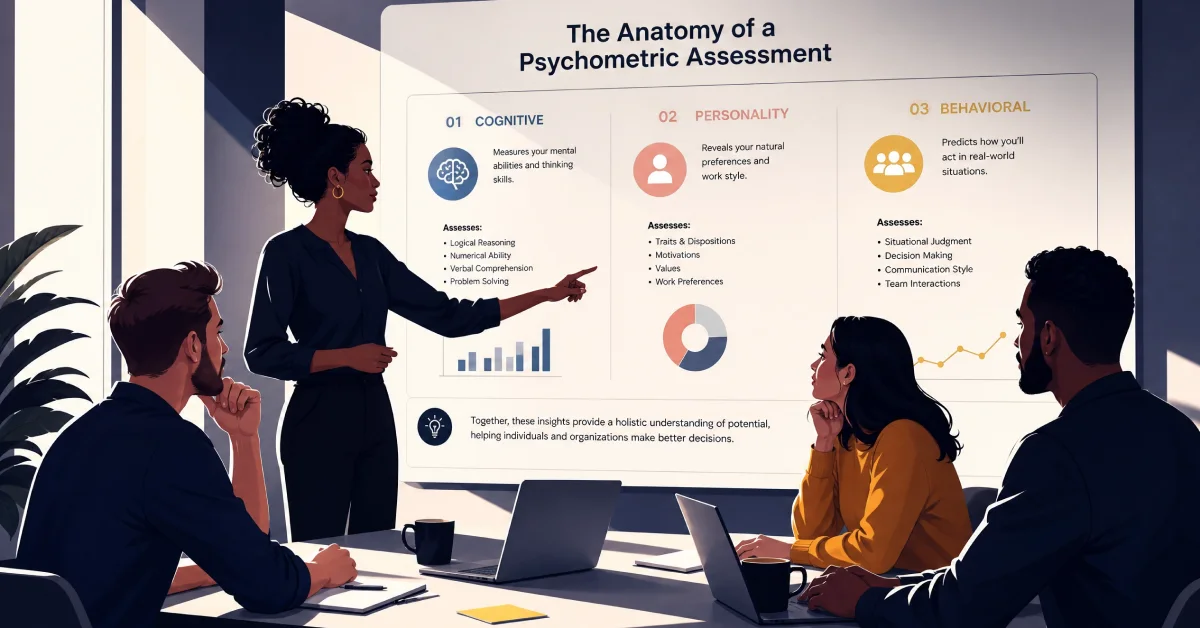
AI-powered psychometric assessment India refers to using digital assessment methods, sometimes supported by AI, to gather structured evidence about candidates’ abilities, behavioural tendencies, and work preferences. For employers hiring across varied regions, languages, and job types, consistency matters—but so does checking whether a test is suitable for the role and candidate group. AI can assist with delivery and analysis; it does not make a measure valid simply by being present. A sound process starts with clear job requirements and a careful account of what the results can and cannot show.
How psychometric tests measure traits, abilities, and work preferences
Psychometric tests use defined questions or tasks to measure specific characteristics, such as reasoning ability, preferences, or behavioural tendencies. Results are meaningful only in relation to the measure’s purpose and evidence of quality; a personality scale, for example, is not a direct measure of job performance. Employers should look for assessments tied to relevant work requirements, not broad labels that appear to explain a whole person. This distinction helps hiring teams use evidence without treating a score as a complete portrait of a candidate.
Where AI fits into test delivery, scoring, and interpretation
AI may support parts of a digital assessment process, including how questions are delivered, how responses are scored, or how results are summarized. Those uses should be described plainly, so candidates and hiring teams know which parts are automated and which are reviewed by people. 9 LINKS uses validated, AI-enabled psychometric assessments to help Indian employers hire for role fit. The relevant question for any employer is whether a particular tool’s stated use is supported by evidence and appropriate to the decision being made.
How these assessments differ from interviews and skills tests
An interview captures a conversation, while a skills test asks a candidate to demonstrate a particular task or capability. Psychometric assessment adds structured measures of defined traits or abilities; it does not replace either of those other sources of evidence. Combining methods can create a more rounded view, provided each method has a clear purpose and is applied consistently. Employers exploring fair assessment decisions can use that principle to keep structured interviews, job-related measures, and human review in proportion.
Why Indian employers are adopting AI-enabled assessments
High-volume hiring across sectors can make it difficult to apply the same standards consistently, especially when many teams or locations are involved. Digital assessments may help employers collect structured evidence at scale, but local candidate access, language, role variation, and job conditions still matter. The assessment should reflect the actual work, whether a role involves customer interaction, safety procedures, or technical tasks. Even details such as workplace accessories may belong in product knowledge for a retail role, but appearance itself should not become a proxy for suitability.
How AI-powered assessments work
A useful assessment process begins before a candidate sees a question. Employers first clarify the role and decision, then select measures that are appropriate to that purpose and decide how results will be considered. The process should make clear what data is collected, who reviews it, and what happens after completion. When these steps are transparent, technology can support consistency without obscuring accountability.

From role requirements to assessment design
Assessment design should follow the work: identify the competencies needed, decide how they can be measured, and define how much weight the evidence will carry. That sequence reduces the temptation to choose a test simply because it is available or easy to administer. A practical role profile can distinguish essential requirements from capabilities that are trainable after hiring. For instance, an employer might specify:
- The decisions or tasks the person will handle.
- The behavioural and cognitive demands that matter for those tasks.
- The evidence the hiring team needs to compare candidates fairly.
- The other information, such as work samples, that will inform the decision.
This short list makes the assessment brief more concrete and easier to review with hiring managers. 9 LINKS uses assessments tailored to specific roles and hiring levels, rather than relying on off-the-shelf templates, according to its stated positioning. Employers can use the same role-first discipline when assessing any provider or in-house process.
How adaptive testing can tailor questions to candidates
Adaptive testing changes the next question or task in response to a candidate’s earlier answers, where the assessment is designed to work that way. The aim may be to gather useful evidence efficiently, but adaptive delivery is not automatically more accurate or more accessible. Employers should ask how the approach affects scoring, whether candidates are measured on a comparable basis, and what validation supports its use. The mechanics should be understandable enough for the organization to explain them without implying that a changing question sequence knows more about a person than it does.
What AI analyzes—and what it should not infer
A responsible system should analyze only information relevant to the assessment’s stated purpose. It should not turn indirect signals—such as a candidate’s device, location, accent, or response timing—into unsupported judgments about character or ability. Employers should ask providers to identify the inputs used, the outputs generated, and the limits of those outputs. A score is evidence to review, not permission to infer qualities the assessment was never designed to measure.
How assessment results become useful reports for recruiters
A report is useful when it makes evidence clear enough for a recruiter to apply consistently, while also showing the limits of interpretation. It should connect results to the role rather than offer a vague verdict about whether a person is “good” or “bad.” 9 LINKS describes its reports as turning behavioural, cognitive, and integrity data into clear, actionable hiring insights. The table below illustrates the kind of careful distinction a hiring team can make when reviewing any assessment output.
| Evidence in the report | Useful question | Appropriate next step |
|---|---|---|
| A measure related to a role requirement | Does this relate to an essential task? | Compare with other job-relevant evidence |
| A behavioural result | What does this measure actually indicate? | Discuss only within the measure’s limits |
| A result that raises a concern | Is there supporting evidence elsewhere? | Seek appropriate human review |
The table is a decision aid, not a substitute for the provider’s technical documentation or the employer’s validation work. Recruiters should record how a result affected the decision and avoid treating a summary label as a complete explanation.
Where organizations can use these assessments
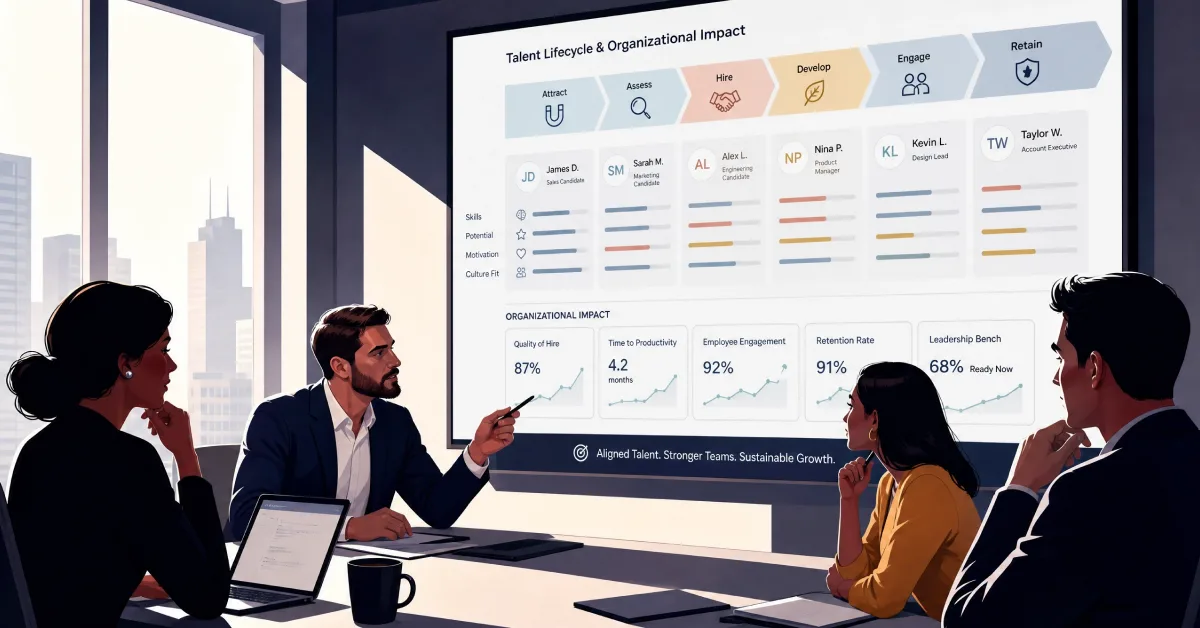
Psychometric assessments can support several talent decisions when the measures match the decision and the organization can explain their use. Recruitment is one common setting, but the same caution applies to development and internal movement: evidence from one context may not transfer neatly to another. Use should be proportionate to the consequences for the person. The central test is whether the assessment adds relevant information that the organization can interpret responsibly.
Hiring for role-specific competencies
For hiring, assessments can help examine role-related behavioural, cognitive, or integrity signals alongside interviews and practical evidence. Their value depends on identifying the competencies that matter in a given job rather than using one broad test for every vacancy. A quality role brief also accounts for the environment and expected duties, not just the job title. In sectors with specialized work, such as pharmaceutical quality work, hiring teams should distinguish role knowledge from broader traits and assess each with a suitable method.
Supporting graduate and high-volume recruitment
Graduate and high-volume recruitment often involves many applicants and multiple decision-makers, so common criteria can help make comparisons more consistent. Digital assessment may support a standardized process, but candidates still need clear instructions, reasonable access, and an opportunity to ask for help. Employers should monitor whether completion or selection patterns differ across candidate groups. For broader guidance on high-volume hiring assessments, the same principle applies: efficiency is useful only when it does not displace job relevance and candidate care.
Identifying development needs and leadership potential
Assessment results may contribute to a development conversation by highlighting areas for further learning or reflection. They should not be treated as fixed predictions of someone’s future or as an automatic ranking of leadership potential. A development plan should draw on several sources, including performance evidence, experience, and the individual’s goals. The purpose is to support a specific next step, not attach a permanent label to a person.
Improving internal mobility and succession planning
For internal mobility, employers can use structured evidence to support conversations about role fit and potential readiness, while recognizing that performance in one role may not predict success in another. Succession planning also carries consequences for employees, so selection criteria and review processes should be documented. Make sure people understand how assessment information will be used and can discuss relevant context. If the evidence is weak or the role changes, revisit the conclusion rather than carrying a score forward indefinitely.
How to evaluate platforms for the Indian context
A platform should be evaluated on evidence and fit, not on the size of its feature list. Employers in India may need to account for varied candidate populations, hiring volumes, connectivity, languages, and organizational processes. Ask providers direct questions, request documentation, and involve people who understand both the job and the candidate experience. An assessment that works in one setting may require further validation before use in another.

Check for validation across relevant roles and candidate groups
Ask what the assessment was designed to measure, how it was validated, and whether evidence applies to the roles and candidate groups you plan to assess. A general claim of validation is not enough if it does not explain the intended use or relevant population. Review how scores relate to the decision and how fairness is monitored. Employers can also consult pre-employment assessment guidance when defining what evidence they need before adopting a test.
Assess language accessibility and candidate experience
Candidates should be able to understand instructions and complete an assessment without avoidable barriers. Ask which languages are available, what accommodations can be provided, and how the process works for people using different devices or levels of connectivity. Do not assume that translation alone creates equivalent meaning across languages. Fairness includes clear communication about the assessment’s purpose, expected time, and next steps.
Review integration, reporting, and support capabilities
Before deployment, determine how results will reach the people who need them and what support is available when something goes wrong. Review report clarity, access controls, and the practical steps involved in correcting data or resolving a candidate issue. A provider’s online assessment and evaluation platform is one example of the broader category; employers should evaluate any platform against their own requirements rather than infer suitability from its description. Keep a record of system responsibilities and the human review points in the process.
Compare pricing, scalability, and data-hosting options
Cost comparisons should consider the full process, including implementation, support, volume assumptions, and any limits on reporting or access. Ask where data is hosted, how long it is retained, who can access it, and what arrangements apply when an organization stops using the service. These details are part of procurement, not technical footnotes. Employers should compare options against actual hiring needs instead of assuming that the lowest per-candidate price is the best value.
How to protect fairness, privacy, and trust
Trust depends on candidates understanding what is being assessed and employers using evidence within its limits. A digital process can be consistent and still produce unfair outcomes if the measure is unsuitable or the data reflects unequal access. Organizations need a process for checking outcomes and responding when concerns arise. Clear accountability matters as much as the technology itself.
Test for bias across gender, language, region, and other groups
Review whether assessment outcomes or completion rates differ across groups, and investigate plausible causes rather than assuming every difference has the same explanation. Where lawful and appropriate, use relevant data to check for patterns and involve qualified reviewers in the analysis. Look at the full process, including access, instructions, accommodations, scoring, and decision thresholds. If evidence suggests an assessment is not working fairly, pause or adjust its use while the issue is examined.
Explain how assessments inform decisions
Candidates should receive a plain-language explanation of why an assessment is part of the process and how its results will be considered. Hiring teams should also be able to describe which other evidence matters and who makes the final decision. Employers can learn from inclusive product design as a general reminder that accessibility and representation need practical attention, not just reassuring language. In hiring, that means making the assessment experience understandable and giving candidates a clear route to raise a concern.
Obtain consent and handle candidate data responsibly
Before collecting assessment data, explain what will be collected, why it is needed, who may see it, and how long it will be kept. Limit access to people with a legitimate role in the process, and follow the organization’s applicable privacy obligations. Avoid collecting information simply because a platform can generate it. Employers should also clarify whether results may be reused for another hiring decision and obtain any required permissions before doing so.
Keep human judgment in consequential hiring decisions
A consequential hiring decision should not rest on an unexplained score or automated label. Human reviewers need enough context to understand the evidence, consider other relevant information, and identify when a result may be incomplete or inappropriate. Consistency does not mean removing judgment; it means applying documented criteria and reviewing evidence in a disciplined way. Resources on AI hiring assessment practice can help teams think through that balance, while responsibility for the final process remains with the employer.
How to implement an assessment program
A reliable program is built in stages: define the decision, test the process, prepare the people who will use it, and review what happens after launch. Starting small gives employers a chance to identify problems before a tool becomes embedded in routine hiring. Keep records of the purpose, measures, decision rules, and review process. That foundation makes later updates more deliberate and easier to explain.
Define the decisions and competencies the assessment will support
Write down which decision the assessment is intended to inform and which competencies it is meant to measure. Clarify how the information will sit alongside interviews, work samples, or other evidence, and identify who is accountable for the decision. If a competency cannot be connected to real work, reconsider whether it belongs in the assessment. This also makes it easier to explain the process to candidates and hiring managers.
Pilot the process with representative candidates
A pilot can reveal whether instructions are clear, whether candidates can access the assessment, and whether the resulting reports are useful to decision-makers. Include a range of candidates and relevant roles, and gather feedback on practical barriers as well as completion. Do not treat a small pilot as proof of validity; use it to identify questions that need further investigation. Record what you changed and why, so the full rollout reflects lessons rather than assumptions.
Train hiring teams to interpret results consistently
Hiring teams need guidance on what scores mean, what they do not mean, and how to compare them with other evidence. Use shared examples and discussion to expose differences in interpretation before those differences affect candidates. Teams should know when to request clarification or escalate a concern, rather than improvising their own rules. 9 LINKS states that its assessments are intended to help employers make clearer hiring decisions and reduce attrition; employers should still define and review the decision process around any assessment they adopt.
Monitor outcomes and update the program over time
After launch, review outcomes such as candidate completion, hiring patterns, and whether the assessment remains relevant as roles change. Look for differences across groups and investigate them with appropriate care. Ask hiring managers whether reports help them make more consistent decisions, while avoiding the assumption that a single metric proves success. Changes to job requirements, candidate access, or assessment design should trigger a fresh review of the program.
Conclusion
AI-powered psychometric assessments can give employers in India a more structured way to consider role-related evidence, especially when hiring at scale. Their value comes from careful design, transparent use, and ongoing review—not automation alone. Match each measure to the work, protect candidate data, check for unfair effects, and keep people accountable for consequential decisions.
Frequently Asked Questions
What is an AI-powered psychometric assessment?
It is a digital assessment process that uses psychometric measures and may use AI to support delivery, scoring, or interpretation. Its purpose and limitations depend on the specific assessment and its evidence.
What can psychometric assessments measure?
Depending on the tool, they may measure defined abilities, behavioural tendencies, or work preferences. The assessment should state what it measures and how those results are intended to be used.
Can an assessment replace a job interview?
No. An assessment can provide structured evidence, but interviews, work samples, and other relevant information may also be needed to understand a candidate’s fit for a role.
Are AI-powered assessments fair to every candidate?
Not automatically. Employers should check validation, accessibility, and outcomes across relevant candidate groups, then address any barriers or patterns that raise concern.
How should employers choose an assessment platform in India?
Review evidence for the intended role and candidate groups, language access, candidate experience, reporting, privacy, support, integration, and cost. Ask providers to explain how the assessment works and what it cannot establish.
What should candidates know before taking an assessment?
Candidates should be told why the assessment is used, what it measures, how results will inform the decision, and how their data will be handled. They should also receive clear instructions and a way to ask questions or request support.
Should hiring decisions depend on an assessment score alone?
No. A score should be considered alongside other relevant evidence and reviewed by people who understand the role, the assessment’s limits, and the decision being made.
We Appreciate The Feedback From Our Clients.
It is always a joy to hear how our work has positively impacted them and how our assessments have helped in finding the right people.
We have used 9 LINKS psychometric tool in our Campus Placement Programme.The tool has helped us to identify right candidate as per our organisation requirements…

We have just started using it. It differentiates various personalities and helps in decision making. The clarity on its precision level will be gathered over a period of time…

Counselling test curated for NES has been very useful in identifying the skill sets and allotting appropriate job fitment to students as per their quotients. Multilingual tests developed by considering various key…

It is indeed great pleasure in my part to share complementing note to you & your team. Needless to say 9 LINKS is one of the best organisation to conduct skill gap analysis through assessment of Cognitive skills..

It is crucial that validating the quality of the candidates in recruitment. 9 LINKS is a service that we can confidently say does that. 9 LINKS online assessment precisely giving us the right candidates to pick and proceed on recruitment…

Read Our Blog For The Latest On Research & Insights.
Get Insights into latest developments in HR industry and psychometric assessments.

Take a Free Assessment


