~ by Pranav Joneja | January, 2026
Hiring decisions have always carried significant consequences for organisations. A single mis-hire can affect productivity, team morale, customer experience, and long-term business outcomes. Traditionally, hiring relied heavily on human judgement through resumes, interviews, and managerial instinct. Today, artificial intelligence is increasingly influencing recruitment decisions, offering speed, data-driven insights, and automation at scale.
As organisations adopt AI-powered tools for screening, assessments, and shortlisting, an important question emerges. Should hiring decisions be driven by machines or by people? More importantly, how can organisations balance the strengths of AI with the contextual understanding of human judgement?
This blog explores the role of AI and human judgement in hiring, their strengths and limitations, and how organisations can combine both to make better people decisions.
Recruitment has evolved significantly over the last two decades. Earlier, hiring decisions were based on academic qualifications, years of experience, and interview performance. While structured interviews and reference checks added some rigour, decisions were still influenced by personal bias, limited data, and time pressure.
With the rise of digital recruitment platforms, organisations began collecting more data about candidates. AI entered the hiring process to analyse large volumes of information quickly and consistently. Today, AI is used to screen resumes, analyse assessments, schedule interviews, and even predict job performance.
Despite these advancements, hiring remains a human-centred decision. Candidates are individuals, not data points. This makes it essential to understand where AI adds value and where human judgement remains irreplaceable.
Artificial intelligence excels at processing large datasets and identifying patterns that humans may miss. In recruitment, this capability translates into several practical benefits.
AI can screen thousands of applications in minutes. This is particularly valuable for high-volume hiring, campus recruitment, and frontline roles where manual screening would be time-consuming and inconsistent.
AI applies the same criteria to every candidate. Unlike humans, it does not experience fatigue, mood changes, or inconsistency. When designed correctly, this can improve fairness in early-stage screening.
AI tools analyse assessment scores, work history, and behavioural data to identify correlations with job success. This allows organisations to move beyond surface-level evaluation and focus on measurable predictors of performance.
Automation handles repetitive tasks such as resume filtering, interview scheduling, and candidate communication. This frees HR teams to focus on higher-value activities, such as stakeholder engagement and candidate experience.
While AI offers efficiency and structure, it also has clear limitations that organisations must acknowledge.
AI analyses data but does not understand nuance. It cannot interpret organisational culture, team dynamics, or situational complexity in the same way humans can.
AI systems learn from historical data. If past hiring decisions contained bias, the AI may replicate or amplify those patterns. Without careful design and monitoring, this can undermine fairness rather than improve it.
Not all leadership potential, creativity, or interpersonal capability can be captured through data alone. AI may undervalue qualities that are difficult to quantify but critical for long-term success.
AI cannot read emotional cues, assess motivation through conversation, or understand personal context. These elements often influence a candidate’s suitability and long-term engagement.
Human judgement brings qualities to hiring that technology cannot replace.
Humans can interpret tone, intent, motivation, and values during conversations. They can recognise potential that may not be evident in test scores or resumes.
Managers understand team needs, leadership gaps, and organisational priorities. This context enables them to make informed decisions aligned with business realities.
Hiring is not just about performance. It is about trust, ethics, and culture. Human judgement plays a key role in evaluating alignment with organisational values.
Candidates assess organisations as much as organisations evaluating candidates. Human interaction builds trust, engagement, and a positive candidate experience.
Human judgement is decisive, but it is not flawless.
Interviewers may favour candidates who resemble themselves, share similar backgrounds, or communicate confidently. These biases often operate unconsciously.
Different interviewers may evaluate the same candidate differently. Without structured tools, decisions can vary widely.
Humans struggle to analyse large datasets objectively. Patterns across hundreds of candidates are challenging to detect without technological support.
Hiring decisions are often made quickly. Under pressure, decision quality may suffer.
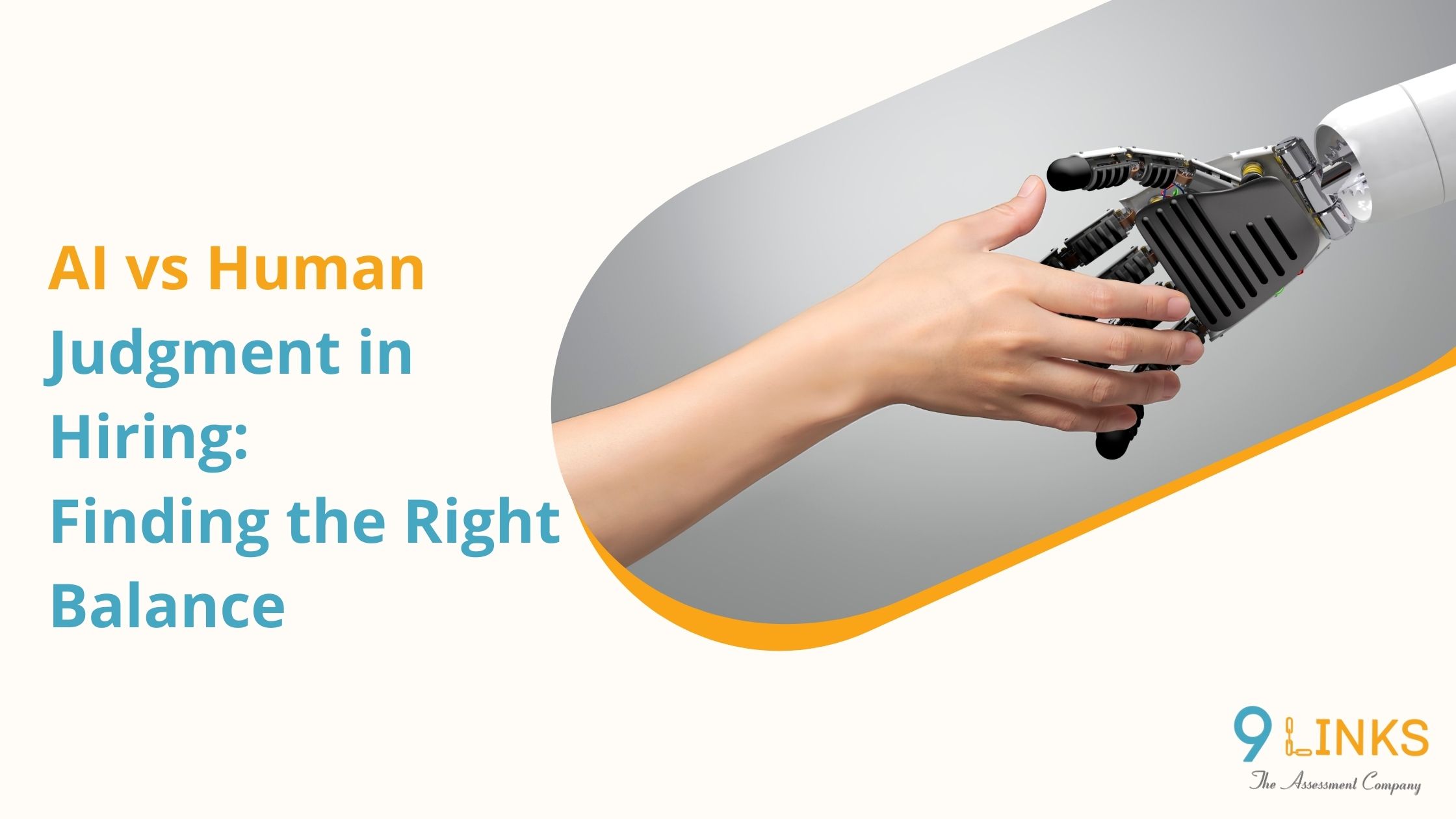
Framing the discussion as AI versus humans oversimplifies the issue. The most effective hiring decisions emerge when AI and human judgement work together.
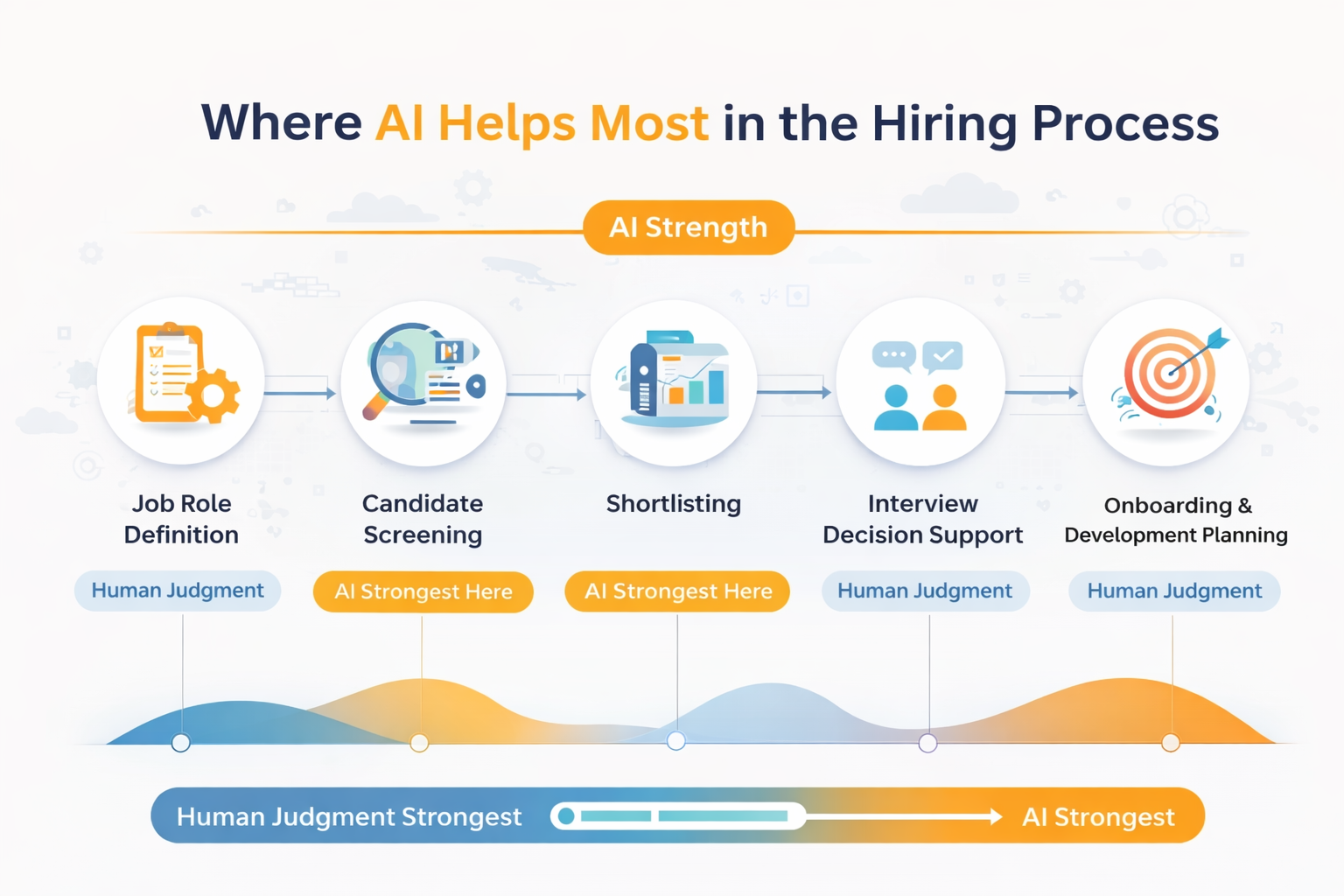
AI is best suited for tasks that require consistency, speed, and data analysis. Human judgement excels in interpretation, ethical reasoning, and contextual evaluation. When combined thoughtfully, they compensate for each other’s weaknesses.
| AI-Driven Hiring | Human Judgment |
|---|---|
| Processes large candidate volumes quickly | Understands context, nuance, and emotional cues |
| Applies consistent evaluation criteria | Interprets cultural and team dynamics |
| Reduces unconscious bias when designed correctly | Evaluates motivation and interpersonal chemistry |
| Analyses patterns across historical hiring data | Applies experience and situational awareness |
| Predicts performance and retention trends | Exercises ethical discretion in complex cases |
Skill-based and Psychometric assessments provide a structured way to integrate AI insights with human evaluation.
Assessments generate objective data on cognitive ability, behaviour, integrity, and leadership potential. AI helps analyse this data at scale, while humans interpret results in context.
For example:
This approach reduces bias while preserving human oversight.
Organisations that succeed in modern hiring typically follow these principles.
AI is most effective in early stages, such as screening and assessment analysis. Human judgement becomes critical during interviews, final selection, and offer decisions.
AI tools should be aligned with role-specific competencies. Humans should be trained to interpret results consistently rather than rely on intuition alone.
Candidates should understand how AI is used in the hiring process. Transparency builds trust and supports ethical hiring practices.
AI models should be reviewed regularly to ensure fairness, accuracy, and relevance as roles evolve.
AI should inform decisions, not replace accountability. Final responsibility must always rest with human decision-makers.
As AI becomes more sophisticated, its role in hiring will continue to expand. At the same time, organisations are recognising the importance of human-centred leadership, empathy, and ethical judgement.
The future of hiring is not about choosing between AI and humans. It is about designing systems in which technology enhances human decision-making rather than overrides it.
Organisations that strike this balance will build stronger teams, reduce hiring risk, and create more inclusive and effective workplaces.
ConclusionAI has transformed hiring by introducing speed, structure, and data-driven insight. Human judgement brings context, empathy, and ethical reasoning. When used independently, both have limitations. When combined, they create a robust framework for better hiring decisions.
The most successful organisations recognise that hiring is both a science and a human responsibility. AI provides evidence. Humans provide understanding. Together, they enable fairer, more accurate, and more sustainable hiring outcomes.
No. AI supports hiring decisions by analysing large volumes of data quickly, but human judgment remains essential for evaluating context, values, motivation, and cultural alignment.
2. Where is AI most effective in the hiring process?AI is most effective in resume screening, initial shortlisting, assessment scoring, and identifying patterns across large applicant pools. These stages benefit from speed, consistency, and data processing.
3. What hiring decisions should remain human-led?Final interviews, leadership evaluations, cultural fit assessments, and ethical considerations require human judgment, as they involve nuance, empathy, and organisational context.
4. Does using AI in hiring reduce bias?AI can reduce some forms of bias when designed and used correctly, but it can also replicate existing biases if trained on flawed data. Human oversight is necessary to ensure fairness.
5. How do psychometric assessments fit into AI-supported hiring?Psychometric assessments provide structured, objective data on cognitive ability, behaviour, and integrity. AI can assist in scoring and pattern analysis, while humans interpret results for decision-making.
6. What is the best approach to using AI in hiring today?The most effective approach is a hybrid model where AI handles data-driven tasks, and humans make final judgments. This balance improves accuracy without losing accountability or insight.
It is always a joy to hear how our work has positively impacted them and how our assessments have helped in finding the right people.


“ It is crucial that validating the quality of the candidates in recruitment. 9 Links is a service that we can confidently say does that. 9 Links online assessment precisely giving us the right candidates to pick and proceed on recruitment...

We have used 9 links psychometric tool in our Campus Placement Programme.The tool has helped us to identify right candidate as per our organization requirements...

" We have just started using it. It differentiates various personalities and helps in decision making. The clarity on its precision level will be gathered over a period of time...

" Counselling test curated for NES has been very useful in identifying the skill sets and allotting appropriate job fitment to students as per their quotients. Multilingual tests developed by considering various key...

“It is indeed great pleasure in my part to share complementing note to you & your team. Needless to say 9 Links is one of the best organization to conduct skill gap analysis through assessment of Cognitive skills..
Get Insights into latest developments in HR industry and psychometric assessments.