

How to Identify High-Potential Leaders Using Assessment Tools
~ by Pranav Joneja | December, 2025
Leadership is no longer limited to job titles or years of experience. As workplaces evolve and organisations face rapid change, identifying individuals who can grow into strong leaders has become a strategic priority. The challenge is that potential is not always visible on the surface. Many high performers fail in leadership roles, while quiet contributors often become exceptional managers once given the opportunity.
Relying on intuition or past performance alone can result in costly misjudgements. This is where assessment tools become invaluable. They offer structured, objective insights into how individuals think, behave, and make decisions, helping organisations identify leadership talent early and accurately.
This blog explores what high potential looks like, why traditional methods often fail, and how assessment tools help create a reliable pipeline of future leaders.
What Is a High-Potential Leader
High-potential leaders are individuals who demonstrate strong promise for assuming larger, more complex responsibilities in the future. This potential can be understood through three core elements:
Ability
This reflects cognitive capacity, problem-solving, decision-making, and the ability to learn quickly. Leaders must process information rapidly and make informed decisions under pressure.
Aspiration
Aspiration refers to the motivation to grow, take on new responsibilities, and contribute at a higher level. Not everyone with the ability seeks leadership roles. Identifying aspiration helps organisations invest in those who genuinely want to lead.
Agility
Agility is the capacity to adapt, learn from experience, and navigate unfamiliar situations.
It includes resilience, curiosity, and openness to feedback.It is important to note that a high performer is not always a high-potential leader. Performance reflects success in a current role. Potential indicates readiness for future roles that demand broader thinking, stronger interpersonal abilities, and strategic awareness.
Why Traditional Leadership Identification Often Fails
Many organisations unintentionally promote the wrong people into leadership roles. This usually happens due to:
Bias or Subjectivity
Managers often choose people who behave or communicate like their own. Personal preferences overshadow actual leadership traits.
Promoting High Performers Only
A strong individual contributor may excel technically but struggle to guide others. This phenomenon is sometimes referred to as the Peter Principle, where individuals rise to a level at which they are no longer effective.
Inconsistent Evaluation
Without clear criteria, leaders are often chosen based on assumptions rather than evidence.
Limited visibility
The Role of Assessment Tools in Identifying High-Potential Leaders
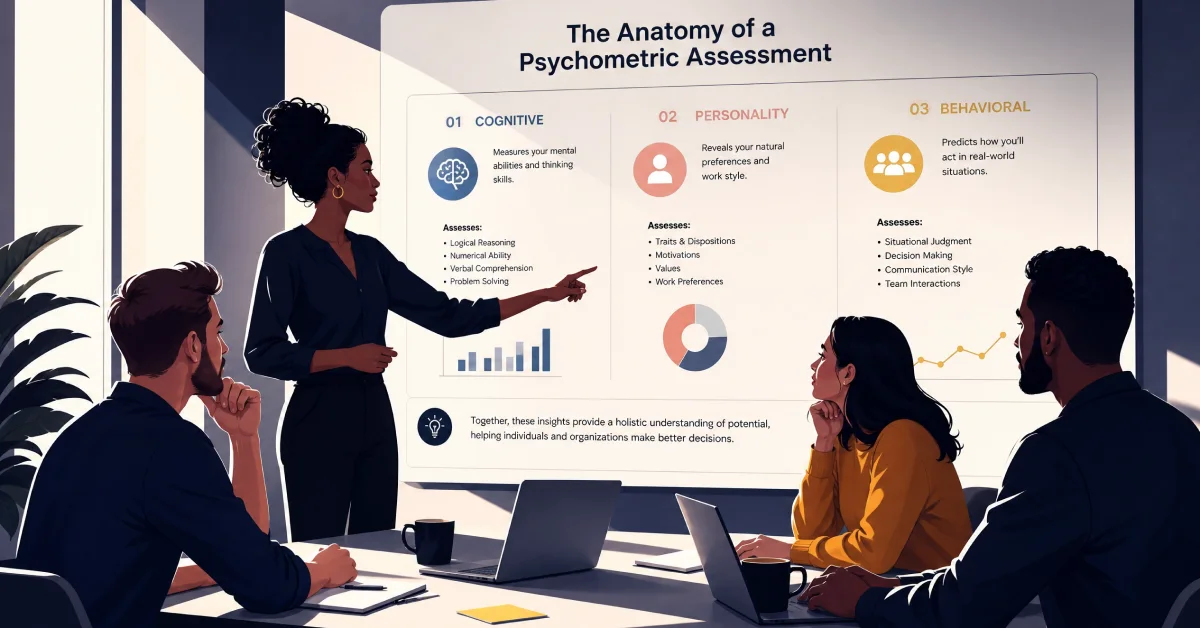
Assessment tools provide meaningful insights that go beyond surface-level performance. They help create a clear picture of how individuals think, behave, and respond to challenges. Below are the key tools used to identify potential leaders.
1. Cognitive Ability and Critical Thinking Assessments
Cognitive assessments evaluate a person’s ability to learn, reason, and solve problems effectively. Leadership involves analysing complex information and making sound decisions, especially in unfamiliar situations.
These assessments measure:
- Logical reasoning
- Abstract thinking
- Verbal and numerical processing
- Decision-making under pressure
Cognitive ability has consistently been one of the strongest predictors of long-term leadership success.
2. Personality and Behavioural Assessments
Personality influences how leaders interact, communicate, and respond to pressure. Behavioural assessments identify traits such as:
- Emotional stability
- Empathy
- Dependability
- Adaptability
- Collaboration style
- Stress tolerance
These insights help organisations understand whether a person can guide teams, manage conflict, or maintain composure in demanding situations.
3. Leadership Assessment Tests
A leadership assessment test evaluates broader leadership competencies. These tests measure:
- Strategic thinking
- Influencing ability
- Managing teams
- Decision making
- Responsibility and accountability
- Conflict resolution
They are effective for identifying emerging leaders and first-time managers.
4. Integrity and Work Ethic Assessments
Leadership requires trust. Integrity assessments evaluate honesty, accountability, adherence to rules, and ethical behaviour. These qualities ensure that future leaders protect the organisation’s values and act responsibly even when not supervised.
5. Situational Judgement Tests (SJTs)
SJTs present realistic workplace scenarios and ask candidates to choose the most effective response. They reveal:
- Judgement
- Interpersonal skill
- Prioritisation
- Leadership style
- Crisis handling
SJTs are particularly useful because they simulate real situations leaders face.
Building a Leadership Pipeline with Assessment Data
A leadership pipeline should not depend solely on promotions or yearly appraisals. Assessments create a structured and predictable system for leadership development.
Step 1: Define Leadership Competencies
Start by listing the behaviours and capabilities needed for leadership roles within your organisation. Examples include critical thinking, collaboration, responsibility, and resilience.
Step 2: Use Assessments Early
Step 3: Combine Assessments with Structured Interviews
Interviews guided by assessment results become more accurate and objective. Recruiters and managers know exactly what to look for and what questions to ask.
Step 4: Create Personalised Development Plans
Assessment data provides clarity on strengths and development areas. This helps form targeted growth plans such as mentorship, leadership training, and stretch assignments.
Early Signs of High-Potential Leaders
While assessments provide objective data, certain behavioural patterns often signal strong leadership potential:
- They take initiative without needing direction
- They remain calm and composed in uncertain situations
- They show curiosity and learn quickly
- They build trust easily
- They take responsibility rather than shift blame
- They influence others naturally
- They think beyond their immediate tasks
These early indicators, combined with assessment insights, help organisations identify leadership talent accurately.
9 Links’ Leadership Assessment Solutions
At 9 Links, leadership identification is supported through scientifically designed assessment tools that evaluate both current capabilities and long-term potential. Our solutions assess cognitive ability, behavioural tendencies, interpersonal style, and problem-solving, all of which contribute to effective leadership.
We work with organisations to:
- Align assessments with leadership competencies
- Map assessments to supervisory and managerial roles
- Provide development insights based on assessment outcomes
- Support succession planning with data-driven recommendations
The goal is not just identifying leaders but preparing them for long-term success in a structured and fair manner.
Best Practices for Using Assessment Tools
To get the maximum value from leadership assessments, HR teams should consider the following practices:
- Always define leadership competencies before testing
- Use a combination of tools rather than relying on one method
- Train managers to interpret assessment reports
- Communicate openly with candidates about the purpose of assessments
- Track outcomes and refine benchmarks over time
- Use insights beyond hiring to guide development and performance planning
Conclusion
Strong leadership does not emerge by chance. Organisations must identify potential early, nurture it, and evaluate it with reliable tools. Assessment tools remove guesswork and bring clarity to the decision-making process, helping companies build confident, capable leaders who can handle future challenges.
By combining cognitive assessments, behavioural insights, integrity measures, and leadership tests, organisations gain a complete view of an individual’s readiness for leadership roles. This approach supports fair decisions, reduces leadership failures, and strengthens the overall talent pipeline.
Leadership potential exists in every workplace. The challenge is identifying it accurately and developing it with intention. Assessment tools offer a practical and scientific pathway to achieve exactly that.
FAQs
1. What is a leadership assessment test
It is a structured tool that evaluates competencies such as decision making, strategic thinking, team management, and emotional intelligence to help identify future leaders.
2. How do assessments identify high-potential leaders
They measure proven predictors of leadership success, such as cognitive ability, behavioural patterns, adaptability, and judgement.
3. Are these tools suitable for first-time managers
Yes. Assessments help identify individuals who may not have leadership experience yet but demonstrate strong potential.
4. What traits indicate high leadership potential
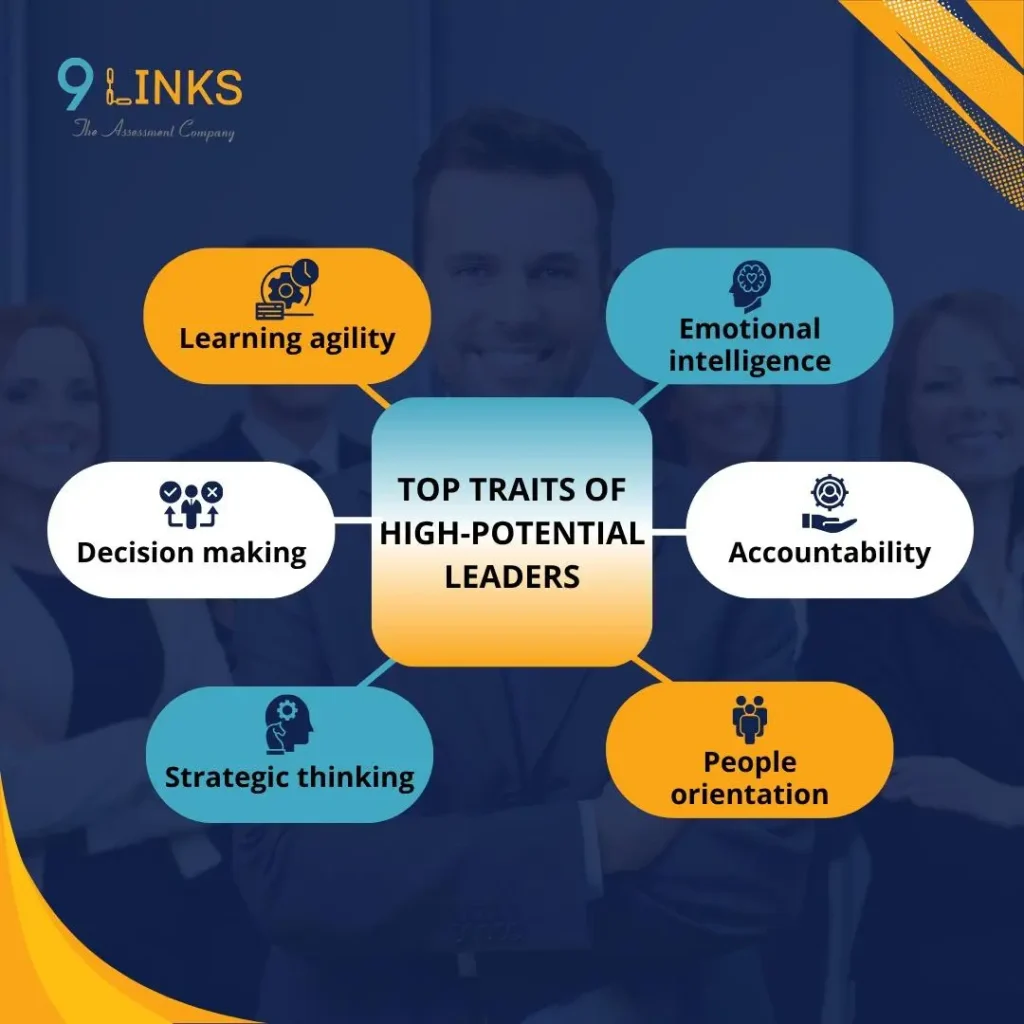
Learning agility, emotional intelligence, responsibility, resilience, and the ability to influence and collaborate.
5. Can assessments replace human judgment
No. They complement human judgment by providing objective data to support decisions.
6. How can organisations use assessment results for development
They can design targeted training programmes, mentoring pathways, and personalised development plans.
7. Do small or mid-sized organisations need leadership assessments
Yes. Leadership quality directly affects team performance, regardless of organisation size. Assessments help reduce risk and improve long-term success.
We Appreciate The Feedback From Our Clients.
It is always a joy to hear how our work has positively impacted them and how our assessments have helped in finding the right people.
We have used 9 LINKS psychometric tool in our Campus Placement Programme.The tool has helped us to identify right candidate as per our organisation requirements…

We have just started using it. It differentiates various personalities and helps in decision making. The clarity on its precision level will be gathered over a period of time…

Counselling test curated for NES has been very useful in identifying the skill sets and allotting appropriate job fitment to students as per their quotients. Multilingual tests developed by considering various key…

It is indeed great pleasure in my part to share complementing note to you & your team. Needless to say 9 LINKS is one of the best organisation to conduct skill gap analysis through assessment of Cognitive skills..

It is crucial that validating the quality of the candidates in recruitment. 9 LINKS is a service that we can confidently say does that. 9 LINKS online assessment precisely giving us the right candidates to pick and proceed on recruitment…

Read Our Blog For The Latest On Research & Insights.
Get Insights into latest developments in HR industry and psychometric assessments.


Take a Free Assessment


