~ by Pranav Joneja | December, 2025
Hiring, training, and developing people has become far more complex than it once was. Job roles are changing rapidly, expectations are evolving, and organisations can no longer rely on intuition or traditional interviews to understand who will succeed. This is where psychometric assessments have become incredibly valuable. They offer a structured, scientific way to know how people think, behave, respond to challenges, and work with others.
Today, psychometric assessments are widely used by HR teams, recruiters, educators, and large organisations because they answer a simple question with clarity: does this individual have the ability and temperament to succeed in each role or environment?
This blog explains what psychometric assessments are, what they measure, where they are used, the different types available, and why so many organisations are now depending on them for people decisions.
Psychometric assessments are standardised tools used to measure an individual’s mental abilities, personality characteristics, and behavioural tendencies. The word “psychometric” simply means psychological measurement. These assessments are carefully designed, validated, and tested to ensure they accurately and consistently measure traits.
Unlike interviews or resume screening, psychometric assessments do not rely on opinions or subjective scoring. They provide quantitative and qualitative data about how a person thinks, learns, decides, and interacts with others. This makes them useful for hiring, development, promotions, team building, and even academic decisions.
A professionally developed psychometric assessment follows scientific principles, including reliability, validity, norm groups, and statistical analysis. As a result, they produce objective insights that organisations can trust.
There are several reasons organisations rely heavily on these assessments.
1. Objective decision makingBias, first impressions, mood, or assumptions naturally influence human judgment. Psychometric assessments introduce fairness and objectivity by basing decisions on measurable data.
Interviews often evaluate how well a candidate talks, not how well they will perform. Psychometric tests measure cognitive ability, work style, integrity, and behavioural traits that directly relate to job success.
A wrong hire can affect productivity, team morale, and operational efficiency. Psychometric tools help identify candidates who are aligned with the role and workplace environment.
Teams function better when members have complementary strengths. Behavioural and personality assessments help managers understand how individuals will collaborate, communicate, and manage conflict.
Assessments highlight strengths and growth areas, making it easier to design targeted training and leadership development plans.
Structured assessments reduce personal bias, creating equal opportunities for all candidates based on capability and potential.
Different assessments measure different psychological attributes. Collectively, they offer a holistic view of an individual.
1. Cognitive AbilityCognitive tests measure how people process information, solve problems, reason logically, and learn new concepts. This is often the strongest predictor of job performance. Common areas include:
Personality assessments examine stable traits such as sociability, dependability, adaptability, emotional stability, and communication style. They help understand how someone behaves at work and how they may respond to different environments.
These assessments explore work styles and behavioural patterns. They reveal whether an individual is detail-oriented, collaborative, assertive, patient, quality-focused, or inclined to take risks.
Integrity assessments evaluate honesty, rule-following behaviour, reliability, and ethical decision-making. These traits are crucial in roles that involve safety, compliance, money handling, confidentiality, or supervision.
EI refers to the ability to understand one’s own emotions and those of others. It includes empathy, self-awareness, emotional regulation, and social skills. Many studies link EI to leadership effectiveness, teamwork, and conflict management.
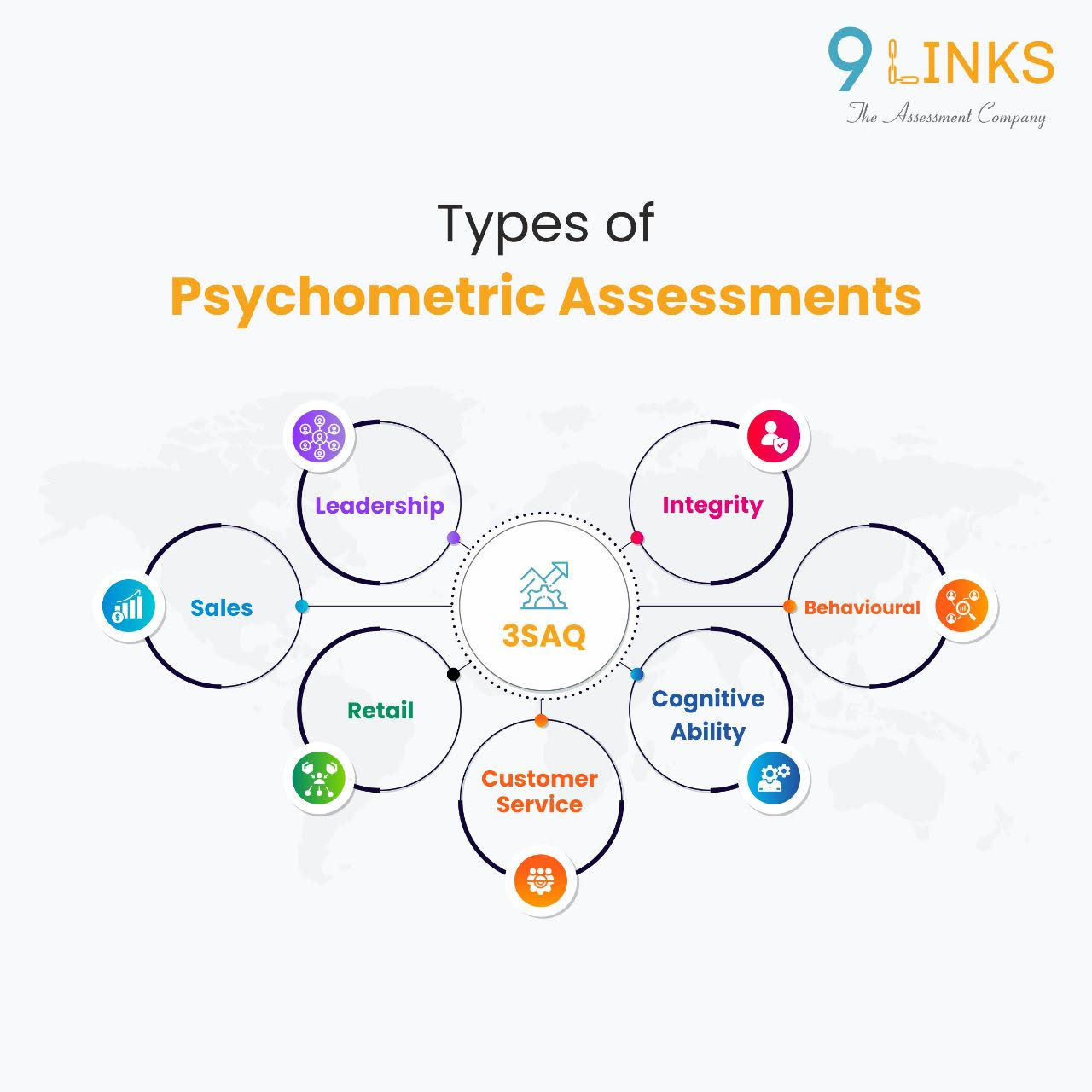
Psychometric assessments cover a range of tools that measure how a person thinks, behaves, and responds to different work situations. While the formats may vary, the core assessment categories used in modern recruitment include the following.
These tests measure reasoning ability, problem-solving, pattern recognition, learning speed, and the capacity to process information. They help identify how quickly an individual can understand new concepts, adapt to unfamiliar tasks, and make logical decisions. Cognitive tests are often strong predictors of overall job performance.
Behavioural assessments evaluate how individuals are likely to act in workplace situations. They explore traits such as dependability, teamwork, stress tolerance, communication style, and adherence to rules or processes. These insights help organisations understand whether candidates will fit into the work culture and perform consistently.
Integrity assessments measure honesty, responsibility, trustworthiness and attitudes toward workplace ethics. They are particularly valuable for roles where compliance, safety, or handling of confidential information is important. These tests help reduce the risks associated with misconduct or policy violations.
Leadership assessments examine a person’s ability to guide teams, make decisions, take accountability and handle complex responsibilities. They often combine cognitive and behavioural insights to predict whether an individual can step into a supervisory or managerial role in the future.
Some assessments focus on skills needed for roles, such as customer service orientation, sales, retail, problem-solving in operational settings, or suitability for high-interaction jobs. These tools help organisations match candidates to the specific demands of a career rather than relying only on interviews or experience.
Psychometric assessments are versatile and can support decisions across the entire employee life cycle.
HR teams use these tests to shortlist candidates who match the job’s cognitive and behavioural demands. This reduces hiring errors and improves job fit.
During campus hiring, with large numbers of applicants, cognitive and personality assessments help identify high-potential candidates early and fairly.
Many organisations use cognitive, behavioural, and integrity assessments to hire Blue/Pink-collar employees, including machine operators, technicians, field staff, customer service workers, and other high-volume roles.
Leadership potential is not always obvious. Psychometric assessments help identify individuals with the potential to grow into managers and future leaders.
Assessment reports highlight strengths and areas for improvement, making it easier to design tailored training programmes.
Psychometric tools help map future leaders by evaluating judgement, emotional intelligence, resilience, and strategic thinking.
Understanding behavioural differences improves collaboration, conflict handling, and communication within teams.
Psychometric assessments create long-term value by improving the quality of people decisions. Key benefits include:
1. Better hiring accuracyOrganisations can identify the right candidates for the right roles, reducing the cost of mis-hires.
2. Faster and more efficient recruitmentCognitive and behavioural filters help HR teams shortlist candidates quickly and fairly.
3. Reduced employee turnoverWhen employees are matched to roles that suit their temperament and strengths, they stay longer and perform better.
4. Stronger leadership pipelineAssessment data helps identify individuals with the potential to take on leadership responsibilities.
5. More consistent and fair decisionsStandardised assessments ensure all candidates are evaluated on the same parameters.
6. Improved team performanceManagers can use assessment insights to create balanced, collaborative teams.
9Links provides scientifically validated psychometric assessments tailored to organisational contexts. Our tools measure cognitive ability, personality traits, behavioural tendencies, emotional intelligence, and integrity. HR teams use these assessments for recruitment, promotions, leadership identification, and workforce development.
Each assessment is backed by strong research, Indian norm groups, and user-friendly reporting. Organisations work with 9Links to ensure their hiring and development decisions are fair, accurate, and aligned with long-term goals.
Psychometric assessments have become a core part of modern hiring and talent development. They bring clarity, fairness, and scientific rigour to decisions that were once based on opinion or intuition. By measuring how individuals think, behave, and respond to challenges, organisations can reduce risk, build stronger teams, and identify future leaders with confidence.
Whether used in recruitment, leadership development, or workforce planning, psychometric assessments offer insights that help companies grow with the right people in the right roles. As workplaces continue to evolve, these assessments will remain a critical tool in shaping talent strategies and creating high-performing teams.
Psychometric assessments help employers measure cognitive ability, behavioural tendencies, integrity and leadership potential. They provide objective data that supports fair and accurate hiring decisions, reducing the risk of hiring based solely on intuition.
Yes. When validated and used correctly, psychometric assessments are strong predictors of workplace performance, cultural fit and learning ability. They help organisations identify candidates who can succeed in both current and future roles.
Most organisations use cognitive ability tests, behavioural assessments, integrity assessments and leadership assessment tests. These tools measure how candidates think, behave and respond to work situations that influence long-term success.
Absolutely. These assessments support employee development, succession planning, leadership training, performance improvement, and high-potential identification. They offer insights that help organisations design targeted growth plans.
Yes. Different assessment types can be mapped to roles ranging from entry-level to leadership positions. For example, cognitive and integrity tests are often used for operational roles, while behavioural and leadership assessments help evaluate managers and future leaders.
Psychometric assessments measure natural abilities and behavioural patterns, so no special study is required. Candidates simply need a quiet environment, stable internet and enough time to complete the test honestly and without rushing.
It is always a joy to hear how our work has positively impacted them and how our assessments have helped in finding the right people.


“ It is crucial that validating the quality of the candidates in recruitment. 9 Links is a service that we can confidently say does that. 9 Links online assessment precisely giving us the right candidates to pick and proceed on recruitment...

We have used 9 links psychometric tool in our Campus Placement Programme.The tool has helped us to identify right candidate as per our organization requirements...

" We have just started using it. It differentiates various personalities and helps in decision making. The clarity on its precision level will be gathered over a period of time...

" Counselling test curated for NES has been very useful in identifying the skill sets and allotting appropriate job fitment to students as per their quotients. Multilingual tests developed by considering various key...

“It is indeed great pleasure in my part to share complementing note to you & your team. Needless to say 9 Links is one of the best organization to conduct skill gap analysis through assessment of Cognitive skills..
Get Insights into latest developments in HR industry and psychometric assessments.